



Lebanese freediver Nour Issa has set four national records in four disciplines, taking her talent from the waters of Tabarja to the international stage while balancing a demanding career in architecture.
The Lebanese freediver redefining her limits
The Lebanese freediver redefining her limits
By Jenna Geagea | November 24, 2026

Reading time: 4 min
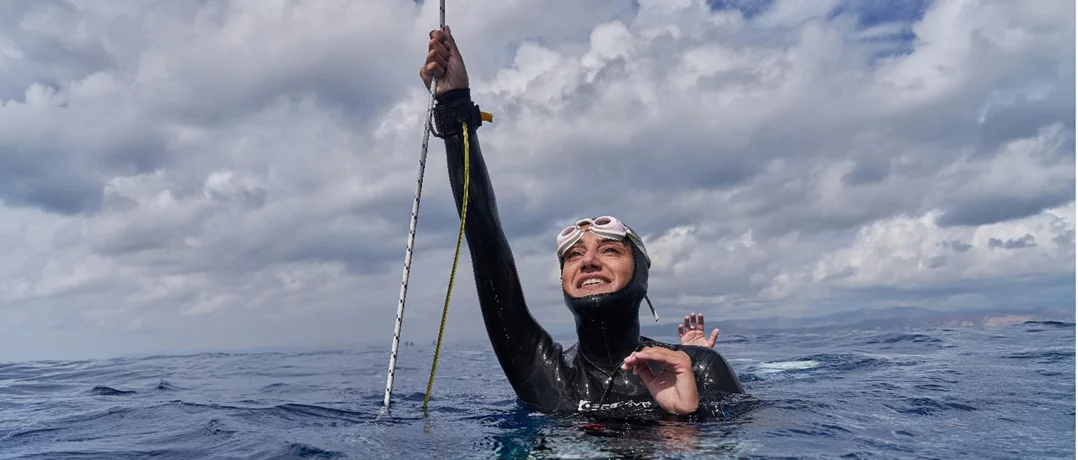
At 7:00 a.m., while most of the city is still stuck in traffic, Nour Issa is already in the water in Tabarja, preparing to descend into the blue on one breath. By mid-morning she is back at her desk in Sin el Fil, an architect with a calendar full of deadlines.
This double life carried the 25-year-old to the biggest stage in freediving, where she walked away with four national records and a place on the global sports map for Lebanese women.
Issa’s connection to water goes back to childhood. She swam competitively from the age of seven or eight until she was about 16, and she remembers it as a lifelong comfort zone. “I was always very comfortable around water,” she told The Beiruter. Then came a long break. University, and later a master’s degree in Milan, pulled her away from the ocean entirely.
When she came back, “I was a little depressed,” she admitted. “I had been abroad, and I kept wondering what I was going to do next.” Scrolling through Netflix, she landed on The Deepest Breath, a documentary about the sport’s most extreme practitioners. Within hours she had started researching, and her search led her to Freediving Lebanon and its founder, Mark, who became her instructor.
Workshops in Dahab, Egypt, a global hub for the sport, followed. There she trained alongside divers from around the world. Progress came quickly. “It escalated really quickly, and it opened up,” she explained. “I started going deeper and deeper.”
Her swimming background gave her a head start. Divers often point to a swimmer’s ease in the water as a foundation for the sport, and Issa felt it from her first sessions. But it was something else that hooked her. “It was like an escape for me during hard times in Lebanon, during the war,” she reflected. “I found the missing piece of the puzzle in my life.”
Four dives and four records
It was Mark who pushed her toward competition. After watching her progress, he urged her to enter the world championship. She agreed without much hesitation.
“He told me my level was great and I should do it,” she recounted. “I thought, why not?”
The event stretched over four competition days, alternating between women and men, with a rest day in between. Issa set a national record on each of her dives, across four different disciplines. She started at 40 meters, pushed to 50, then 53, and finished on the final day at 60 meters. Each performance earned a white card, the judges’ signal of a clean, valid dive.
With only two years in the sport, the results were remarkable. She credited the preparation rather than luck. A fellow athlete once offered her advice that stuck. “When you train so hard for something, the hard way, you go there and automatically you do great,” she recalled him telling her. “All the hard work pays off.”
Behind the records lied a schedule that would exhaust most athletes. Issa trained roughly three mornings a week in Tabarja before driving to Sin el Fil for work. Her job as an architect on large wedding projects peaked in summer, exactly when her training intensified. “That was the most difficult part,” she admitted. “It was stressful. Finding the right balance was intense.”
Money added to the pressure. Freediving in Lebanon offers little financial reward, and local sponsorship is scarce. Issa is blunt about the gap between her sport and better-funded ones. “It’s not like basketball players who get paid a hundred and fifty thousand a season,” she pointed out. “I can’t give up work. I have to work to fund my training.”
She did receive some backing from local sponsors. “They told me, ‘We want to support you and your passion,’” she recalled. The support was modest, and she produced videos in return.
The mental load was just as heavy. Before the championship, doubt crept in. She questioned whether she had trained enough and felt the weight of her own expectations. “There were breakdowns, moments when I thought I couldn’t do it anymore,” she admitted. Her team of Mark and Saeed, along with family and friends, kept her going. She eventually settled on a mindset she now repeats to herself, trust the training and trust your intuition.
“It’s an experience at the end of the day. Even if a dive goes wrong, you learn from it.”
Issa is conscious of what her results mean beyond the numbers. Women remain a minority in deep freediving, and few Lebanese athletes of any gender have competed at this level.
“I’m very happy that I was able to elevate the Lebanese woman on the global sports map,” she reflected. “It shows that anything is possible when you’re passionate about something.”
The championship gave her a new sense of direction. Having experienced a world-level competition once, she expects the next to feel more manageable, and she believes she can manage her time better. “I know how competition goes now, so the second time is going to be easier,” she predicted.
Her long-term ambition is bold. She dreams of reaching a three-digit depth, a hundred meters, though she is careful not to overreach. “It’s too soon to talk about that because I’ve just started,” she cautioned. “But if I continue with motivation and discipline, hopefully one day I can get there.”
Just as important, she wants to protect what drew her to the sport in the first place. “I don’t want to reach a point where I’m burned out and it’s consuming me,” she insisted. “I want to keep it fun while exploring the competitive side more and more.”
Freediving has changed her above the surface as well. It demands that athletes push their limits, but only within them, and that balance has reshaped her instincts. “It taught me to listen to my body,” she reflected. “It’s a very meditative sport. It helped me calm down and think twice before reacting.”
She reiterated that “you should always follow your dreams. They lead you to happiness and beautiful places.”
-
-
-
Jenna GeageaReporter/Writer
-
