

Football in Lebanon is often about more than goals and trophies, with many fans paying as much attention to players' character and personal lives as their performances on the pitch.
The Lebanese woman's guide to football

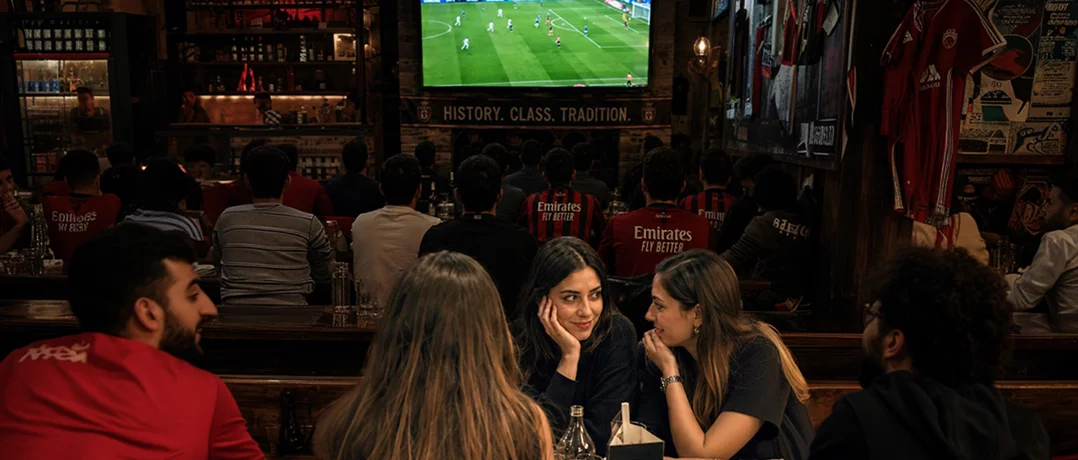
Football has long been marketed as a game of tactics, statistics, and athletic brilliance. Ask many Lebanese women, however, and they will tell you that the sport offers something far more revealing: a masterclass in character.
While pundits dissect formations, passing accuracy, and expected goals, Lebanese women often find themselves focused on a different set of metrics loyalty, judgment, emotional maturity, and the ability to sustain a long-term relationship without creating an international scandal.
This is not because they misunderstand football. Quite the opposite. It is because they understand that what happens off the pitch can be just as telling as what happens on it. For many Lebanese women, football is not merely a game. It is an ongoing study of men, their choices, and the consequences that inevitably follow.
The offenders' list
Let's begin with Gerard Piqué, because every story needs a villain. Lebanese women did not need to know Piqué's pass-completion rate, defensive statistics, or collection of Champions League titles to form an opinion about him. We needed exactly one piece of information: he cheated on Shakira. The woman who gave the world Hips Don't Lie.
Piqué dismantled a decade-long relationship, a home, two children, and a shared legacy for a 22-year-old woman he reportedly met during the World Cup. Lebanese women have collectively, unanimously, and without appeal, retired his jersey. He could score the winning goal in a World Cup final. He could discover a cure for a disease. It would not matter. In our stadium, he plays to an empty house.
Then there is Neymar Jr., a more complicated case. Neymar is, objectively, extraordinarily handsome. Lebanese women acknowledge this fact. The complication lies elsewhere. Over the years, the Brazilian star has fathered children with multiple women while navigating a series of highly publicized relationships. Lebanese women respect the spectacle. They do not necessarily respect the player. We watch Neymar the way people watch a car crash: wincing, unable to look away, and deeply grateful not to be personally involved.
The defender we didn't know we needed
Lionel Messi occupies a very different place in the Lebanese women's court of public opinion. This has little to do with Ballon d'Or trophies or Argentina's triumph at the 2022 World Cup.
Instead, it has everything to do with the fact that Messi married his childhood sweetheart, Antonela Roccuzzo, whom he has known since he was nine years old. Their wedding brought together football's global elite, yet the story that resonates most is the apparent simplicity and stability of their relationship.
By all accounts, Messi has remained a devoted husband, father, and teammate. To many Lebanese women, that achievement is more impressive than any free kick.
Messi is the example raised at family dinners as evidence that elite men are capable of behaving responsibly. He is the benchmark. He is the standard. Every other footballer is, implicitly, being compared to him and coming up short, which, coincidentally, is also what often happens to them professionally.
The defendants we are still deliberating
Cristiano Ronaldo remains perhaps the most contested figure in this informal tribunal, and the debate has been ongoing for nearly a decade. The charges are well known. Ronaldo became a father through surrogacy and did not publicly disclose the identity of his son's mother for years. He has spent much of his adult life living on a scale that can only be described as maximalist.
The defence is equally straightforward. The man is exceptionally handsome. This is not a superficial observation. It is a legal argument. Ronaldo has also spent more than seven years with Georgina Rodríguez and has reportedly proposed with a diamond ring of such magnitude that it generated headlines of its own. Seven years is a long time to wait. The ring, by all accounts, was not small. Lebanese women are still deliberating. No verdict has been reached. For now, the ring continues to do a considerable amount of heavy lifting in the courtroom.
What it all means
It would be easy to dismiss this phenomenon as trivial, reducing football to celebrity gossip and suggesting that women care more about personal drama than athletic achievement. That interpretation is both lazy and incomplete. What Lebanese women have built, entirely organically and without formal organization, is a character-based scouting system.
We evaluate loyalty, consistency, emotional intelligence, and long-term commitment, qualities that matter not only in relationships but also in determining whether someone can be trusted when the stakes are high.
Notably, the football record often aligns with the personal one. Piqué left Barcelona under complicated circumstances. Neymar's clubs have repeatedly expressed frustration with questions surrounding his reliability. Messi's teammates, meanwhile, routinely describe him as a steady presence and an exceptional team player.
Lebanese women will continue watching football on their own terms, one eye on the match and the other on the subtext. We will cheer for the faithful and boo the unfaithful. We will evaluate ring sizes and custody arrangements with the same scrutiny that pundits apply to expected goals and defensive lines. And if that makes us less serious football fans, consider this: We were never wrong about Piqué.
-
-

-
Jenna GeageaReporter
-
