



Vintage postcards reveal a changing Lebanon, preserving forgotten streets, vanished landmarks and the landscapes, architecture and way of life of a bygone era.
The Lebanon that postcards left behind

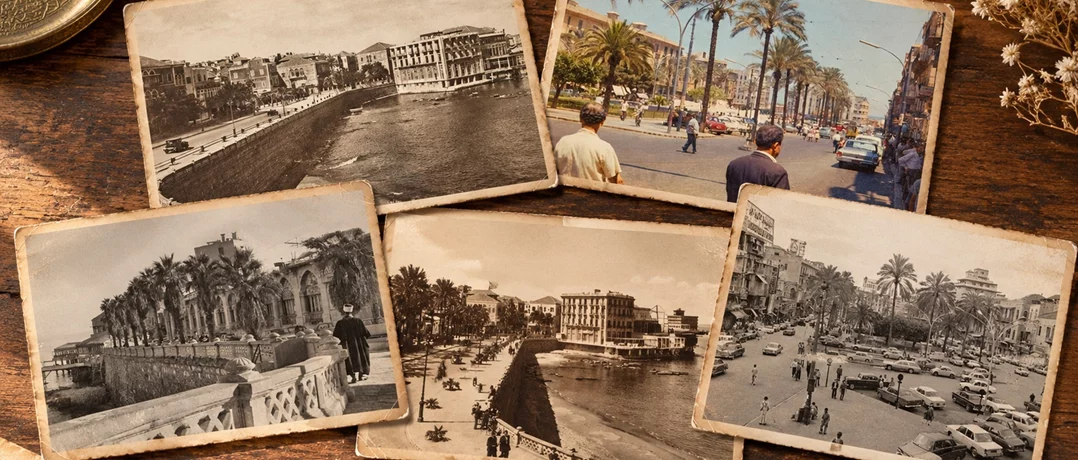
Before Lebanon became the country captured in today’s photographs, it was documented through postcards that offered glimpses of its streets, architecture, landscapes and everyday life. Some preserved places that have since been transformed beyond recognition or disappeared altogether. By the 1930s, the Sarrafian Brothers had established themselves as one of the country’s most prolific postcard publishers, producing roughly one-fifth of all cards printed in Lebanon, among approximately 120 known publishers. International publishers also contributed to this visual archive, including Swiss firm Photoglob and Cairo-based Lehnert & Landrock, whose hand-tinted images often presented Lebanon through an orientalist lens.
As the years passed, postcards began promoting a different image of the country, one of grand hotels, casinos and the internationally celebrated Baalbek Festival. Yet beyond their role as souvenirs and tourism advertisements, these cards have become historical records of a Lebanon that no longer exists in quite the same way. Martyrs’ Square, for instance, was once crossed by a tramway that operated from 1908 until September 1965. Much of Beirut’s historic souks, meanwhile, was lost to demolitions during the 1980s. What was once printed to be sent as a greeting has since become a way of tracing the country's changing identity.
Jean Mouawad: “The card tells you who was meant to be looking”
Jean Mouawad, 70, a retired journalist in Achrafieh, keeps his collection in archival boxes. He owns around 2,300 cards and began in 1991, soon after the guns went silent.
“I bought my first card for the equivalent of two dollars at a Sunday market near the port. It showed the Place des Canons around 1910, with horse carriages, a few men in tarbooshes, and a kiosk. I stood there and could not place a single building. The seller laughed. ‘That’s your city,’ he told me.”
His core collections are Sarrafian. “They worked from Bab Idriss, and their studio kept going until 1975. You can follow Beirut growing up through their numbering. Early cards have a small, careful look,” he explained. “By the 1920s they are confident, with printed captions in French and English, because the buyers were soldiers, pilgrims, and tourists under the Mandate.”
He told The Beiruter that the images were staged. “Nobody is crossing the street by accident. The Sarrafians waited until the frame looked orderly. A peasant stands in front of his house, the street is swept, the minaret and the church tower share one skyline. That was the pitch, a country where everyone lives together. I do not hold it against them. It was their business, and it is also what we long for now.”
His favorite card is a 1956 view of Martyrs’ Square printed by Cultraco. “The tram is crossing in front of the monument. By 1965 the rails were gone. Look at the faces, two women are waiting to board. They had no idea.”
Rony Succar: “I collect the places the lens loved”
Rony Succar, a graphic designer in his late forties, works from his home in Bcharre. His 1,400 cards cover Tripoli, Baalbek, and the mountain villages, and he displays them in a long glass-topped table.
“Baalbek is the great pitch of every publisher. Lehnert & Landrock and the Swiss printers loved the Temple of Bacchus. Their colors are almost too blue, because the sky was painted in afterward. I have eleven versions of one view from the 1920s, and no two skies match.” He tracked the festival era carefully. “After 1956 the cards change. The columns stay, but now a stage appears, and evening gowns, and audiences from Paris.”
Tripoli, he told The Beiruter, is where cards matter most. “People think of Tripoli as a place that never changed, so photographers feel it needs less care. Wrong. I have a card of the souk by the citadel from the early 1930s with a covered lane that is now partly open to traffic.” He has another of the fairground planned in the early 1960s, a white modernist dream that was never completed. “A postcard does not mention what happened next. It is stubborn that way,” he noted.
Mountain villages like Bcharre, his first love, trace the summer-resort boom. “Hotel Cedrus holds the memories of my grandparents falling in love. Every village had a grand hotel and a card to prove it. I look at the postcards and ask where those families are now.”
The cards show how the country wished to be seen, and in doing so they preserve streets, rails, and skylines that no one else photographed so carefully. These postcards have become a map of what was lost.
-
-

-
Jenna GeageaReporter/Writer
-
