



Europe and Russia, despite sharing Christian roots, evolved into fundamentally different political and cultural civilizations shaped by history, geography, and power.
The long divide between Europe and Russia

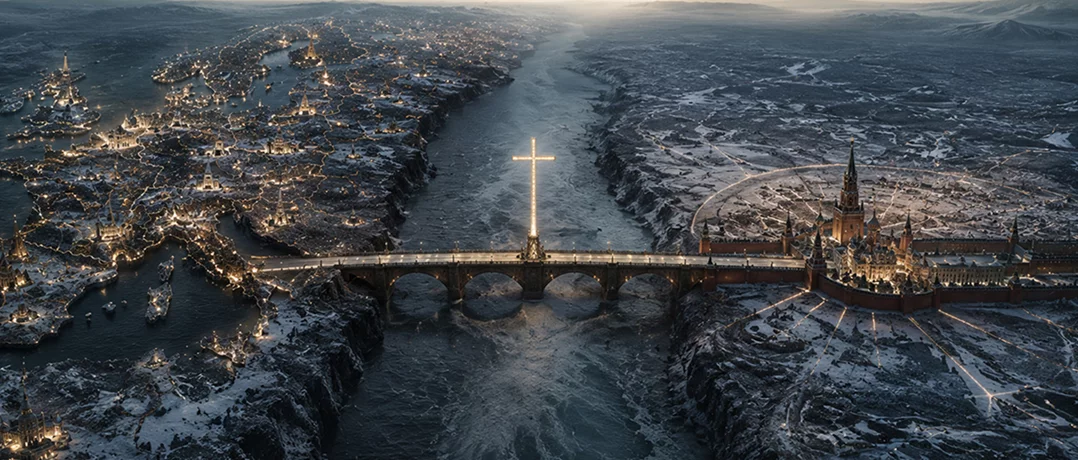
If Christianity carries a universal message of unity, why did it not prevent the long divide between Europe and Russia? The question becomes sharper in the Russia–Ukraine War, where two societies sharing an Orthodox Christian heritage now stand on opposite sides of a violent conflict.
Religion as a cultural construction
Religion is often presented as a universal and transcendent truth. Yet, from a sociological and philosophical perspective, it emerges within specific historical and cultural contexts, shaped by social relations, political structures, and systems of meaning.
As Émile Durkheim explains, religion is deeply connected to what he calls the collective conscience-the shared values and beliefs that hold a society together. One of religion’s central functions is to reinforce this collective framework, without which social cohesion would not be possible. In this sense, what is considered sacred or profane is not inherent in objects themselves, but constructed through cultural processes. (Durkheim Emile, 1912/1995). Similarly, Max Weber highlights the reciprocal relationship between religion and culture. Religion is shaped by its social context, yet it also actively shapes social behavior and historical development (Weber & Parsons, 2010).
This framework shows that religion is never separate from power, identity, history, and cultural context. As a result, the same faith can be practiced and understood differently across societies, leading us from religion to the broader role of culture.
Culture and the structures of historical formation
Culture itself can be understood as the system of beliefs, values, customs, and practices that define a society. It encompasses language, religion, social norms, and everyday life, shaping how individuals perceive and interact with the world. While often simplified as “the way things are done,” it is in fact a much more complex process>
A major contribution to understanding this process comes from Fernand Braudel, who argued in his book The Mediterranean and the Mediterranean World in the Age of Philip II, that history unfolds across three temporal layers, often referred to as the longue durée. The first consists of events short-term occurrences such as wars and political decisions. The second includes conjunctures, referring to medium-term economic and social cycles. The third, and most significant, is the level of structures, which encompasses geography, environment, and deeply embedded cultural mentalities.
For Braudel, geography is not just a background; it shapes what societies can do and what becomes likely over time.
Geography and the divergence of Europe and Russia
When this framework is applied to Europe and Russia, a fundamental divergence becomes visible. Europe’s fragmented geography characterized by mountains, rivers, and coastlines contributed over time to political fragmentation, multiple centers of power, and competition between states. This produced a cultural environment marked by diversity, pluralism, and the absence of a single dominant authority.
In contrast, Russia’s vast plains, lack of natural borders, and historical exposure to invasions created a structural need for centralized authority and strong state control. Over the long term, this led to a culture organized around unity, hierarchy, and state dominance.
Before Christianity could divide Europe and Russia, geography and history had already shaped two fundamentally different worlds in which that Christianity would be lived.
Geography does not directly determine historical outcomes, but it shapes the structural conditions within which societies evolve. Following Braudel, these long-term geographical factors played a decisive role in shaping the distinct political and cultural formations of Europe and Russia, ultimately influencing how Christianity developed in each context.
The formation of divergent Christian systems
Although Christianity presents itself as a universal faith, it developed into distinct political-theological systems in Western Europe and Russia. This divergence became formalized with the Great Schism, which established a lasting separation between Western (Catholic) and Eastern (Orthodox) Christianity.
In Western Europe, Christianity evolved within a system of dual authority, characterized by ongoing tension between Church and state. Influenced by early thinkers such as Augustine of Hippo, this system generated conflicts between religious and political power, eventually leading to the Protestant Reformation, religious wars, and the gradual emergence of secularism. As a result, Christianity became fragmented, pluralized, and partially separated from political authority.
In Russia, however, Orthodox Christianity developed within a system of unified authority, where Church and state were closely aligned. Following the fall of Byzantium, Russia adopted the idea of the “Third Rome,” (Keleher, Edward P., 2022) positioning itself as the successor of Orthodox civilization. In this context, religion became a central instrument of political legitimacy, reinforcing centralized power and state authority.
Christianity did not fail because it lacked a message of unity; rather, it was shaped by different cultural and political contexts in Europe and Russia. Over time, it shifted from a universal ethic of love and compassion into a marker of collective identity, separating communities through distinctions between “us” and “others.”
Contemporary reflection: The Russia–Ukraine war
A contemporary illustration of this dynamic can be found in the Russia–Ukraine War. Despite sharing an Orthodox Christian heritage, Russia and Ukraine remain in conflict. Yet this shared heritage does not function as a unifying force, because it is itself contested. The conflict is not only about territory, security, or geopolitical alignment; it is also a struggle over historical memory and the right to interpret a shared Orthodox past.
These tensions are intensified by cultural differences in historical orientation. Russia often imagines itself through civilizational continuity, centralized authority, and the inheritance of a broader Orthodox-Slavic space. Ukraine, by contrast, has been shaped by a more plural borderland experience, Black Sea openness, and a modern struggle for sovereignty and self-definition. What Russia may narrate as historical unity, Ukraine often experiences as imperial absorption (Borker, 2017). Thus, the conflict is not only over territory, but over the meaning of history, language, religion, and political belonging.
Russia mobilizes religious symbolism to reinforce a vision of civilizational unity and historical continuity, presenting Ukraine as part of a broader spiritual and cultural space. This logic appears clearly in Vladimir Putin’ speech, where he claimed that Ukraine was “not just a neighboring country” but “an inalienable part of our own history, culture and spiritual space.” (Putin, Vladimir, 2022)
This raises a deeper question: who has the authority to interpret a shared past? More precisely, what happens when two nations claim the same sacred history but use it to imagine opposite political futures?
Ukraine, in contrast, defines itself through sovereignty, self-determination, and a European political orientation. In this context, Orthodoxy does not function mainly as a shared moral framework, but as part of competing narratives of identity and legitimacy. The war therefore shows that shared religion does not guarantee unity when it is shaped by different histories, identities, and structures of power.
Christianity as a civilizational language
Christianity did not merely fail to bring peace; it was transformed into a civilizational language through which different societies define themselves and, in doing so, define their differences. As long as religion functions primarily as an identity embedded within political and cultural structures, it will continue to reinforce division rather than overcome it. A return to Christianity’s shared ethical foundations may reduce tensions, but it cannot by itself dissolve the deeper historical and structural differences that have shaped Europe and Russia into separate political worlds.
