



Hypersonic missiles and preemptive strike plans sharpen the Korean arms race. Could a conventional clash spiral into nuclear escalation?
The new Korean arms race

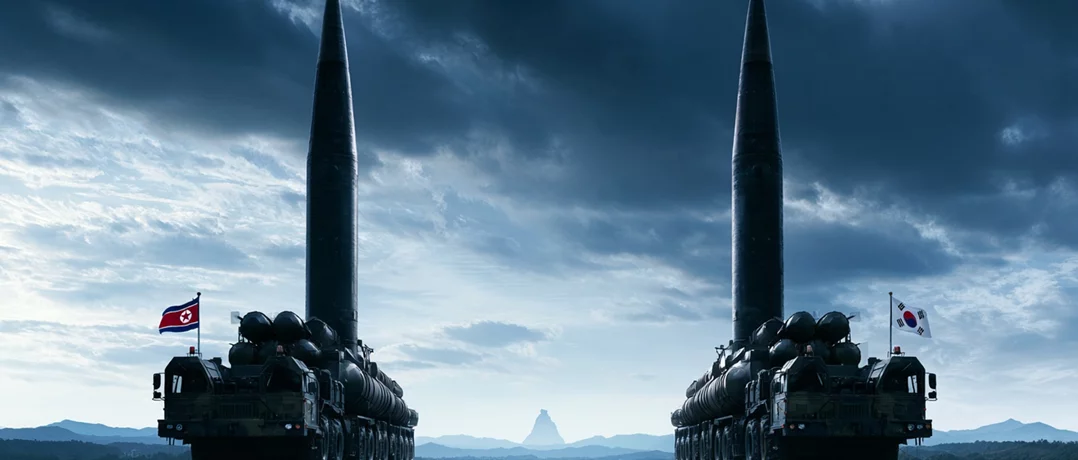
When North Korea fired another salvo of ballistic missiles toward the East Sea on 12 October, the peninsula had already witnessed two competing demonstrations of hypersonic technology. Nine days earlier, Pyongyang had tested a missile it described as hypersonic, while South Korean President Lee Jae Myung had watched his country's first domestically developed hypersonic glide vehicle take flight on 8 October. In just ten days, the two Koreas had staged three demonstrations of military power, each adding to an arms race unfolding along one of the world's most dangerous fault lines.
A race for speed and survivability
Speed alone does not distinguish modern hypersonic weapons. Conventional ballistic missiles already travel at more than five times the speed of sound. The difference lies in maneuverability and flight trajectory. Hypersonic glide vehicles can change direction while traveling through the atmosphere at lower altitudes than traditional ballistic missiles, making their paths harder to predict and complicating interception.
South Korea's recent test demonstrated several of these capabilities. According to Seoul, the domestically developed vehicle successfully separated from its rocket booster, performed horizontal and vertical maneuvers, and struck its designated target. Seoul also reported progress in guidance systems and heat-resistant materials, although the weapon remains under development and its deployment timeline is undisclosed. Pyongyang was quick to question whether the test was succesfull, citing the vehicle's clean exterior, but Seoul attributed the absence of soot to heat-resistant materials
North Korea, meanwhile, has pursued its own hypersonic technology. Pyongyang claimed its October test struck a target 1,000 kilometers away along an irregular trajectory, although South Korean and Japanese assessments indicated a shorter flight distance.
For Seoul, such weapons fit into a broader effort to deter a nuclear-armed adversary through conventional military power. That effort is central to its Three-Axis Defense System.
South Korea’s strategy of preemption
Developed over successive administrations and maintained under President Lee Jae Myung, the system combines preemptive strikes, layered missile defenses, and large-scale retaliation. It gives a nonnuclear state military options against an adversary armed with nuclear weapons.
The first axis, Kill Chain, envisages identifying signs of an imminent North Korean missile attack and destroying launchers or associated military facilities before the weapons can be fired. Korea Air and Missile Defense (KAMD), the second, aims to intercept missiles already airborne. The third, Korea Massive Punishment and Retaliation (KMPR), threatens devastating strikes against North Korean command facilities and leadership-related targets in response to an attack.
Of the three, Kill Chain presents the greatest intelligence challenge. It requires commanders to distinguish preparations for an imminent strike from routine military movements, locate concealed or mobile launchers, and act before missiles are fired. Reconnaissance satellites and precision weapons improve Seoul's options, but detecting preparations does not necessarily reveal intent.
Yet the missile forces and command facilities Seoul might seek to neutralize are also essential to Pyongyang's ability to retaliate. South Korea's doctrine therefore confronts North Korea's overriding concern with nuclear survivability.
North Korea’s doctrine of nuclear survival
For Pyongyang, a nuclear arsenal can deter an attack only if it remains capable of retaliation. Mobile missile launchers and an expanding range of delivery systems are intended to make its weapons more difficult to locate and destroy.
North Korea is also extending these capabilities underwater. On 14 October, it tested two types of submarine-launched strategic cruise missiles, according to state media. South Korea confirmed detecting launches from a submarine, although the vessel's operational readiness and the missiles' nuclear capabilities remain uncertain.
Pyongyang's nuclear doctrine reflects the same concern. A law adopted in September 2022 permits nuclear use not only against nuclear attacks but also when conventional strikes against the leadership, nuclear command structure, or major strategic sites occur or are judged imminent. It further declares that an attack threatening nuclear command and control would trigger an automatic nuclear strike under a predetermined plan. Whether North Korea could execute such a response remains uncertain, and the provision does not establish the existence of an automated launch mechanism.
Consequently, an attack that Seoul considers preventive could cross thresholds Pyongyang has explicitly associated with nuclear use.
Where the doctrines collide
Neither side can be certain how the other will interpret its military actions. South Korean commanders must assess whether North Korean movements signal an imminent attack, while Pyongyang must judge whether a conventional strike is limited or the beginning of an attempt to disarm its nuclear forces.
The security dilemma becomes particularly acute when measures intended to protect one side threaten capabilities the other considers essential to its survival. On the peninsula, overlapping conventional and nuclear military infrastructure makes the intended scope of an attack particularly difficult to assess.
The danger was illustrated on 30 August 2023, when American B-1B bombers conducted joint exercises with South Korean fighter jets. Pyongyang interpreted the drills as preparations for a preemptive nuclear strike and responded by launching two ballistic missiles in an exercise simulating nuclear attacks on South Korean command centers and airfields.
The episode demonstrated how military preparations intended to reinforce deterrence can provoke an escalatory response. More sophisticated weapons may discourage either side from initiating hostilities by raising the anticipated costs of aggression. Yet those same capabilities can make escalation harder to control once a confrontation begins.
Nor is this an exclusively bilateral danger. South Korea's conventional military power operates alongside American nuclear guarantees, adding another decision-making authority to any confrontation with Pyongyang.
Washington's role in the escalation equation
Washington guarantees South Korea's security through extended deterrence, backed by the full range of American military capabilities, including nuclear weapons. The Nuclear Consultative Group, established in 2023, has expanded bilateral cooperation on nuclear planning and crisis response, although decisions concerning American nuclear weapons remain under U.S. authority.
President Lee Jae Myung seeks to transfer wartime operational control to a South Korean-led combined command before his term ends in 2030. Seoul is pursuing nuclear-powered submarines, seeking greater independence without acquiring nuclear weapons.
However, the transfer of wartime command has exposed differences between the allies. On 15 October, a South Korean Defense Ministry spokesperson warned that continually changing the requirements could make the transfer impossible. Her remarks followed comments by the U.S. military commander in Korea that evolving threats required updated standards.
The disagreement has implications for military coordination in the event of a crisis.. Wartime command shapes the planning and execution of allied operations, while nuclear decisions remain Washington's alone. Seoul's growing strike capabilities make coordination essential when Pyongyang might interpret conventional operations as threats to its nuclear command.
Greater South Korean autonomy may redistribute responsibilities between the allies, but it cannot remove the risks created when conventional and nuclear deterrence intersect in a crisis.
-
-

-
Nami El KhazenJournalistFocusing on geopolitics and international affairs.
-
