



Three survivors of the Beirut port explosion reflect on the pieces of their lives the blast took, and the lives they rebuilt in its aftermath.
The pieces the explosion stole

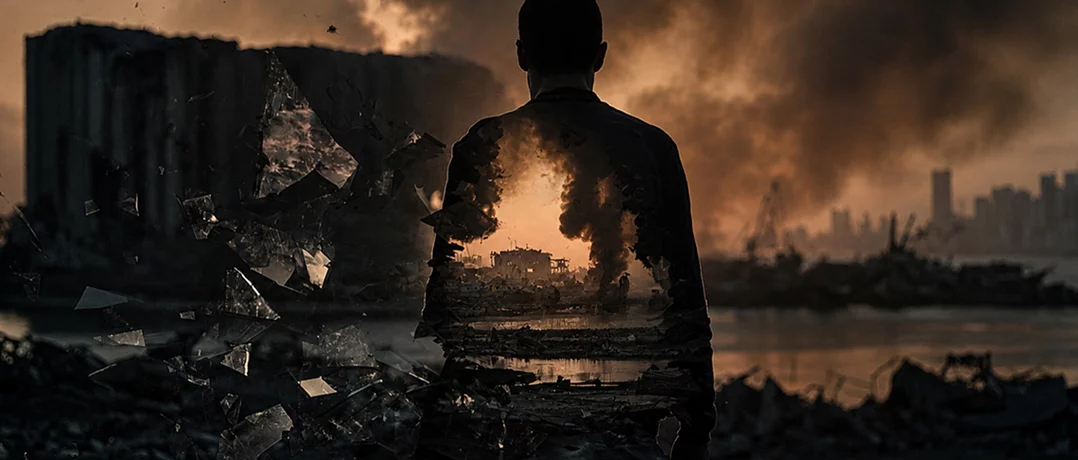
On August 4, 2020, at 6:07 that evening, a warehouse at the Port of Beirut turned a city's ordinary Tuesday into a wound that has not closed. In the years since, the people who lived through it have learned that survival is not the end of the story, it is only the beginning of a much longer one.
This is not an account of the blast itself. It is an account of what it left behind, the sight one woman lost, the six screws now fused into a young man's spine, the six days a bride-to-be could not remember. Three survivors. Three different answers to the same impossible question, what did it take from you?
Nour Haddad: The woman who lost the light
Nour Haddad was home in Beirut before the blast occurred. "It was an ordinary evening," she said. "I remember the small details more clearly than I remember the day itself.". The windows were shattered. She was thrown to the ground, cut, disoriented, and beneath the blood, she felt that something had happened to her eyes. "I kept trying to open them, but I couldn't see properly," she remembered. "I kept repeating it because I thought if someone came and cleaned my eyes, everything would go back to normal. I don't think I understood yet that I might not see again."
What followed was not a single loss but an unraveling of every certainty she had built her life on. "I knew where the furniture was. I knew how many steps it took to get to the kitchen. But I couldn't see any of it," she said of returning to her own home.
The house hadn't changed. I had.
Her grief, when it came, was aimed at a catastrophe she insists was never inevitable. "It wasn't a natural disaster," she said. "There were people who knew about the danger. And we were the ones who paid for it." That anger, eventually pushed her out of Lebanon entirely. She rebuilt her independence in France, learning to use a cane, a new relationship with her phone, the triumph of walking somewhere alone for the first time. "Little things became achievements," she said.
She has not returned to Beirut since.
I love Lebanon. And I don't know if I can live there again.
What remains is a kind of double vision without sight at all, a woman who carries two cities in her memory, the one she knew and the one that broke her, "I survived it," she said simply. "And I'm still here."
Bassem Akkawi: The weight that never lifted
Bassem Akkawi was fifteen, standing with friends near the Rafic Hariri shrine downtown, filming what looked at first like a fire, curiosity, then confusion, then the sky itself seeming to fold in on him. "I saw it in slow motion," he recalled. "I wanted to run. But between the flash and the shockwave, you have maybe two seconds."
Two seconds were not enough. Behind him stood iron barricades, installed during Lebanon's protests to shield shopfronts from being smashed, five centimeters of solid metal. The blast tore them loose and drove them down onto him. "It all fell on my back," he said. Bassem was pinned beneath the iron, unconscious, until ten young men, security guards from the shrine, lifted the barricade off him by hand.
The ride to find a hospital that could take him became its own ordeal, three hospitals full, his makeshift stretcher too long for his mother's car, his legs hanging out of the open trunk. When they finally reached an emergency room already flooded with the wounded, doctors found he had a broken back. Today, six screws hold his lower spine together. “Now, when I overexert myself, or when it gets cold, I feel the ache in my spine."
It is a strange kind of inheritance, a body that works, mostly, except when it insists on remembering.
I'm feeling it every day. I will feel it forever.
Clara Chammas: The guilt of survival
Clara Chammas was three weeks from her wedding, newly moved into an apartment overlooking the port, arranging bedsheets with her mother on the afternoon of August 4. Of the explosion itself, she remembers nothing at all, the blast erased it clean.
Her first memory afterward is fragmented, waking on a staircase in a home she barely knew, not recognizing her own mother's face. "She told me, 'I'm your mom. Today we were shopping for bedsheets. You're getting married,'" Clara recalled. "And I'm like, but where are we?" Her mother, seeing her collapsed and unrecognizing, believed in that moment that her daughter had died. Clara's face, neck, and ribs were shattered; doctors would soon tell her that her neck itself was broken.
What has stayed with her longest is the guilt. In a hospital overwhelmed with the dying, she watched people far worse off than herself and could not understand why she had been spared. "Why me? Why am I not him?" she remembered thinking. "It's his turn." Her mother tried to talk her out of the shame, you're lucky?, look at you, your look destroyed and you're still feeling guilty? but guilt, Clara learned, does not obey logic.
This feeling was horrible.
She insists, in the end, that the blast took nothing from her directly, only from the people who did not survive it, or who lost far more. "It showed me how strong I was," she said, of walking again within a month against every prediction. But beneath that resilience sits the loss of a sense of safety that once lived inside her own walls and has never quite returned. "You are supposed to feel safe at home," she said.
What remains
Three different losses, inflicted in the same two seconds. What connects Nour, Bassem, and Clara is the fact that each of them has had to build an entire second life around what the blast removed.
Beirut's port explosion is remembered, rightly, in numbers, the dead, the injured, the displaced, the tons of ammonium nitrate that should never have been there. But numbers cannot hold what these three carry.
And yet none of them describe themselves only as what was taken. They describe themselves as what remains. It is, perhaps, the only honest ending this story can have, not healing, exactly, and not forgetting, but the act of continuing, in a body and a life reassembled from what the explosion left behind.
-
-

-
Jenna GeageaReporter/Writer
-
