



Three Lebanese women share how the pressure to marry before 30 shapes their relationships, choices and fears, and why love should never have an expiration date.
The pressure to marry before 30

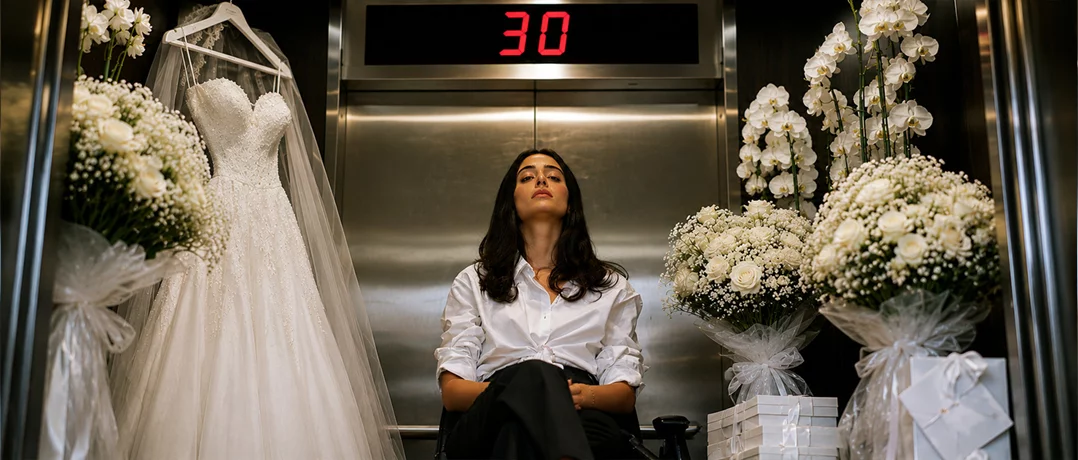
In a society where marriage is often treated as a milestone with an unspoken deadline, turning 30 while single can feel like a verdict. The pressure rarely announces itself, it arrives instead as a comment at a wedding, a mother's hopeful text, a silence at a family lunch. Where does that urgency actually come from? Three women, each approaching this milestone from a different angle, offer an answer that is less about age itself than about the stories built around it.
Names have been changed to pseudonyms to protect the women’s anonymity.
Chloe, 30: "I thought by 30, I would have someone to call my husband"
For Chloe, the pressure is internalized. "My parents don't wake up every morning asking me when I'm getting married. It's become something inside my own head," she said. Four serious relationships, one nearly ending in marriage, have left her recalculating what's still possible. "When you lose a relationship like that at 28 or 29, you're grieving the future you had already built in your head."
What haunts her most is the arithmetic of time itself. "You need time to know someone... then you get married, and maybe you want a year or two before having children. I start doing the math in my head and it terrifies me." That math has reshaped how she dates entirely. "Before, I dated because I wanted to see where something would go. Now I find myself evaluating men almost immediately... It's exhausting because I don't want to treat love like a job interview."
Asked to imagine turning 35 still unmarried, her answer was blunt: "Fear. And sadness... I don't want people to tell me, 'You're still young.' I know I'm young. I just wanted the life I thought I'd have by now."
Maya, 28: "I want the chance to become a mother."
For Maya, the countdown is about what marriage is meant to open the door to. "Marriage has started feeling less like this romantic milestone and more like a door that I need to reach before another door closes," she explained. Watching close friends become pregnant reframed her own timeline overnight, and dating has changed accordingly. "If I date someone for six months and he's still saying, 'Let's see,' I start panicking. I'm thinking, I don't have unlimited time to see."
Her mother's well-meaning interventions, including once texting a photo of an eligible bachelor, only sharpen the pressure. "I laughed, but then I cried later," Maya said, adding, "I think she's afraid for me." That fear has shaped Maya's choices in ways she's uneasy about, including staying in a relationship she knew wasn't right simply to avoid starting over. "I couldn't stop thinking, if I leave him, I'm starting from zero. And zero felt terrifying."
Her deepest worry is the impossible standard she feels caught inside. "People tell women, 'Don't settle.' Then they tell us, 'Don't wait too long.' And somehow we're supposed to know exactly where the line is."
Sara, 31: "The worst part was becoming a subject of conversation."
Sara's account centers on how visibly the world's treatment of her changed the moment she crossed 30. "I was single before 30 and nobody cared. I turned 30 and suddenly people looked at me differently," she said. A family lunch where an aunt told her, "You should be next," while everyone laughed, sent her crying in the bathroom afterward.
That external judgment, she said, reshaped her self-perception. "You start believing that being single must mean there is something fundamentally wrong with you. And that's dangerous because you can start romanticizing relationships that weren't actually good for you." She described calling an ex out of loneliness and panic during a low moment, only to feel "ridiculous" afterward, a moment she now sees as proof of how pressure distorts judgment. "It can make an unhappy relationship look safer than being alone."
What frustrates her most is the impossibility of answering the question everyone asks. "'Why are you still single?' Because there is no good answer," she said. "The truth is more complicated. I'm happy in many parts of my life... But yes, I want a partner... Wanting those things doesn't mean I'm desperate, but admitting that I want them shouldn't make me desperate." Her advice to younger women echoes a hard-won clarity: "I'd tell her not to let fear make the decision for her... I'm trying to stop treating 30 like an expiration date. It was never supposed to be one."
A deadline nobody actually set
Across all three accounts, the pressure to marry before 30 rarely comes from a single source, not always parents, not always culture explicitly stated, but a diffuse accumulation of glances, comments, and comparisons that women absorb and eventually enforce on themselves. Chloe fears running out of time. Maya fears choosing between the right partner and the right timeline. Sara fears the judgment more than the solitude itself. What unites them is the exhausting effort of resisting a deadline that was never supposed to exist in the first place.
Because love was never meant to be a race against a birthday. Marriage is not a constitution to be signed before a woman reaches a certain age, nor a social contract entered into simply because the years are moving. It is supposed to be the consequence of finding someone with whom a life can be built. When marriage becomes something women are pressured to secure rather than a choice they are free to make, the meaning of it begins to erode. Love needs time, time to know someone beyond the excitement of the beginning, to discover their flaws, their values, their capacity for tenderness and commitment, and to decide, without fear breathing down your neck, that this is the person you want beside you. No woman should have to rush into a lifetime because society has convinced her that being unmarried is a failure.
-
-

-
Jenna GeageaReporter/Writer
-
