

Beirut’s 12th 48 Hour Film Project brought 14 teams together for a high-pressure filmmaking sprint, proving the local film community’s determination to keep creating.
The race to make a film in 48 Hours

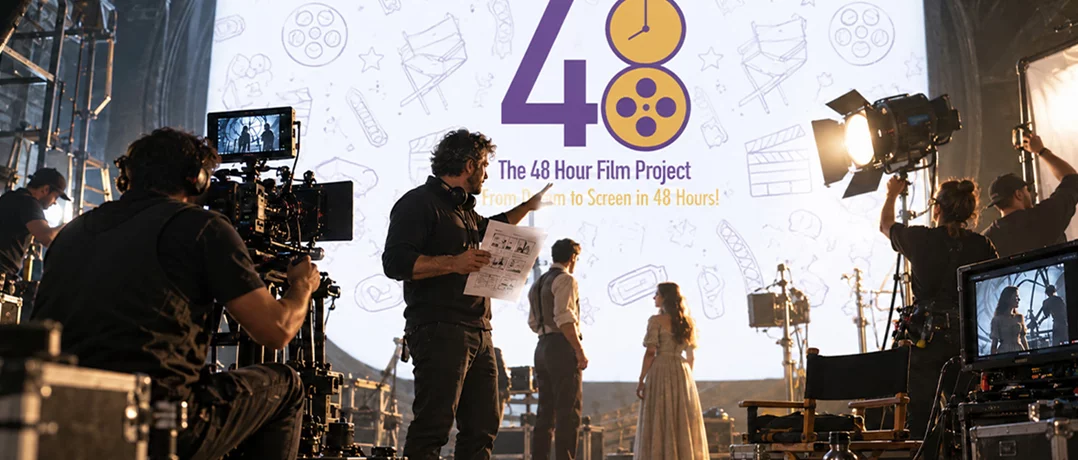
The global 48 Hour filmmaking competition gives teams exactly two days to write, shoot, and edit an entire short film from scratch. Founded by Mark Ruppert in Washington, D.C. in 2001, the project has grown into the world's largest timed filmmaking competition, now running in more than 100 cities worldwide. This year marked its 12th edition in Beirut, organized by the Beirut Film Institute. The Beiruter spoke with City producer Nour Akiki about how the local edition came together, and why it almost didn't happen at all.
The rules of the race
The premise, according to Akiki, is unforgiving by design, “the challenge is to create an entire film within 48 hours, from writing the script to filming and completing the final edit.” The finished product must run between four and seven minutes and weave in every required competition element, a fixed set of constraints announced only minutes before the clock starts.
This year's kickoff took place at D.Space in Mar Mikhael, where 14 registered teams each drew two assigned genres before receiving the mandatory elements everyone had to build a story around, a character named Salma or Salim Mahfouz, an archivist by profession; a prop, either a single flower or a bouquet; and a line of dialogue, "One day, we'll understand why.” Teams launched into production at 7:00 PM, racing toward a Sunday deadline of 7:30 PM. Films that ran over the time limit were automatically disqualified from the official competition, though they were still screened for the audience.
Of the 14 teams that registered, 12 completed finished films in time to be judged. "Those 12 films were screened and evaluated by the jury and formed the basis for the awards," Akiki said. Categories spanned Best Film, First and Second Runner-Up, and a long list of craft awards, Best Actor, Best Actress, Best Director, Best Screenplay, Best Editing, Best Cinematography, Best Sound, Best Use of Prop, Best Use of Character, and Best Use of Line, among others.
A festival almost cancelled
Behind this year's edition was a genuine question mark over whether it should happen at all. Registration typically opens in April, but organizers hesitated this year given the situation in Lebanon. "We were concerned that people might not register or might not have the enthusiasm to make films while the war was still ongoing," Akiki said. What changed their minds was persistent demand from the filmmaking community itself. "We decided to go ahead after receiving constant questions from people asking when the 48 Hour Film Project would return."
Registration finally opened with a dramatically compressed window compared to previous years. Even so, all 14 teams signed up within that short stretch. "This is a significant number considering how briefly registration was open in Lebanon," Akiki noted, framing the turnout as proof of the project's staying power locally. "This ultimately confirmed that the 48 Hour Film Project has a strong community of filmmakers who return every year, excited to challenge themselves."
The Verdict
The screening and awards ceremony took place at Grand Cinemas ABC Verdun, the event's annual home, complete with a red carpet reception before the films rolled. This year's jury brought together actor Talal Jurdi, director Elie Fahed, and AFAC Film Program Manager Soleil Gharbieh. Hosting duties went to actress Zeina Ziadeh, marking her fourth consecutive year presenting the ceremony.
The stakes for finalists extend well beyond a night of local recognition. Beirut's Best Film winner will go on to represent Lebanon at Filmapalooza, the project's global finals, scheduled for Curaçao in March 2027, where top films from cities around the world compete for the title of Best Film in the World. Roughly 14 films selected from the global pool of city winners also earn a screening slot at the Short Film Corner of the Cannes Film Festival, a genuine launchpad opportunity that has previously helped Beirut filmmakers gain international exposure.
The event's producers, Akiki alongside co-producer Bachir Abou Zeid, describe the project as something bigger than a single weekend of frantic filmmaking. Many participating teams go on to submit their 48-hour creations to other local and international festivals long after the competition ends, treating the sprint less as an endpoint than a springboard. The Beirut edition has built a loyal filmmaking community willing to show up, as this year proved, even under just weeks of notice and considerable uncertainty. That passion is a testament to the power of art to move and connect people.
-
-

-
Jenna GeageaReporter/Writer
-
