



Southern Lebanon’s losses go beyond $1.3 billion in physical damage, as war has disrupted businesses, agriculture, jobs and investment, making economic recovery dependent on stability, reconstruction and rebuilding trust.
The real cost of rebuilding southern Lebanon
The real cost of rebuilding southern Lebanon
By Rimah Hashem | September 02, 2026

Reading time: 6 min
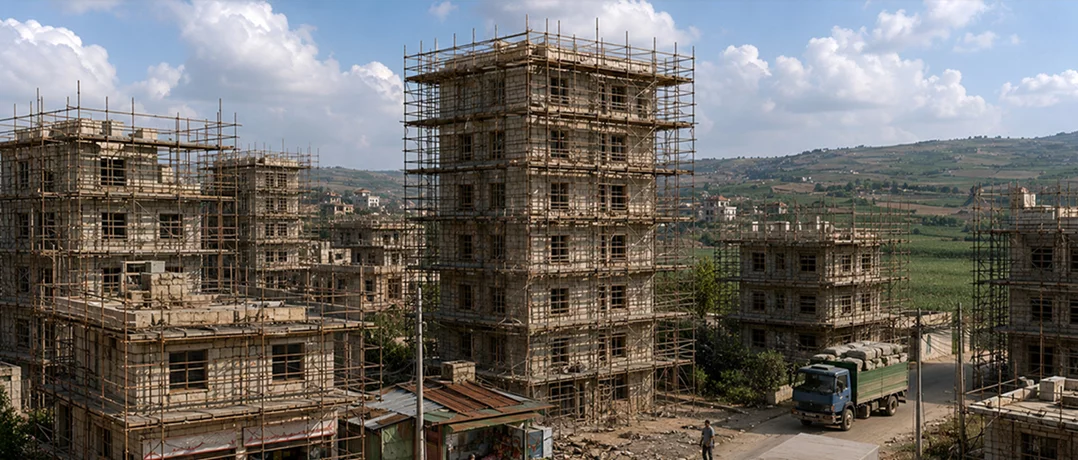
The scale of the losses suffered by southern Lebanon can no longer be measured only by the cost of destroyed buildings and property. The consequences of the war have damaged the foundations of the local economy and disrupted a large part of the productive cycle, from agriculture and trade to industry and services. With direct damage estimates approaching $1.3 billion, the actual cost appears far greater, after adding production losses, lost income, lost job opportunities, disrupted businesses and damaged agricultural seasons in a region where the local economy is a key pillar of livelihood for thousands of families.
Restarting the economy of southern Lebanon is not linked only to financing and reconstruction. Before that, it depends on the availability of security and political stability capable of rebuilding confidence. Attracting investments, bringing back expatriate capital and restarting businesses require a stable and predictable environment, while the continued presence of weapons outside state control, according to Hakim’s assessment, remains an obstacle to long-term investment. Therefore, rebuilding the south becomes a comprehensive economic battle, one that cannot succeed through rebuilding physical structures alone unless it is accompanied by restoring security, confidence and the production cycle.
Former Minister of Economy and Trade Alain Hakim paints a picture that goes far beyond the damage to buildings and property when discussing the losses in southern Lebanon. He told Nidaa Al Watan that “assessing the scale of the disaster cannot be limited to the cost of physical reconstruction, but must include the economic, productive and social losses that affected the region and halted a significant part of its activity.”
Hakim notes that “the latest figures related to damages in the area south of the Litani River are estimated at around $1.3 billion,” pointing out that “around 11,000 buildings were damaged or destroyed. In comparison, the World Bank estimates the total economic cost of the war on Lebanon at more than $14 billion, while the urgent needs to begin the recovery and reconstruction phase amount to around $11 billion.”
Losses cannot be reduced to buildings alone
However, Hakim stresses that “assessing the losses in the south should not be limited to the cost of destroyed buildings,” explaining tha
“the widely circulated figure of around $1.3 billion alone is not enough to determine the actual scale of losses.
He says that “there is a direct cost of destruction, but it is matched by an equally important economic and productive cost, represented by the halt in economic activity, income losses, job losses, declining agricultural and commercial activity, in addition to the consequences of displacement and the disruption of economic movement in many southern areas.”
He considers that “accurately estimating losses requires calculating the productive losses suffered by the south, because the extent of damage cannot be measured only by the number of destroyed buildings, but also by the number of businesses that stopped operating, activities that were disrupted, jobs that disappeared and income that was cut off from thousands of families.”
The South is an economy of its own
Hakim confirms that housing and infrastructure were among the sectors most affected, but the greatest risk, he says, extends to agriculture, trade, industry and services.
The south, he notes, is not “merely a residential area, but an economy of its own, largely based on land, agriculture, small and medium-sized enterprises and trade, in addition to expatriate communities and tourism.”
He believes that
the greatest loss may not be in buildings that can be rebuilt, but in businesses that closed their doors, farmers who lost their seasons, young people who were forced to migrate, as well as expatriate capital that may not return to invest in the region.
He stresses that “dealing with the south through the logic of rebuilding physical structures alone is not enough. What is required is rebuilding a productive economy capable of achieving high levels of productivity.” He adds that “reconstruction must include people, production and expatriate capital within the framework of a genuine economic revival, because rebuilding buildings alone will not be sufficient to restore the economic cycle in the region.”
Investment requires stability
Hakim highlights the issue of investment, considering that “reviving the southern economy and attracting capital are directly linked to providing a stable and secure environment.”
He stresses that “serious and long-term investments in the south cannot be discussed while weapons remain outside the control of the Lebanese state and the Lebanese Army,” asking: “How can an investor inject money into a project if they are not confident about its continuity and ability to generate sustainable returns?”
From this perspective, he believes that
security stability and the state’s monopoly over weapons are essential conditions for restoring investors’ confidence and encouraging capital to return to the south. Investors need a clear and stable environment that allows them to plan long-term projects away from risks and uncertainty.
Investing in the South’s future
Hakim confirms that “the south needs investments on multiple levels. The first level involves rebuilding buildings, homes and infrastructure, while the second focuses on saving the local economy by financing small businesses and farmers, and restarting factories and workshops.”
The third level, according to Hakim, involves “investing in the future of the south rather than its past, through establishing an investment fund and financing new productive projects including modern agriculture, food processing, energy, digital services, tourism, as well as projects linked to the Lebanese diaspora.”
He believes that “the goal is not to return to the same previous economic model, but to launch a new phase that opens the door to more productive sectors capable of creating jobs and attracting capital, transforming reconstruction from a process of repairing destruction into an integrated economic project.”
The state alone cannot do it
Hakim stresses that “reconstruction cannot rely solely on waiting for the Lebanese state,” noting that “the state does not have the financial capacity alone to fund the scale of existing needs.”
He adds that “the need for around $11 billion, according to World Bank estimates, reflects the size of the financing gap required to begin recovery, making the attraction of private investment and external financing essential.”
Therefore, he calls for “adopting new financial structures combining international grants, concessional loans, international guarantees and public-private partnerships, alongside attracting expatriate funds and directing them toward productive and investment projects.”
Hakim emphasizes in this context that “transparency and good governance are essential conditions for the success of any reconstruction plan,” stressing “the need for every dollar entering the south to have a known and clear source, and for spending to be subject to transparent monitoring and accountability mechanisms.”
He concludes by stressing that “rebuilding the south is not merely a concrete construction project or a process of rebuilding buildings, but an opportunity to rebuild the economy, the state and trust.” The real challenge, according to Hakim, “should not be limited to restoring what was destroyed, but to building a new economy capable of producing, creating jobs, attracting investments and securing the foundations for sustainable growth in the south.”
Rebuilding southern Lebanon will not only be a financial and technical task, but a test of Lebanon’s ability to transform the post-war period into a sustainable economic path. International funds, aid and private investment can finance reconstruction, but they alone cannot guarantee the return of economic activity. What is needed is a stable environment that protects investment, a state capable of enforcing clear rules, transparent management that prevents the waste of funding, and a plan that revitalizes productive sectors and creates jobs. Rebuilding buildings without restoring confidence and stability may reconstruct the south physically, but it will not restore its economy or its ability to recover.
