



Exclusive interview to The Beiruter with Elissar Naddaf, President and Director-General of Tele Liban, on the Arab world's first television station, its golden age, and the mission to rebuild Lebanon's national screen.
The revival of Lebanon’s first screen

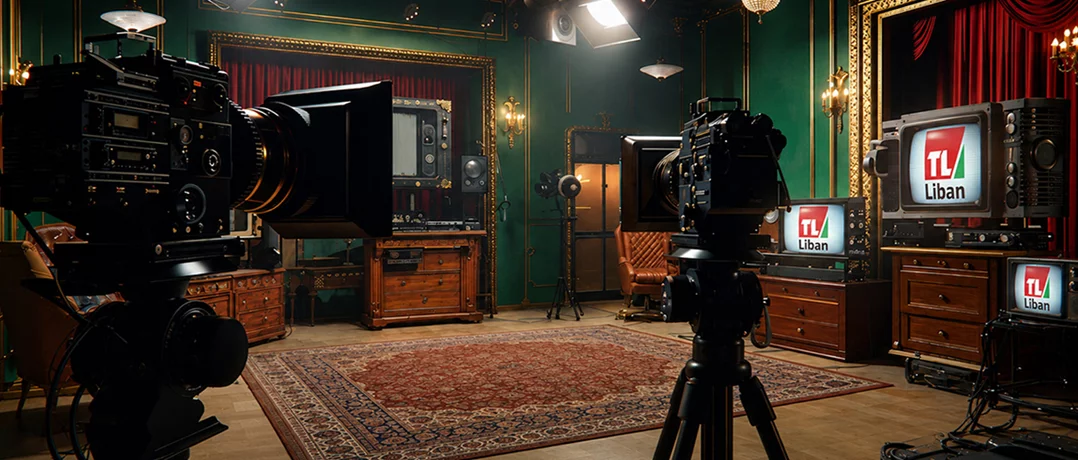
Before the Arab world had a television screen to call its own, Lebanon was already imagining one. It was 1954, when two Lebanese businessmen, Wissam Izzeddine and Alex Moufarrej, submitted a request to build and broadcast television. By 1957, President Camille Chamoun and Prime Minister Sami Solh were breaking ground on Tallet El-Khayat, laying the cornerstone of the first television building in the Middle East. On May 28, 1959, the signal went live. Compagnie Libanaise de Télévision (CLT) became the first TV station in Lebanon, the Arab world, and the region, broadcasting just six hours a day on two channels: Arabic and French.
What made it remarkable was not just timing, but intent. In a pluralistic country, it was a rare attempt to reflect a society back to itself, not as propaganda, but as shared image. A second station, Télé-Orient, launched in 1962, and after years of competition, both merged in 1977 with the state to form today’s Télé Liban. Its golden era in the 1960s and 70s built an archive that now holds over 50,000 hours of Lebanon’s cultural memory, from news and drama to Umm Kalthoum concerts and rare historical footage stretching back even before its founding.
That legacy was fractured during the Civil War, when both stations were taken over and divided along militia lines, turning a national screen into a reflection of a divided country. Today, as Télé Liban marks its 67th year, it stands again at the center of conversation, as both witness and institution, carrying Lebanon’s memory while trying to redefine its future.
24 years without a board
The Beiruter conducted an exclusive interview Elissar Naddaf Geagea, Télé Liban’s President and Director General, to trace its story and explore where the national broadcaster stands today.
Among the most significant challenges facing the station is institutional: Tele Liban spent 24 years without a legitimate, fully empowered board of directors. Every successive caretaker administration, however dedicated, lacked the authority to sign agreements, accept grants, or make structural decisions. "They didn't have the wide powers needed to make change," Naddaf acknowledged. "That is why people noticed the change now, because we can make decisions."
With a permanent board finally in place, the station has opened what Naddaf calls "several fronts simultaneously." These include a full administrative and organizational audit, a new organigram that reflects today's media realities, including dedicated units for social media and artificial intelligence, which did not previously exist, and a professional evaluation of existing staff to identify training needs.
Naddaf does not deal in false comfort. She is candid about how much remains undone, and unapologetic about why. "We are working every moment to make a difference," she said.
Even if we've only achieved 30%, we still have a long way to go, because you cannot fix 24 years of accumulated neglect in just eight months.
She came to the role with her eyes open. Before her appointment, Naddaf built an intimate knowledge of Tele Liban's files, including its archive, on which she had already begun working before formally taking the position. "But when you actually step in," she said, "you realize the scale of what you're facing. You're dealing with multiple fronts at once; you can't say this comes before that." Some gaps, she acknowledged, happened for reasons that are no longer fully traceable. Others simply accumulated, layer by layer, until the burden became what it is today.
An archive unlike any other
The archive, held at the Hazmieh headquarters, stands as perhaps the station's most singular asset. Digitised initially in partnership with France's INA (Institut National de l'Audiovisuel) and the French Foreign Ministry, and subsequently with UNESCO, the collection spans the entirety of Lebanon's broadcast history. The station is now moving past digitisation into the next phase: how to exhibit, protect, and monetise this material, through watermarking, licensing, and on-air integration.
"Tele Liban's archive exists nowhere else. It is the most important archive, very rich, and everyone knows this," Naddaf said. Archive segments will be a recurring feature throughout the anniversary broadcast, surfacing between programs in short segments that give audiences, young and old, a continuous thread back through the station's history.
Asked to identify Tele Liban's golden era, Naddaf pointed to the station's earliest years and the 1980s, a period when the broadcaster commanded not just viewers but the street itself. "When "Al Aasifa Tahob Maratayn" aired, the streets would empty," she recalled. "People stayed home to watch." That cultural gravity is what the current leadership is working to recreate.
Winning back the young
Perhaps the sharpest challenge is generational. Young Lebanese know Tele Liban, but they have largely stopped watching television altogether. The station's answer is threefold: partnerships with every major Lebanese university bringing large cohorts of trainees through its doors; a slate of new programming aimed at youth, the diaspora, music, health, and culture; and opening its studios to young creators who need recording facilities.
When I saw the enthusiasm of the young journalists who came in recently, how attached they still are to this place, I understood that we have not lost them. We just have to earn them back.
The dream, as Naddaf articulates it, is not simply to survive but to become Lebanon's platform for national dialogue, a neutral, publicly owned screen where no party line is imposed and all Lebanese can find themselves reflected. After 67 years, 24 without a proper board, Tele Liban is still transmitting. It is still the pulse of our nation.
-
-

-
Jenna GeageaReporter/Writer
-
