



The rise, fall, and return of Bhamdoun

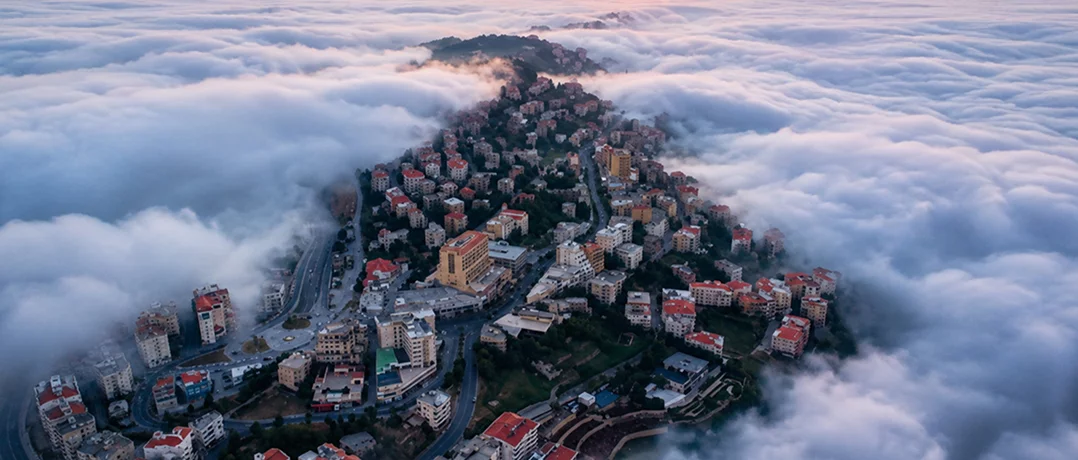
In the Aley District of Mount Lebanon, Bhamdoun overlooks the scenic Lamartine Valley 23 kilometers from Beirut on the old road to Damascus. For over a century it has carried a dual identity, half working mountain village, half fabled resort town, shaped as much by railways and tourism as by the sectarian geography that has long defined Mount Lebanon.
A name stitched from two villages
Local tradition holds that Bhamdoun's name descends from the merger of two smaller settlements, Hama and Dun, which combined over time into "Bayt Hamdun" and eventually Bhamdoun. Historians tracing the area's clans, notably Kamal Salibi's detailed study of the village, point to waves of Christian migration into the district, including families arriving from the Qurnat al-Rum area near Jbeil, and later Greek Orthodox settlement tied to broader 17th-century population movements out of the Hawran region into Lebanon, Transjordan, and Palestine as Ottoman control over Bedouin tribes weakened. Other families, like the stonemason Mujais clan, arrived later still, in the 19th century, from Shwayr in the Matn, a reminder that Bhamdoun's population, like much of the Aley district, was built through successive layers of migration rather than a single founding moment.
Feudal lords and a village spared
Under the Shihab emirate, local clans such as the Abdel-Maliks controlled Bhamdoun's district and farmed its taxes, a role that lasted until the emirate's downfall in 1841. The village's most consequential historical moment, though, came during the sectarian violence of 1860, when civil conflict between Druze and Christian communities tore through Mount Lebanon. Bhamdoun was spared largescale attack, an outcome local history attributes to the intervention of a resident American missionary, whose appeals to Druze leaders helped avert violence against the village, leaving Bhamdoun as something of an exception in a period that devastated many neighboring Christian towns.
The railway age
Bhamdoun's modern character was forged in 1895, when the Beirut-Damascus railway was completed, cutting through the mountains and transforming a string of villages, Aley, Sofar, and Bhamdoun among them, into some of the first purpose-built resort towns in the Levant. The Bhamdoun station opened in 1898, and the settlement that grew around it, Bhamdoun al-Mhatta ("Bhamdoun the Station"), quickly outpaced the older village core, Bhamdoun al-Day'aa ("Bhamdoun the Village"), in wealth and prominence. In 1904 the station area was little more than a single house; within a few decades it had become a thriving town in its own right, eventually separating administratively from the original village.
Around the station, hotels, restaurants, shops, and religious buildings multiplied, including churches, mosques, and a synagogue built in 1910 for the Jewish tourists who summered there alongside Christian and Muslim visitors, one of only three grand synagogues Lebanon ever had. Wealthy families from across the Levant and the Arab Gulf flocked to Bhamdoun each summer for its cool air, linden-scented streets, and mountain views, cementing its reputation as one of pre-war Lebanon's most celebrated resorts.
War and its aftermath
That golden era ended with the Lebanese Civil War. As cars replaced trains and the rail line fell into disuse, Bhamdoun's fortunes as a resort declined, a decline made far worse by the Mountain War of 1983, when Bhamdoun became a front line in the fighting between Druze and Christian militias, decades after its village had been spared the same fate in 1860. The station and much of the town's built heritage were badly damaged in fighting that displaced residents and hollowed out what had once been a bustling vacation hub.
In the decades since, Bhamdoun has clawed back some of its former identity. Hotels, restaurants, and entertainment venues have been renovated or rebuilt, and the town has reasserted itself as a summer destination, known today as much for its vineyards and wine as for its scenery.
Culture, faith, and hrissé
Bhamdoun's cultural life still centers on its Saydeh, Our Lady's, church, from which the town's main square takes its nickname, "Sahat Eddayaa." The village's most distinctive tradition ties directly to the Feast of the Assumption on August 15, when the whole community gathers to prepare hrissé, a slow-cooked dish of wheat and meat whose local tradition is said to date back to 1851.
Between its layered migrations, its brush with both sectarian violence and sectarian tolerance, its vanished railway glory, and its enduring feast-day traditions, Bhamdoun remains a village whose history is written as much in who came and stayed as in what was built and lost.
-
-

-
Jenna GeageaReporter/Writer
-
