



Tripoli’s centuries-old soap-making tradition continues to endure through family-run workshops that preserve Lebanon’s artisanal heritage while adapting to modern economic challenges.
The scent of history, Tripoli's soap-making tradition
The scent of history, Tripoli's soap-making tradition
By Jenna Geagea - Lynn El Khalil | July 21, 2026

Reading time: 7 min
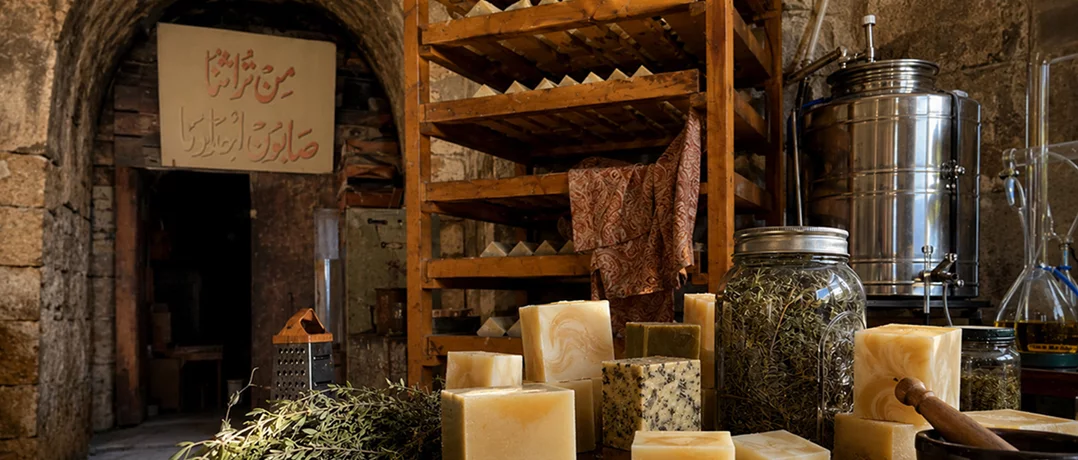
Lebanon's tradition of soapmaking, known locally as Saboun Baladi, dates back centuries, with Tripoli and Sidon emerging as the country's historic centers of production. At its peak during the 18th and 19th centuries, Tripoli was home to hundreds of massabna (soap factories), producing olive oil soaps that were exported across the Mediterranean and earned the city a reputation for quality craftsmanship. While industrialization and economic pressures have reduced the industry to only a handful of traditional producers, the centuries-old craft continues to survive in the workshops of Tripoli's Old Souks, where generations of families are preserving one of Lebanon's oldest artisanal traditions.
The Beiruter spoke with Khan el Saboun and Sharkass Soap, who together carry the weight of Tripoli's identity as one of the Levant's great soap-making capitals, a reputation that predates Marseille's, and one that its own custodians insist has never gotten the recognition it deserves.
A trade born of crusaders, baths, and chemistry
According to Bader Hassoun, CEO of Khan el Saboun, the story did not start with the Khan itself, a trading hall built roughly 500 years ago, but centuries earlier, with the Crusaders who occupied Tripoli during the medieval Crusades. Returning home, their commanders carried back soap, perfumes, and remedies as gifts for European nobility.
Hassoun explained that Europeans at the time avoided bathing almost entirely; the practice was considered taboo, and the resulting skin ailments, eczema, scabies, infections, became widespread. It was this crisis, he argued, that eventually turned Levantine soap, infused with real therapeutic value, into a coveted European commodity. "We became known first for perfume, and only afterward became known for soap," he said. "But soap earned a far bigger reputation, because we were the ones who cured them, the same way we used to treat our own horses and camels." He traced the trade's wealth directly back to that moment: "I can tell you that most of Tripoli's capitalists were, at their root, capitalists because of soap. Our whole history is soap, soap and perfumers." The perfumers, or attarin, doubled as chemists, he explained, "The attar was a chemist. He's the one who made the formula. We just call it kimya, which in Arabic literally means the science of blending."
By the Ottoman era, Tripoli soap had reached the royal court itself. Hassoun references Hurrem Sultan, wife of Suleiman the Magnificent, as a patron of soap from Khan el Saboun specifically. The Mamluks built the Soap Khan in 1480, later expanded under the Ottomans, and Suleiman is said to have received tributes of soap and sugar from Tripoli, particularly ornate "bridal soaps" bundled into wedding trousseaus.
Importantly, Hassoun was adamant that the Khan itself was never a factory. "Khan el Saboun wasn't a factory. Khan el Saboun was a trading center," he said. "The factories were around it, in the surrounding area." It was a caravanserai, a commercial hub where traders tied up their horses at Bab el Baraka, closed deals in ground-floor offices, and slept in upstairs rooms before moving their goods onward the next day. "Traders would come, tie up their horses, sign their contracts in the offices, and go up to sleep in the rooms," he recalled. "By the end of the day he'd have closed his deal, loaded his goods, and left."
Speaking about his presence in the industry, Bader Hassoun said one of the biggest obstacles facing local production is the lack of support and protection. With little institutional backing, he believes survival depends on innovation and adaptability. “The stronger you are in marketing, production, and ideas, the better you can survive,” he explained. For Khan Al-Saboun, preserving tradition means means creating something new while remaining rooted in heritage. “Our strength was creating ideas, producing new concepts,” he said.
But Hassoun sees the workshop’s role extending beyond soap production. A successful business, he argued, creates an entire network of opportunities for its community. “Before I succeed, I create jobs,” he said, explaining that producers support farmers, workers, craftsmen, drivers, and many others connected to the industry.
For him, local businesses are the foundation of society itself. When industries disappear, communities begin to disappear with them. He pointed to Lebanon’s emptying villages as an example, arguing that places survive when productive people create opportunities for others.
As younger generations increasingly leave the country in search of a future elsewhere, he warns that Lebanon risks losing not only its population but also its identity. “The producer is the cornerstone. The foundation,” he said, describing those who continue to create as the people keeping communities alive.
The older rival: Sharkass soap
The Sharkass family, originally from the Caucasus, fled political turmoil and has been based in the Khan since 1803. Mahmoud Sharkass is the seventh generation of his family to practice the same trade in the same building.
Speaking to Reem, a lead soap maker in the Sharkass factory, the craft leans less on grand history and more on a simple, repeated principle. For her, soap-making is chemistry, and chemistry dictates method. "Every formula forces us to work with a different technique than the last one," he explains. She draws a sharp line between a farmer making simple bar soap at home and a chemist working under lab conditions: "There's a difference between someone working in a lab, by scientific, lab-grade standards, and a farmer making his own soap for his household.”
She walks through an example, making a citrus soap entirely from natural ingredients. The base oil, the essential oil, and the distilled floral water all have to be extracted first, each through its own process. From there, she says, olive oil alone won't lather, so a working formula has to be built, almond oil, coconut oil, olive oil, glycerine, calibrated for both lather and a smooth, silky feel on skin. Only then does the mixture go through the actual cooking: what she calls a "semi-hot" process, half air-dried and half heat-controlled over a bain-marie, until the oils visibly begin to saponify, turning creamy, "close to cream" in texture, before being poured into molds, left to sit for roughly 72 hours, and cut.
Asked how the workshop has preserved its traditional methods since 1803, she answered simply: "It's honesty. Honesty is always what keeps things going."
She was equally direct when speaking about the industry's challenges. "The burning costs keep rising," she said, referring to the increasing fuel required to heat the large vats in which the soap is produced. Yet despite rising costs and a shrinking traditional manufacturing sector, the craft continues to be passed down much as it always has. "The father teaches the son. It's inheritance."
That commitment to tradition has not prevented innovation. Sharkass is credited with introducing a distinctive evolution in Lebanese soapmaking. While soap was once produced only as plain white or green rectangular bars, the family's founders began experimenting with different shapes and natural-looking colors, using the same food-grade colorants found in ice cream and confectionery. It was a simple innovation that helped redefine how Lebanese soap was presented, proving that even a centuries-old craft can evolve without losing its authenticity.
Keeping Tripoli's soap heritage alive
Tripoli's soap trade has survived Crusader occupation, Ottoman rule, the decline of its own khans, and decades of regional instability, yet it has never disappeared entirely. Of the many factories that once operated in Tripoli's old souks, only a small number still make soap by hand today. But what remains is a living trade, passed from parent to child, still practiced in the same buildings, with the same base ingredient, by people who see it as inheritance rather than business. Every batch they produce is the preservation of a craft, a family legacy, and a chapter of the city's identity.
-
-

-
Jenna GeageaReporter/Writer
-
