



Lebanon’s olive harvest reveals a living inheritance shaped by family tradition, changing climate, rising costs, and the farmers fighting to preserve it.
The season of the olive trees

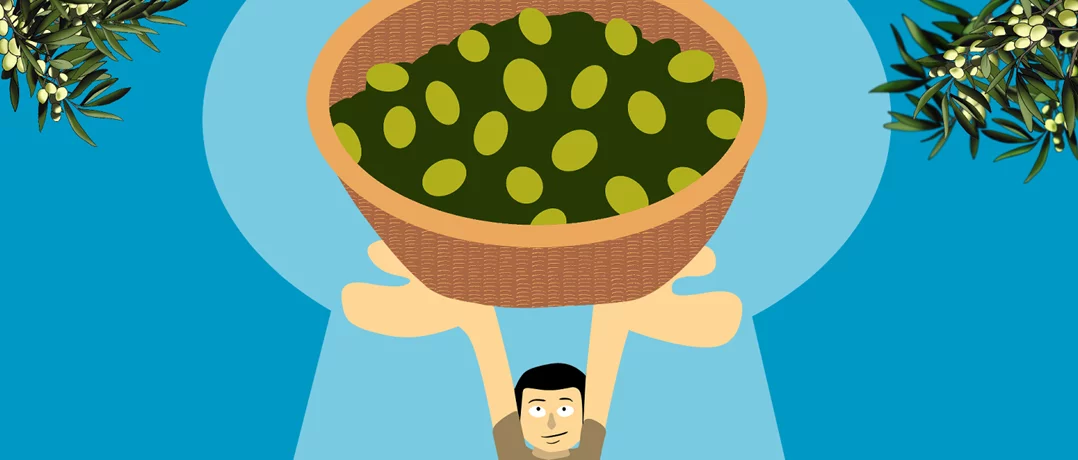
Olive cultivation predates Lebanon itself by millennia, with archaeological evidence placing domesticated olive trees in the region as far back as 3500 BCE. But it's the harvest itself, arriving each year with the first cool rains of autumn, typically between September and November, that has become a national ritual. Families gather in ancestral groves. Nets are spread beneath centuries-old trunks. Neighbors and cousins take turns climbing, collecting, and filling sacks, before the whole group settles into a picnic under the same trees that have anchored their families for generations. It is equal parts labor and reunion.
Lebanon produces an estimated 15,000 to 25,000 tons of olive oil annually, drawing on roughly 400 olive mills scattered across the country, according to figures from the Lebanese Ministry of Agriculture. Fewer than one in ten liters produced is exported, with the rest consumed domestically, fitting, given that Lebanon also ranks among the world's highest per-capita olive oil consumers, at an estimated 3.8 kilograms per person annually according to the International Olive Council, trailing only a handful of Mediterranean nations. Two farmers, a generation apart and working groves in different corners of Lebanon, describe what that inheritance actually requires and what it risks losing.
Elias Antaky, 67 Koura: "You can see history in an olive tree"
For Elias Antaky, who inherited his family's olive grove near Amioun from a father who inherited it from his own, the harvest calendar was never dictated by the month alone. "We don't look only at the calendar. We look at the olives themselves," describing the shift from green to violet that signals a tree's readiness. His father's guiding rule has stayed with him, "don't harvest the olive because you are impatient. Harvest it because the tree is ready."
Antaky learned the craft the way most in his generation did, through years spent trailing his father through the fields, gradually absorbing the rhythm of nets, sticks, and patience. "The first thing you learn is actually patience," he noted. "You plant one and you may wait years before it becomes productive." In his youth, the harvest doubled as the region's defining social event, drawing ten or fifteen people, cousins, neighbors, friends, into a single coordinated effort. "The harvest was work, but it was also social life." That communal structure has thinned considerably; young people are less willing to spend full days picking for a wage, and hired labor now eats into a farmer's margins before a single liter of oil is produced.
Across roughly 600 trees, some old enough that his grandfather remembered them as mature, Antaky has watched the climate itself grow less predictable a shift he considers one of the defining threats to the craft. Flowering season has become more sensitive to sudden heat, and yields swing wildly from one year to the next as a result. Yet for farmers, the arithmetic of profit was never really the point. "For me, producing oil is about keeping the land alive," describing decades-long customers who call ahead of each season simply to ask when the oil is coming. His deepest worry is the loss of knowledge attached to the land. "The younger generation will inherit the land but not the knowledge," he warned. "A field can survive without a farmer for a few years. The craft cannot." His advice to his own children is characteristically direct, “they don't need to become farmers, but the trees should never be sold because one day, they may want to come back."
Karim Saad, 39 Batroun: "Modernizing agriculture isn’t abandoning tradition"
Karim Saad’s path back to the family farm in the Batroun countryside was far less linear. Having built a career outside agriculture, Saad long viewed farming as an obligation his parents' generation had inherited rather than chosen, until his aging father began urging him to "come see the trees," a phrase that eventually revealed itself as a request to take over entirely. What followed, in his words, was a slow obsession.
Saad's early education came from discovering how much he didn't already know. "People sometimes think olive oil is just olives pressed in a machine,” pointing to the dozens of variables, harvest timing, handling speed, storage temperature, capable of undoing a year of careful cultivation in a single afternoon. His operation now blends tradition with selective modernization, nets and hand-picking for older trees, mechanical vibration tools for efficiency elsewhere, though never at the expense of a farmer's judgment. "The machine should help the farmer, not replace the farmer's judgment," he insisted.
His first solo harvest, at 31, delivered a humbling lesson in yield expectations. Since then, Saad has pushed his farm toward quality over volume, harvesting at precise stages, moving olives to the mill quickly, and bottling smaller batches rather than chasing raw output. He views this shift as central to keeping younger Lebanese engaged with agriculture at all. "If you tell a young person, 'come work twelve hours in the field and accept that you will barely make money,' of course they will leave," he argued. "But if you tell them you can build a brand, sell directly to consumers, export it, then the conversation changes." Land pressure compounds the challenge, a grove that represents a century of continuity to Saad looks, to others, like a future construction site.
Despite embracing new tools, Saad pushes back firmly on the idea that modernization means abandoning inherited knowledge. "My grandfather knew which tree needed attention just by looking at its leaves," he said. "I use technology, but I still call my father when I don't understand what a tree is telling me." What he wants consumers to understand, above all, is that a bottle of good olive oil represents an entire agricultural cycle, fairly paid labor, careful timing, and no shortcuts.
An inheritance measured in trees
Antaky and Saad represent two different generations of the same commitment, one preserving a craft passed down from a grandfather he never met, the other rediscovering it as an adult after years spent elsewhere. Both describe a tradition under genuine strain, pressured by shifting climate patterns, rising costs, and a labor force pulled toward easier work. And both, in their own way, resist reducing the harvest to economics alone. For families across Lebanon who still spread nets beneath the same trees their grandparents once climbed, the olive harvest remains a yearly appointment with land, memory, and each other.
-
-

-
Jenna GeageaReporter/Writer
-
