



From the Bird Language to playful word games, Lebanon's secret childhood languages reveal a unique oral tradition that reflects the country's rich linguistic heritage, creativity, and cultural identity.
The secret languages of Lebanon's villages

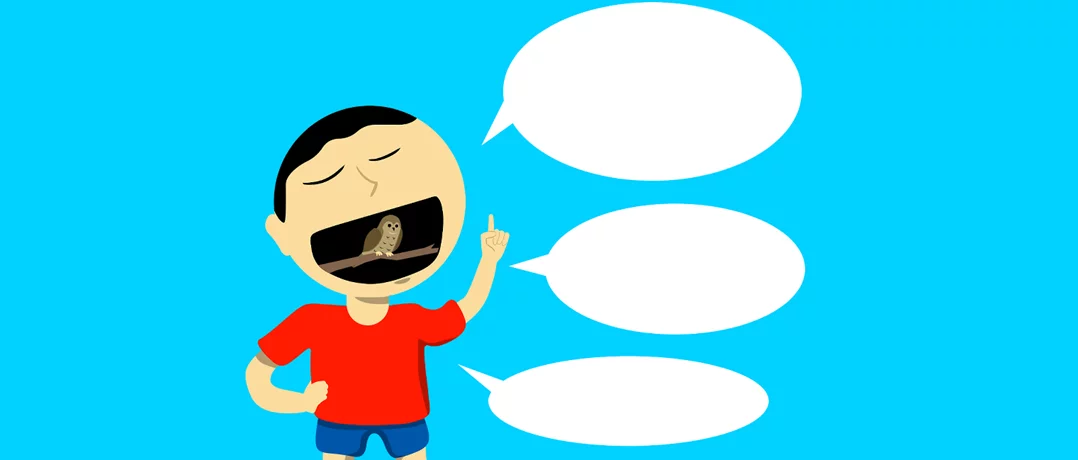
Illustration by Karim Dagher
Lebanon's relationship with language has always been layered. The Lebanese dialect itself is a living archive of Phoenician, Aramaic, Arabic, Turkish and French, accumulated across millennia of trade routes, empires and migrations. But beneath even that rich surface, Lebanese children built another layer still: a set of spoken codes invented not by scholars or kings but by siblings and schoolyard friends, passed mouth to ear across generations, never written down, never formally taught.
The bird language
The most famous of these codes is Loughat al-Asfour, the Bird Language, known to children across Lebanon's villages and city neighborhoods alike. The name captures the effect perfectly: when spoken at speed, it sounds like quick, elaborate birdsong, melodic, patterned, but resisting interpretation by the uninitiated.
The mechanics are deceptively simple. Between each syllable of a word, a fixed sound cluster, typically az, zi, or za, is inserted. The word habibi (my love) might stretch and flutter into something like haz-a-biz-i-biz-i. Said slowly, the original word shines through the gaps. Said at the pace that fluent speakers reach after years of practice, it vanishes entirely into music.
What makes the Bird Language genuinely remarkable is how quickly a practiced speaker could achieve that pace. The goal was always speed, to render comprehension impossible before the listener had time to break the pattern down. Children drilled each other, racing through phrases, collapsing the coding into automatic rhythm. The best speakers could hold full conversations that sounded, to outsiders, like an entirely different tongue. Interestingly, the Lebanese tradition is far from unique in this. Linguists call these systems “ludlings”, playful language games found in cultures worldwide.
Reversals and transpositions
Lebanese children also practiced a range of syllable-reversal codes, where words were spoken back-to-front or had their constituent parts swapped. A two-syllable word would have its halves exchanged; longer words were broken into units and scrambled. The principle is similar to what linguists describe when analyzing, transposition of syllables in normal words, as one of the core strategies human language games use globally.
In Lebanon's mountain communities, where extended families lived in close proximity and the walls between houses were thin, a private code was genuinely useful. Conversations between siblings about things they wished to keep from parents, negotiations between cousins about where to meet and when all of this could take place in the open air without requiring a whisper or a note.
There was also an element of social membership. Language games are used primarily by groups attempting to conceal their conversations from others, but the concealment is as much social as it is practical. Knowing the code meant belonging to a circle.
Insertion games and letter swaps
Beyond the Bird Language and syllable reversal, Lebanese children also played with insertion codes: games in which a fixed sound, sometimes a single consonant, sometimes a whole syllable, was placed after every vowel, or before every consonant, disguising the original word within layers of added noise. These methods belong to, the broader family of language games created by inserting a "code syllable" before the vowel in each syllable, a technique documented from Australia to Brazil to Scandinavia.
Other variants swapped word parts entirely, exchanging the beginning of one word with the beginning of another, a kind of spoken spoonerism applied systematically. These linguistic changes can be layered on top of one another until the ludling becomes ever more complex and harder for outsiders to figure out. The oral transmission of these codes meant that local variants developed. A village in the Chouf might have its own preferred insertion sound, while a neighborhood in Tripoli used a different one. There was no standardization, no authority, only the informal curriculum of childhood, passed between friends.
Play with ancient roots
Lebanon's linguistic creativity did not emerge in a vacuum. The country's spoken dialect is itself an amalgamation of various languages that passed over Lebanon, a result of centuries of cumulative linguistic assimilation. Many words in the Lebanese Arabic dialect today have Syriac roots, along with many Lebanese villages and personal names which have retained their Syriac names. Children inheriting this layered tongue were, in a sense, already accustomed to a language that carried multiple voices at once. Inventing yet another layer was simply the natural next move.
Languages rarely disappear entirely; instead, they dissolve into those that follow them. They leave traces in grammar, survive in proverbs, echo in village accents. The same is true of the secret codes. Even Lebanese adults who can no longer produce fluent Bird Language often retain fragments, a phrase, a rhythm, the memory of the rule, that surfaces when they meet someone from the same village, or when they want to say something in front of their own children that they would prefer not to be understood.
The Bird Language has not vanished. Grandparents still teach it to grandchildren who are curious. The code lives on, now encoded in new media rather than passed mouth to ear. There is something fitting in that persistence. A language invented to be incomprehensible to outsiders has, paradoxically, become a symbol of belonging, proof that the most intimate things a culture carries are not always written in books, but whispered in codes between people who know how to listen.
-
-

-
Jenna GeageaReporter/Writer
-
