



The destruction of Maqam Shamoun al-Safa in Shamaa erased a sacred Lebanese site that had survived nearly two thousand years of history.
The Shrine that outlived empires… until it didn't
The Shrine that outlived empires… until it didn't
By The Beiruter | April 28, 2026

Reading time: 3 min
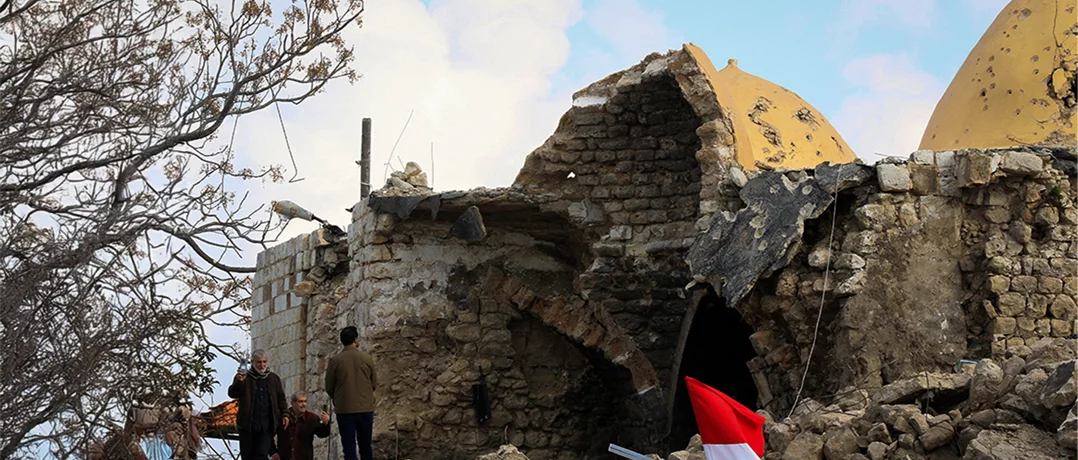
An Israeli airstrike in April 2026 reduced the minaret of Maqam Shamoun al-Safa, in the southern Lebanese village of Shamaa, to rubble, the second time in less than two years the shrine had been destroyed, and the third time in two decades it had been deliberately targeted.
What was lost was not merely stone. Maqam Shamoun al-Safa had quietly outlasted empires.
A tomb at the crossroads of faith and history
The hill of Shamaa has been considered sacred for nearly two thousand years. Archaeological excavations at the site have uncovered building material dating to the first century CE, making the maqam one of the oldest continuously venerated sites in the Levant.
At its heart is a crypt a burial chamber accessed through a circular opening covered with wooden formwork, enclosed within an arcaded room surmounted by four domes. According to local oral tradition and Islamic exegetical scholarship alike, this is the resting place of Simon Peter. In Arabic, Simon becomes Sham’un; the epithet al-Safa, the pure, is the Arabic rendering of Cephas.
Within Shia Islamic tradition, the shrine carries an additional weight that elevates it beyond ordinary pilgrimage. Shamoun al-Safa is held, according to historical references, to be the maternal great-grandfather of the Imam Mahdi the twelfth and final Imam in Shia theology, the divinely appointed figure believed to be living in occultation and destined to return at the end of time to restore justice to the world. That genealogical connection, linking the first apostle of Christ to the eschatological savior of Shia Islam, gives the site a theological significance that is difficult to overstate.
Built by the fatimids, battered by the crusaders
The architectural history of the maqam mirrors the turbulent history of the region itself. The current structure was built or renovated by the Fatimid dynasty in 1097 CE, a date recorded in an inscription preserved within the shrine. That the Fatimids the great Ismaili Shia caliphate of Egypt chose to renovate a site associated with the Christian apostle Peter speaks to a medieval culture of religious coexistence that is easy to underestimate from the vantage point of the present.
The renovation was barely complete when the Crusaders arrived. Following the fall of Tyre in 1124, the shrine sustained damage at Crusader hands, only to be restored during the Mamluk period the dynasty that ultimately expelled the Crusaders from the Levant. An adjacent prayer room was added in 1688, and by the mid-18th century the shrine had become an established stop for Shia religious scholars, among them Yusuf al-Bahrani, one of the most distinguished figures of his generation, who documented his visit sometime after 1750. The maqam had, by then, accumulated nearly seven centuries of continuous institutional Islamic life on top of its older Christian and pre-Islamic foundations.
Occupation, renovation, and the pattern of destruction
The modern history of the shrine is inseparable from the modern history of Israeli military involvement in southern Lebanon. During Israel’s occupation of the south which lasted from 1978 to 2000 the Shamaa citadel, the medieval fortification within whose grounds the maqam sits, served as an Israeli military post. The same hilltop that generations of pilgrims had climbed to seek intercession became, for more than two decades, a vantage point overlooking Tyre.
When Israeli forces withdrew in 2000, the citadel and shrine passed back to the community. Six years later, during the 2006 war, Israeli artillery and missiles struck the fortress’s northern and eastern walls and the shrine itself, causing serious structural damage. Qatar financed a full renovation in 2007, and for a few years the maqam stood restored, a symbol, perhaps, of the region’s stubborn insistence on memory.
Then came November 2024. During Israel’s ground offensive in Lebanon, Israeli forces entered Shamaa, occupied the citadel, and placed explosive charges within the shrine before withdrawing and detonating them. A 900-year-old adjacent medieval castle was brought down alongside it. The grave showed signs of having been disturbed. By November 2025, the local community had begun rebuilding, stone by stone, largely without international institutional support. Five months later, an Israeli airstrike finished what the explosives had started.
What is lost
The maqam had survived the Crusades. It had survived Ottoman rule. It had survived two decades of military occupation and a major war. It held within it building material from the time of the apostles, an 11th-century Fatimid inscription, a prayer room from the Ottoman era, and the living memory of every family in Shamaa who had ever climbed that hill.
What cannot be rebuilt from stone is the unbroken chain of presence the accumulated centuries of people arriving, praying, leaving, and returning. That continuity, once severed, does not simply resume. What endures instead is remembrance without access, and history that can be described but no longer inhabited.
-
-

-
The Beiruter
-
