Meet three of Lebanon's last traditional tailors whose workshops preserve not only a disappearing craft but also decades of family memories, resilience, and the human stories stitched into every garment.




Meet three of Lebanon's last traditional tailors whose workshops preserve not only a disappearing craft but also decades of family memories, resilience, and the human stories stitched into every garment.

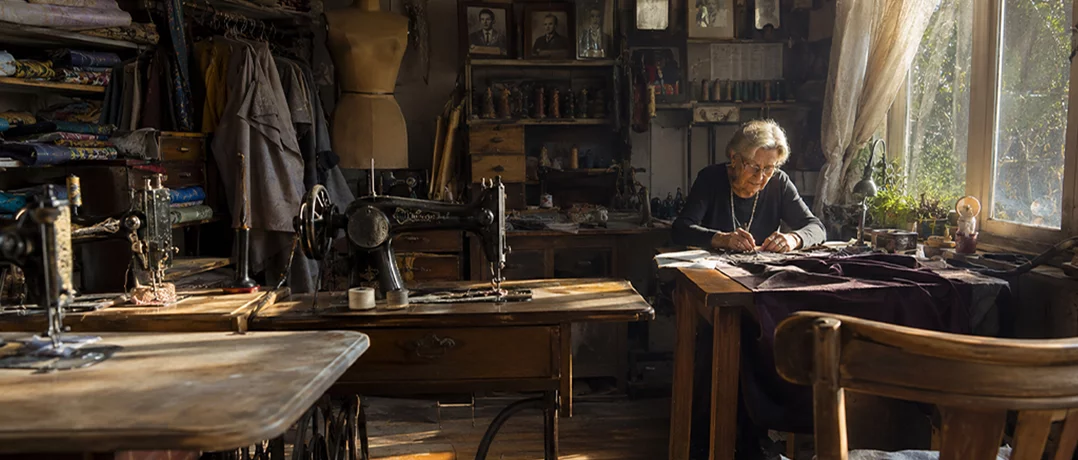
Every Lebanese neighborhood has its tailor: a craftsman who knows every customer's measurement by memory, stitches initials into shirt cuffs, alters wedding gowns, and witnesses the milestones of entire families. Behind a handful of aging sewing machines, Lebanon's last tailors continue to work, preserving not only a disappearing profession but also the intimate rituals of a country that values things made to last. From the streets of Gemmayze to the alleys of Old Zouk and the mountain village of Hasroun, these are the stories of three people whose hands continue to mend far more than clothing.
Fadlo Ghalieh has worked behind the same counter in Gemmayze since 1962. He did not inherit the trade; he apprenticed for it in Souk al-Tawileh in 1958, under a master tailor. Ghalieh was one of the first to sew custom-made shirts, complete with the customer's initials embroidered onto the fabric. Today, only around ten shirtmakers remain.
He trained in wool suit tailoring, all hand stitching, no machines. Speaking to The Beiruter, he recalled, "a jacket front alone required about a hundred stitches,". Within a year his eyes gave out, so he chose shirts instead. He opened his own shop in 1962. When war broke out in 1975, he was spared the worst of the fighting but not its cost. "Foreigners stopped coming," he said. Lebanese customers, he added with a wry affection, "always try to negotiate." Foreign clients never did: "If I tell them it's a hundred dollars, they simply pay it."
More than sixty years on, he still opens the shop every morning, with an assistant to finish each seam by hand "so it won't bother the customer." He never had children of his own, but speaks of his brother's kids as the family he built instead. The hardest part of the job has not changed, the collar, and cutting the pattern, where "one small mistake can ruin the entire shirt."
Ask what he loves about the work, and there's no hesitation. "This profession became part of me," he explained. "I love it with all my heart." And if you doubt how much craft goes into a simple shirt: "Come visit the shop and I'll show you my work."
In Old Zouk, on a corner people simply call "the tailor's," 74-year-old George bou Chaaya sits at a machine that was never meant to be his.
George told The Beiruter that the shop belonged to his wife, someone who "could look at a piece of fabric and already see the dress inside it." Brides trusted her with wedding gowns; mothers brought school uniforms. George would sit beside her in the evenings, watching her hands move. "One day I'll teach you," she used to say.
Eleven years ago, his wife fell ill, faster than anyone expected. Everyone told him to close the shop for good. "I couldn't," he said. "Closing the shop felt like losing her twice."
So at 63, he sat in her chair and opened her old notebooks of measurements and patterns. His first shirt came out crooked; he almost threw it away. Some days he would talk to her as he worked, asking, "Did I do this right?" and somehow still hearing her correct him.
George has watched the neighborhood grow up in front of him: boys returning years later for a wedding suit, families leaving the country with one suitcase, asking only that he take in a jacket they could no longer replace. "Every piece my wife and I have ever done carries someone's story."
"Her scissors are still here," he explained. "Her sewing machine is still here." When old customers say his wife would have known how to fix a thing, he smiles. "She still does." He no longer says he learned tailoring at seventy-three. "I say my wife is still teaching me," he says, "every single day."
High in the north, in Hasroun, 78-year-old Mariam Ishak no longer measures her life in years. "I remember it by dresses," she told The Beiruter. "The dresses I stitched." She was born, married, and raised her only son there, beneath the mountains.
Her son used to stop by the shop each evening. Then the war came, and he left and never came back. "You spend your whole life sewing torn things together," she expressed, "but when my son died in the war parts of me died with him."
After she buried him, she locked the shop for weeks. "I thought, who am I sewing for now?" Then came a knock: a young bride holding lace, insisting no one else could fix her dress. Mariam opened the door. "And somehow," she said, "I never closed it again."
What keeps her going now is the village itself. Some visitors don't need anything fixed at all; they come only to sit and talk. "They leave with a hemmed dress. And I feel happy and grateful." She lost her son, but never the people around her. "Sometimes God takes one family away and gives you another," she said. "It doesn't replace what you've lost though,” she explained.
The future of Lebanon's traditional tailoring is uncertain. Few young people are entering the trade, mass-produced clothing has transformed how people dress, and many of the country's remaining master tailors are now well into their seventies. When they eventually lay down their scissors, the profession risks disappearing.
Yet inside these modest workshops, the sewing machine echoes decades of resilience, loss, love, and patience, reminding us that craftsmanship is as much about the people behind the needle as the garments they create.