Lebanon's native birds are facing growing threats from illegal hunting, habitat destruction and pollution, raising concerns about the future of one of the Middle East's most important migration corridors.




Lebanon's native birds are facing growing threats from illegal hunting, habitat destruction and pollution, raising concerns about the future of one of the Middle East's most important migration corridors.

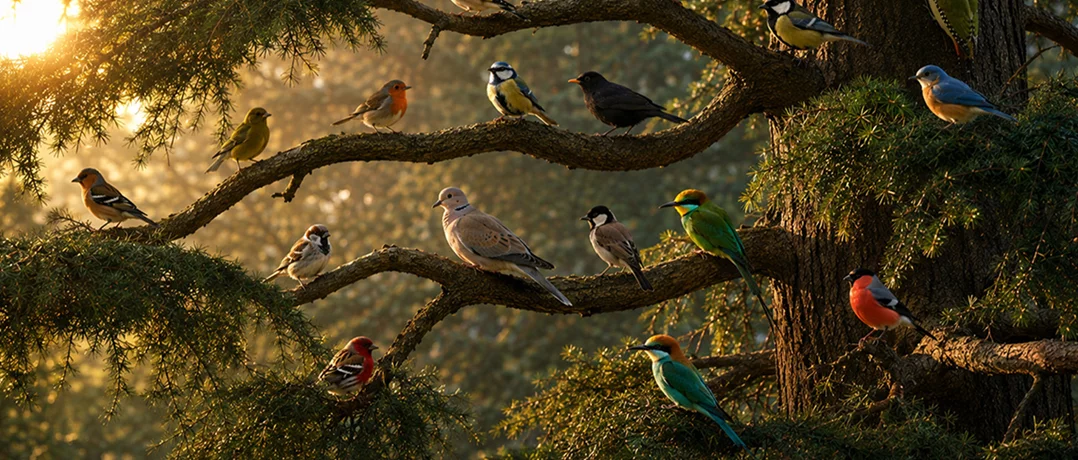
From the sparrows nesting beneath rooftops to falcons soaring above mountain cliffs, birds have always been woven into Lebanon's natural landscape. They inhabit multiple areas, often going unnoticed despite their constant presence. Yet many of the species that have long called Lebanon home are steadily disappearing as illegal hunting, habitat destruction and pollution reshape the country's environment. According to birdwatcher and conservationist Chadi Saad, the problem cannot be reduced to a single cause. "There isn't one factor," he says. "All the factors are coming together against every living creature."
Lebanon's geography makes it one of the most important countries for birds in the region. Its mild climate, abundant water sources, varied landscapes and the short distance between the Mediterranean coast and mountain ranges create ideal conditions for wildlife. More than 60 bird species live in Lebanon year-round, while the country's location between Europe and Africa makes it a crucial migration corridor. Every spring and autumn, hundreds of migratory species cross Lebanese skies, stopping briefly to rest or feed before continuing their journey. Resident species include herons such as the little egret, cattle egret and black-crowned night heron, along with birds of prey like the peregrine falcon, the common kestrel and the short-toed snake eagle. Familiar birds such as the blackcap, known locally as the khoury and shammas, and the rock bunting also remain in Lebanon throughout the year, moving between mountain and coastal areas as temperatures change. Despite this diversity, Saad says Lebanon is becoming increasingly difficult for native birds to survive in.
When asked which bird best represents Lebanon, Saad does not choose an eagle or a falcon. Instead, he points to the ordinary house sparrow. For him, the sparrow reflects something deeply Lebanese: resilience and attachment to home. It lives alongside people, adapts to changing surroundings and remains close to the place where it was born unless survival becomes impossible. At his family home in Hammana, sparrows have nested for generations. "We come and go," Saad says. "We get tired of Hammana, go down to Beirut or travel. They remain in the same place." Although their numbers have declined over the years, the birds continue returning to the same house, generation after generation. "They're more rooted than we are," he adds.
For more than 200 days each year, Saad monitors birds from the Hammana Bird Observatory. Over the years, he has watched countless birds hatch, grow and leave their nests. One story, however, still stands out, for five consecutive years, a pair of short-toed snake eagles nested in Hammana. Each year they raised a single chick, carefully caring for it until it was old enough to leave. The species reproduces slowly, laying only one egg a year, making every successful nest particularly important. Then someone set fire to the tree holding the nest "we lost these birds in Hammana," Saad says. "Today they only pass through. They are no longer resident." A similar fate befell another nesting species, the long-legged buzzard. Construction began beside the cliff where it nested, forcing the birds to abandon the site entirely. For Saad, these stories demonstrate how quickly decades of natural behaviour can disappear through a single human action.
Some birds that once bred in Lebanon have already vanished as resident species. Saad says both the griffon vulture and the Egyptian vulture no longer breed in Lebanon and are now seen mainly during migration. Other birds continue to decline chukar partridges are heavily hunted, while blackcaps are frequently shot despite their small size. Peregrine falcons are often targeted whenever they are spotted, even though they can live in Lebanon throughout the year. One of the species that worries Saad most is the Syrian serin, a small finch found only in Lebanon and neighbouring countries. With fewer than 10,000 individuals believed to remain globally, it is still hunted and trapped for trade.
For Saad, the biggest threat remains illegal and indiscriminate hunting. He argues that modern hunting has moved far beyond obtaining food. Many birds are shot simply for photographs or trophies before being discarded. The white stork is one example. Throughout Europe, the bird is valued for helping control insects, snakes and other agricultural pests. Yet when it crosses Lebanon during migration, it is frequently shot. The consequences extend beyond Lebanon's borders. Every migratory bird killed removes a natural pest controller from the countries where it would normally breed and feed, increasing dependence on pesticides and disrupting ecosystems. Saad's views are shaped by personal experience. "I was a hunter," he says. "I thought I was protecting nature. Then I realised I was committing crimes against it." He believes hunting laws already exist but are rarely enforced strongly enough to prevent widespread illegal killing.
Hunting is only one part of a much larger problem. Saad points to widespread habitat destruction as another major threat. Wetlands are drained, forests are cleared, wild trees are cut down and mountains are increasingly covered by poorly planned development. Pollution adds another layer of pressure. Sewage, industrial waste, rubbish, smoke from factories, vehicle emissions and the burning of waste all damage ecosystems that birds rely on for food and nesting. He also warns against introducing non-native species into Lebanon's ecosystems.One example is the common myna, a bird imported through the pet trade because of its intelligence and ability to mimic human speech. After many were abandoned, they established wild populations that now compete with native birds for food and nesting sites.
Saad believes people often underestimate the role birds play in maintaining healthy ecosystems. They control insects and rodents, disperse seeds and help maintain the balance between species. Losing even common birds can trigger changes that ripple through forests, farms and wetlands. "There is nothing in this universe," he says, "not an insect, not a plant, not a bird or an animal, that doesn't have a role in maintaining the natural balance." Lebanon's native birds are more than beautiful wildlife. They are indicators of the health of the country's environment. As habitats disappear and hunting continues, the loss extends far beyond individual species. It is a warning that the ecosystems supporting both wildlife and people are becoming increasingly fragile. Protecting Lebanon's birds, Saad argues, ultimately means protecting Lebanon itself.
