



Lebanese DJ Chloe Barakat, known as KLO, shares her journey from violin and architecture to international dance floors, mentorship and music education.
The world of Lebanese DJ KLO

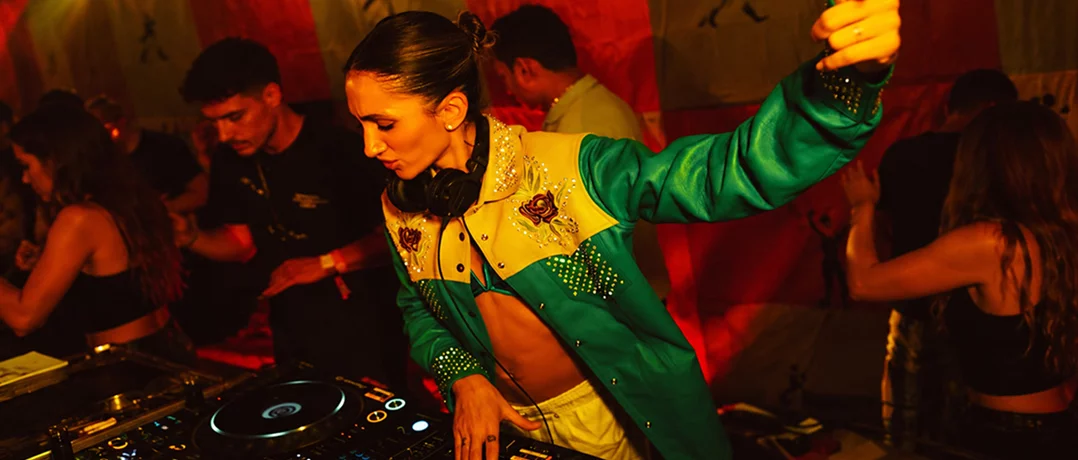
Long before she was mixing house sets across London, Dubai, and Beirut, Chloe Barakat, known to audiences as KLO, was a 12-year-old discovering herself through violin lessons. Music, even then, was part of her life. It just took another decade, a move across three cities, and an emotional journey behind the decks that made her who she is today.
From architecture to the decks
Barakat's path into DJing started almost by chance. "At 14 I started tapping into DJing. I was inspired by a movie and I was curious about this art," she recalled, though she admitted she wasn't serious about it yet. The real turning point came years later, while she was studying interior architecture, a demanding field she described as intense and rule-bound. DJing became her outlet. "It was kind of my healing, my passion, like my escapism," she said. "This medium was helping me escape a bit when I want to escape."
What began as a release slowly became a career. She started playing gigs around Lebanon, building her name organically, before relocating to London to formally study music production and sound engineering. There, she built a network, played in clubs, and threw her own parties. When a gig booking flew her to Dubai, the city immediately won her over. "The moment I stepped into the city, I fell in love with it," she said. She's now been based there for three years.
Barakat is candid about how differently the craft operates across the markets she's worked in. London and the broader European scene, she explained, pushed her toward underground music and deeper genre research, driven by a larger, more specialized audience. Dubai's scene, by contrast, is built around community, where music, fashion, and lifestyle blend together rather than existing in separate lanes. That overlap has shaped her own public presence: alongside her sets, she's collaborated with fashion brands including Sandro, crediting her mother, whom she calls her “stylist and biggest inspiration for cultivating my sense of style from an early age.” Her core genre remains consistent across both scenes, house music, which she describes as inherently feminine as an art form, built on emotional storytelling within a set rather than simple track selection.
Finding her voice in a male-dominated industry
Working as a woman in DJing, Barakat described a genuinely mixed experience. On one hand, she's found herself inspiring other women to step outside their comfort zones and pursue an unconventional career. "A lot of women approach me for that, and I'm really grateful for it," she said. On the other, she's felt the industry's imbalance directly. "Not everyone takes you seriously in the industry, and obviously it's male dominated," she said, noting that men in the same clubs she works in often avoid the scrutiny or pushback she receives over the same creative decisions. "It's very hard to voice yourself if you're not really assertive."
The most difficult obstacle Barakat has faced was profoundly internal. Describing herself as an anxious person by nature, she recounted experiencing a panic attack in the middle of a set, and having to keep performing regardless. "I had to play for a whole night, six hours, while experiencing a panic attack and having anxiety after it," she said, "while keeping a smiley face on, while trying to entertain people at the same time." She credits that night with reshaping her relationship to self-doubt going forward. "What's the worst? Okay, you have anxiety, you go through this, but you still stood strong," she said. "This will always be my reference point if I ever doubt myself." She says she's since grown considerably more confident, though the underlying anxiety hasn't disappeared entirely, she's simply learned to work through it. "You have to put the mask on and play, because at the end of the day, you're handling a night."
From DJ to mentor
Among her proudest milestones, Barakat points not to a specific stage but to teaching. In May 2025, she hosted her first DJ workshop, converting a studio into what she describes as a cozy creative space for aspiring students. "My whole purpose is being part of a community, passing on my experiences, my knowledge," she said, a mission she's since continued in Dubai through initiatives introducing open-deck sessions and pop-up sets in unconventional locations, aimed at giving newer DJs a lower-stakes way to gain performing experience. Among her most memorable performances, she cites a recent set at a Palestinian wedding in Croatia, which she says connected her back to her Arab identity in a way few other gigs have.
Looking ahead, Barakat's ambitions extend beyond performing. She hopes to keep expanding her brand collaborations and her community of students, with an eventual goal of opening her own music school, a space to consolidate everything she's learned across London, Dubai, and Beirut into a single institution built for the next generation of DJs.
From a young violin student to a rising name across three continents' worth of dance floors, Chloe Barakat's journey is a series of genre shifts, architecture to music, anxiety to confidence, student to teacher. If her ambitions hold, the next chapter may not merely be a set, but a classroom as well.
-
-

-
Jenna GeageaReporter/Writer
-
