



Providing free haircuts, a trio from Khaldeh, Baalbek, and Saida are restoring more than hair, they’re bringing back a sense of self for the displaced during difficult times.
Three barbers, one purpose: Making people feel human again
Three barbers, one purpose: Making people feel human again
By Rayanne Tawil | April 12, 2026

Reading time: 4 min
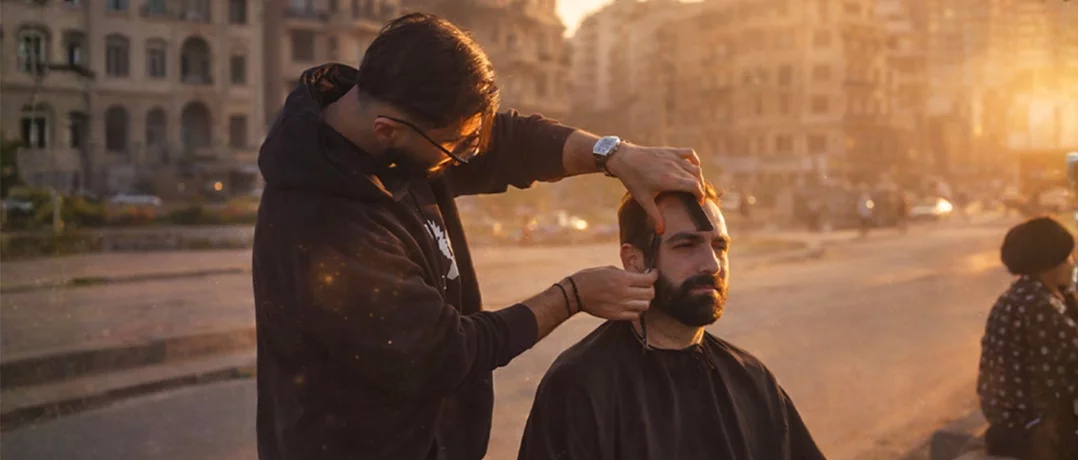
“Even if it’s just a haircut, it makes them feel like themselves again.”
By late morning, the chairs are already taken. Not salon chairs, just plastic ones, mismatched, donated, dragged from nearby corners by strangers who decided to help in the only way they could.
Every day, Daniel Zaiter makes the drive from Wadi Zayneh, a village north of Saida, to Beirut. He doesn’t come for work, at least not the kind that pays. Instead, he meets Karim el Hajj and Mohammad Issa, and together, the three set up a makeshift barbershop in areas like Ain al Mreisseh and Biel, where displaced families now live in limbo.
They cut hair for free, men, boys, girls, anyone who sits down.
A chair, a clipper, a moment
Someone asks, “Who’s next?” A child at the chair begins to fidget before he finally sits still when the clippers start to operate. The area has people gathered waiting and some stand while others watch.
Issa, a 38-year-old street photographer from Baalbek, moves from one conversation to another, observing as well as participating in taking pictures and cutting hair. The original concept developed into a larger daily project that the three friends created.
They don’t just show up; they stay.
“We spend our days among our brothers and sisters,” he says, as if this rhythm has always been part of his life. Then he adds that their focus is often on the children. The goal isn’t just a haircut. It’s a distraction and a relief. A break from the weight of everything happening around them.
They create an atmosphere where kids can laugh again, even briefly. Where a routine as small as a trim feels like a return to something stable. With unpredictability everywhere, routine itself becomes somewhat of a haven.
More than a haircut for the people
El Hajj, 23, had plans before all of this. He had everything required to start his own barbershop: the equipment, his business plan and built up his operational capacity. Then everything stopped.
Now, instead of opening doors, he works out in the open air. “I decided to help my people,” he says, shrugging slightly. “If it’s not something material, it can still change their mentality.”
What these three are offering isn’t just grooming. It’s psychological. Emotional. A reminder that self-care still matters, even now.
People don’t always ask for much. Sometimes, they just sit down and say nothing. Other times, they talk. About where they came from. About what they left behind. About small, strange details like missing their barber, or how their hair has grown too long because life got in the way.
Zaiter listens as he works, his hands solid, his movements practiced. After seven years of cutting hair, he now experiences a different feeling. The process takes more time while its results become more demanding. The wordless message he delivers shows that he believes every haircut establishes a narrative connection.
The quiet power of showing up
At first, the trio weren’t sure how people would respond to their initiative. On the first day, they set up beside people already sitting on the street. Then, slowly, people gathered. By the second day, they didn’t need to call anyone over; people recognized them. Word spread, faces returned.
They currently perform daily haircuts, which range from 25 to 30 customers, but they sometimes exceed that number. There’s no formal system for what is happening, no sign-up sheet, just the presence of the people.
Zaiter had stepped away from work shortly before the war began, planning to rest. Instead, he found himself pulled into something else entirely. He expresses a feeling of pride that he cannot fully explain in his own words.
He talks about love instead of how much of it he feels here, how it moves between people without needing explanation. How strangers become familiar in the span of a haircut. Even the setup itself is a collective effort. Chairs appear. Tables are offered. Someone brings something small, then someone else adds to it and no one asks for credit.
Holding on to normal
Upon completing the haircut, there would be a moment when the person looks at themselves in the mirror with a new haircut. A cleaner line, a fresh fade and a sense of being put together again.
The moment holds great significance for people who faced home loss and disruption of their daily lives and stability. The matter is not about vanity; rather, it seeks recognition. Seeing yourself, not just as someone displaced, but as someone still whole.
“Even if it comforts them a little,” Zaiter says. “Even reaching 75 percent is enough.”
Issa, standing nearby, nods in agreement. The message to him requires only two things: people must have patience and stick together hand in hand, because he believes that without these two things, progress will not happen.
And so they keep coming back. From Khaldeh. From Baalbek. From Wadi Zayneh.
Different roads, same destination.
A small act, a big echo
As soon as the light starts wavering, they start preparations to leave and all chairs with the previous seating get taken off.
But something stays. A lighter step. A child running off, freshly groomed, smiling at nothing in particular.
Tomorrow, they’ll do it all again, not because they have to but because they’ve chosen to.
And in a moment where so much feels out of control, that choice to show up, to give, to care becomes its own kind of resistance. A reminder that even the smallest gestures can carry people through, even something as simple as a haircut.
-
-
-
Rayanne TawilCultural writer
-
