



At Azal Heritage, over 60 photographs from the Mohseen Yammine collection revisit the work of pioneering Lebanese photographer Marie El-Khazen, curated by Yasmine Nachabe Taan and Georgia Makhlouf.
Under Ehden’s stone vaults, Marie El-Khazen comes home
Under Ehden’s stone vaults, Marie El-Khazen comes home
By Rayanne Tawil | October 02, 2026

Reading time: 6 min
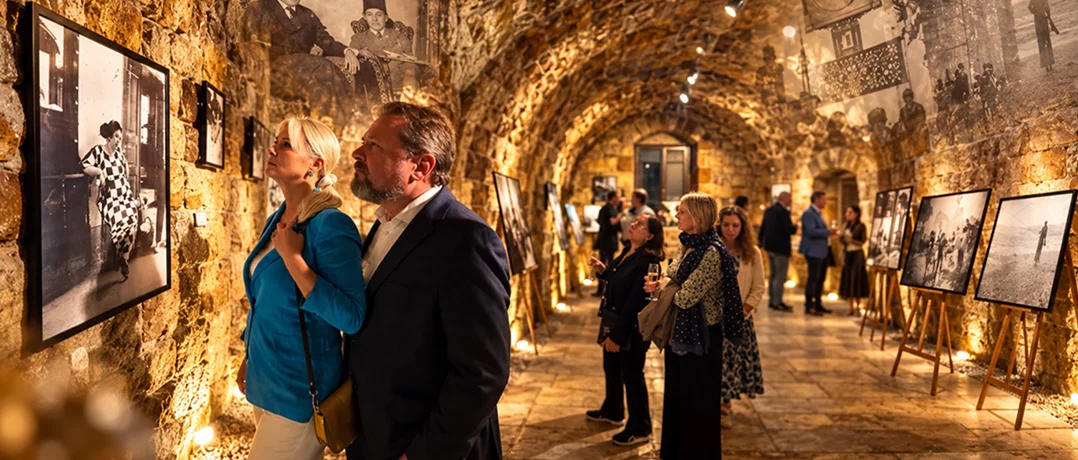
Under the cross-vaults of the old stone building, rough blocks of honey-colored stone rise into the ceiling, their uneven surfaces picked out by small lights. Along the walls, black-and-white photographs introduce another Lebanon: families gathered indoors, women dressed for the camera, early cars, rural landscapes, travel and faces from a century ago.
This is the setting for “Marie El-Khazen (1899–1983): A Pioneer Lebanese Photographer,” which opened September 25 at Azal Heritage in Ehden. The exhibition brings together over 60 photographs from the Mohseen Yammine collection, returning El-Khazen’s work to the northern landscape closely connected to her life.
Curated by Dr. Yasmine Nachabe Taan and Georgia Makhlouf, the exhibition was organized through the Institute of Art in the Arab World at Lebanese American University, in collaboration with the Arab Image Foundation and the Arab Institute for Women at LAU.
A woman behind the camera
Yasmine first encountered El-Khazen’s photographs online through the Arab Image Foundation over a decade ago. The images eventually became the subject of her PhD research at McGill University.
“I was immediately struck by how different they were from the images I had encountered of Lebanese women and Lebanese society in the early twentieth century,” she says.
Her research focused on what the photographs reveal about the ways people, particularly women, were negotiating modernity in Lebanon during the 1920s and the French Mandate.
Women appear driving cars, smoking cigarettes, travelling, hunting and participating actively in social life, while remaining connected to family, landscape and tradition.
Yasmine describes this as “a much more complex and locally produced modernity.”
A history outside the usual frame
For Yasmine, El-Khazen’s significance extends beyond her position as an early woman photographer. Her photographs provide a way of looking at history through ordinary life.
“I believe that Marie’s photographs give us the possibility of teaching history differently,” she says.
They allow us to move away from a history constructed only around political events, political leaders and major historical moments, and instead look at everyday life — at how people lived, socialized, travelled, dressed, played and imagined themselves.
“Her archive therefore gives us an intimate view of a northern Lebanese community which is rarely visible in conventional histories of photography, which have often focused on professional photographers and urban centers,” she adds.
The collector who knew her
The exhibition also carries a personal connection through Mohseen Edmond Yammine, whose collection preserves a significant portion of El-Khazen’s photographs.
“The images of Marie al-Khazen represent a large portion of my collection of photographs, which began in my youth,” he says. “Collecting all possible information about their owner means a lot to me, personally and as a researcher.”
Yammine first met El-Khazen in 1982 at the Khazen family mansion in Tallet al-Khazen in Zgharta, while taking his own first photographs. He was struck by discovering that the 83-year-old was still developing photographs herself.
“Marie al-Khazen stands out among all professional and amateur photographers whose work I managed to access, due to my closeness to her,” he says.
During subsequent visits, Yammine asked to see the photographs she had kept from her box camera. She eventually gave him part of the collection, allowing the images to move beyond the family archive and into public view.
A camera that followed her
El-Khazen photographed extensively around her home and beyond. Yammine recalls images from Beirut, Beirut Airport, Baalbek Citadel, Al-Ma'amaltein, Zgharta and Ehden, alongside visitors to the family villa, farmers and laborers working in the fields.
“The first thing Marie did was photograph every movement and stillness in their mansion in particular, before directing her lens toward her surroundings, the people, and the place,” he says.
Her camera was a permanent companion, capturing through it everything she saw on her travels and visits.
For him, the fact that these photographs were made by a woman adds another layer to their significance. They preserve details of a changing Lebanon through a perspective formed within the community itself.
Why Ehden matters
Bringing the collection to Ehden gives the photographs another context. The exhibition is taking place within the northern landscape that El-Khazen knew and photographed, close to the community from which her story emerged.
“Bringing the exhibition to Ehden is deeply meaningful because these photographs come from this landscape and from this community,” Yasmine says. “Returning them here creates a different relationship between the archive and its audience.”
For Georgia, the move also addresses Beirut’s dominance in Lebanon’s cultural life.
“I am very happy that this exhibition reaches out to a new audience and is seen by people outside of Beirut,” she says.
Most cultural events take place in the capital and to take the exhibit to other parts of Lebanon and soon, outside Lebanon hopefully, is very important to us.
She adds that it is especially important to bring El-Khazen’s work to her hometown, where “very few people have heard about her.”
Here, an archival photograph can become something more immediate: a recognizable landscape, family, building or way of dressing.
Playing with identity
One photograph remains particularly important to Yasmine: El-Khazen and her sister wearing European men’s suits and tarboush, holding cigarettes beneath a portrait of their father.
Yasmine devoted a chapter of her 2020 book “Reading Marie al-Khazen’s Photographs” to the image.
“The photograph is fascinating because it brings together things that we tend to separate: European clothing and the traditional tarboush, women and men’s dress, modernity and local identity,” she says.
Across the archive, she also sees staged scenes, costumes, unusual shadows and apparent experiments with double exposure.
“The more closely you look at Marie’s photographs, the more you realize that she was not simply documenting reality,” Yasmine says. “She was also playing with photography, with identity and with performance.”
Georgia hopes that same independence will resonate with younger generations.
“I hope the audacious personality of Marie, her artistic talent, her desire to live the life that she chose to live and not to be imprisoned by traditions, will inspire younger artists,” she says.
A collection still speaking
Yammine believes bringing these photographs back into view is ultimately about ensuring El-Khazen receives the recognition he believes she deserves.
“All I wish to show through her displayed photos is that she receives the recognition she deserves as a pioneer in the field of photography,” he says.
The collection has already travelled from Yammine’s personal connection with El-Khazen to exhibitions through the Arab Image Foundation, first in Beirut and now in Ehden.
Inside Azal Heritage, the photographs now sit beneath the old stone vaults, where visitors move between images of a Lebanon that has changed and details that remain familiar.
-
-
-
Rayanne TawilCultural writer
-
