



A look at how one photographer’s shifting relationship with the camera reflects photography’s evolution from documenting reality to questioning what is real.
War, fashion, and reconciliation in photography
War, fashion, and reconciliation in photography
By Jenna Geagea | August 25, 2026

Reading time 4 min
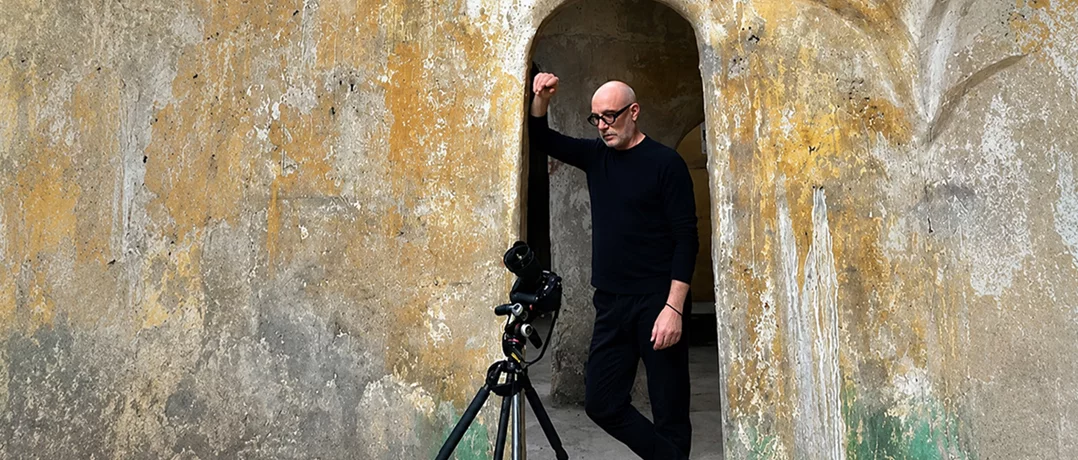
The photographs of Roger Moukarzel have moved from Beirut's civil war frontlines to Parisian fashion runways, from a Druze-Maronite reconciliation project to a tribute built from the debris of the Beirut port explosion. What connects the work is an instinct he describes as constant across every genre he's touched, quick, unposed, and unwilling to look away.
The Beiruter spoke to the photographer to understand the depth and meaning behind his different types of work.
War photography
Moukarzel’s photographs across international agencies captured the human impact of war on Lebanon. His subject was whatever surrounded him. "I was very young when the war started," he recalled. "So I photographed the war around me, in my own environment, between Beit Chabab and wherever I happened to be. And I became a war photographer."
What that meant, in practice, was documenting the full texture of a country in conflict, soldiers stationed at makeshift checkpoints behind heaps of sandbags, the wreckage left behind by shelling and street fighting, the wounded and displaced, and the human moments that persisted even inside the chaos, a soldier resting, a neighborhood going about its routines between rounds of violence. Moukarzel was known for capturing the pauses within the destruction, the brief instances of calm or human kindness set against a backdrop of rubble and blockades.
This kind of photography demanded a discipline that left no room for hesitation. "You had to be very quick. You had to anticipate. And you had to be technically precise," he explained. Shooting on film meant every frame carried real consequences. "If your technical skills weren't good enough, you could come back with a photograph that was completely burned out or unusable." The process itself was slow and unforgiving. "It wasn't a digital world like today," he noted, the images were shot, carried back to the office, developed, printed, and sent out, with no opportunity to review or correct a shot in the field.
Years later, reviewing archived slides from this period, Moukarzel noticed something he hadn't fully recognized in the moment: even his war photographs, images of checkpoints, wreckage, and soldiers, were composed with a deliberate, almost stylized framing. "I realized that even my war photographs had been framed in a very particular way, almost like fashion photography," he said. It was an early signature of the eye that would later define his work in an entirely different industry.

Fashion photography
Fashion photography redefined carried a sense of urgency in the process. "I became what I would call a fashion warrior, because I approached fashion the same way I had approached war photography," he said. "I was quick. I was condensed. I was very straight to the point. I didn't waste time sitting around saying, 'let's try this, let's try that.' I worked with the same instinct and urgency."
That approach translated into images shot from unusual, inventive angles, often unposed and captured in motion rather than staged, closer to documentary photography than the meticulously art-directed conventions typical of high fashion at the time. Models, including Naomi Campbell, reportedly found the style unusual at first before embracing its rawness. In Paris, this technique became known within the industry as "Reality Pictures", spontaneous, immediate, and visibly influenced by the same reflexes Moukarzel had developed photographing conflict years earlier.
The documentary book
Among Moukarzel's most significant projects is a documentary book, referred to by Moukarzel as Three Portraits, and elsewhere published under the title Trait/Portrait, photographing Druze and Maronite communities across Lebanon's mountains. The project's purpose, in his words, was to use photography to reveal a truth obscured by sectarian division, that beneath differing religious identities, the two communities shared far more than they were typically credited with. "Photographing the Maronites and Druze in the mountains was very interesting to me, and visually, it was extremely important," he said.
The project began during the war itself, though its full realization waited years. "At the time, I was living through the war. I would see these people, but I couldn't stop and photograph them," Moukarzel said. "I would see the elderly men and observe how they lived, but I wasn't able to stop."
After four years in Paris, he returned to Lebanon in 2002 and revisited the project, turning it into a full art initiative. He credited access and trust within both communities to key collaborators. "May Sheikh Khaled Zaeiter rest in peace, he helped me with the Druze community. The Maronites also helped me, and I was able to bring the two communities together for the project," he said. "I created this book, which is a unique book about the Druze and Maronites in the mountains."
Its reach, according to Moukarzel, extended well beyond gallery walls and bookshelves. "At one point, the book even reached the President of the Republic," he said. "Someone went to the president and said, 'If we can bring them together in a book, why can't we bring them together in real life?' It became a beginning for a relationship between the Druze and Maronites." Whatever its precise political impact, the project stands as one of the clearest examples in Moukarzel's catalogue of photography deployed with explicit reconciliatory intent and a documentary commitment to showing what was actually true, rather than what division assumed to be true.

On AI and the coming return to analog
Asked about artificial intelligence's growing role in photography, Moukarzel, an early adopter of digital photography in the Middle East despite criticism at the timemdidn't dismiss the technology, but drew a sharp distinction between using a tool and losing a craft. "AI is still at the beginning of its era. It is a tool, but it is a very disturbing tool... Today, you don't necessarily need a camera anymore. You need a computer. And that's where the problem will come."
His concern centers on the erosion of a clear line between the documented and the fabricated. "It's not the tool itself that bothers me. It's the question of truth." He predicts the disruption will eventually drive photographers back toward analog processes and negatives as a way of proving authenticity, a shift he sees as already beginning, and one that mirrors his own current pivot toward gallery and exhibition work centered on materials and process rather than commercial output alone.
Photography as art
War photography, fashion photography, and documentary reconciliation work are rarely spoken of in the same sentence, let alone treated as a single continuous practice. One is built on urgency and survival, the second on image and desire, the third on patience and trust. Yet across Moukarzel's career, the three genres reveal themselves as far less distinct than they first appear, each shaped by the same underlying instinct, just aimed at different ends.

-
-

-
Jenna GeageaReporter/Writer
-
