



Lebanon's cancellation of the 2026 Baccalaureate raises major questions about university admissions, educational equality, and international recognition.
What happens to students after the Baccalaureate is cancelled?
What happens to students after the Baccalaureate is cancelled?
By Jenna Geagea | June 25, 2026

Reading time: 4 min
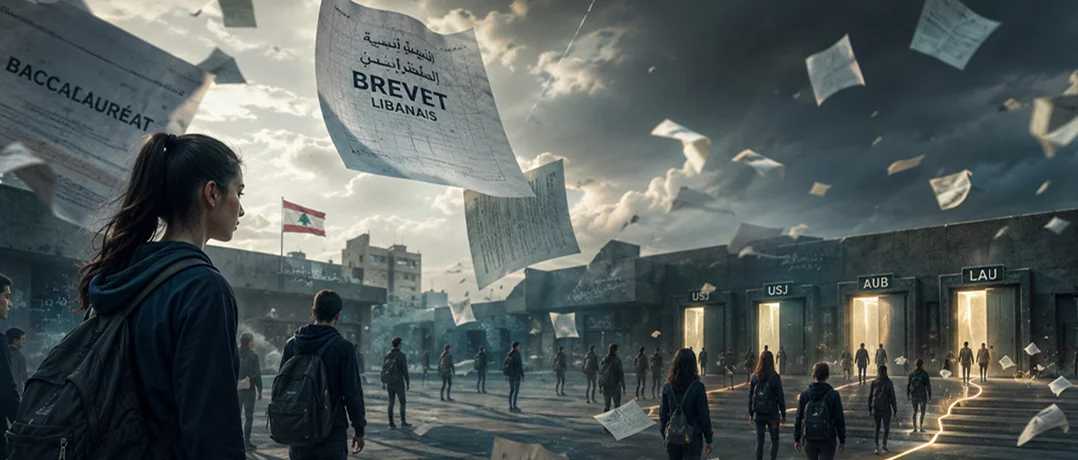
As of June 25, 2026, the Lebanese Cabinet has extended the exam cancellation policy from the Brevet all the way up to the Baccalaureate, the school-leaving certificate that is legally the gateway to university in Lebanon. School grades will now replace the official exams for both the school certificate and the technical baccalaureate.
This is a different order of magnitude from what had been announced in May. Until today, the official baccalaureate exams were scheduled to take place over three sessions, on June 29, July 27, and September 7, 2026, with each candidate having the opportunity to attend two consecutive sessions. The minister had explicitly resisted a full cancellation, emphasizing the importance of preserving the value of the official certificate and not moving toward its complete abolition. That position has now been reversed by Cabinet, over the ministry's head.
This pattern has a precedent. In a remarkably similar sequence in 2022, the Lebanese Cabinet canceled the brevet certificate in a surprise move just before its scheduled date, a decision that "confused the Education Ministry, students and schools." The then-minister had warned against the move, saying "the number of supervisors and correctors is secured, the logistical arrangements are in place and the funding is available."
The scope of the problem
About 42,000 students were registered for the Baccalaureate exams across public and private schools. These students were preparing for what is, in Lebanon's legal framework, the single most consequential credential of their academic lives. Admission to higher education institutions is based on the Baccalauréat libanais, making it not just an exam but a legal prerequisite for university entry. Now, each of those 42,000 students will carry a school-issued grade rather than a nationally standardized certificate.
What universities now face
Lebanese universities are in uncharted territory. Institutions like AUB already hedged against this possibility by weighing high school grades heavily, AUB's admission is competitive and equally based on high school averages in grades 10 and 11 (50%) and SAT scores (50%). That model is actually better suited to absorbing this change than a purely exam-dependent one.
But the Lebanese University, the country's only public institution, has no such flexibility. Its framework explicitly requires student marks in the baccalaureate certificate for first-year students, or marks in the competitive entrance exam. It will now have to determine how to handle hundreds or thousands of applicants presenting school certificates of wildly varying reliability.
The deeper problem is comparability. Public schools in Lebanon follow the grading scale set by the Ministry of Education, while private schools might have the autonomy to implement their own grading scales, especially those following international curricula such as the IB or British GCSE and A-Levels. Without a common yardstick, universities comparing applicants from a well-resourced private school and a war-affected public school in the south are not comparing like with like.
The international recognition crisis
For students hoping to study abroad, today's decision is potentially the most damaging element. The Lebanese Baccalaureate already required a foundation year at institutions like the University of Manchester, which only considers students with an overall grade of 16/20 or higher, with a minimum of 16/20 in Mathematics and Physics, for its Science and Engineering with an integrated foundation year. A school-issued certificate replacing a national exam is a different credential entirely, one that foreign admissions offices have no framework to evaluate.
The broader regional picture adds context. Exam boards Cambridge, Pearson, and Oxford AQA confirmed that in Bahrain, UAE, Kuwait, and Lebanon, IGCSE and A-level exams for the May/June 2026 series had been canceled, with students to be graded via school-submitted work and teacher assessments. Those boards, however, have established protocols for alternative grading in conflict zones. Lebanon's Lebanese-track students have no equivalent international body advocating on their behalf.
The inequality that gets locked in
The cancellation of the Baccalaureate, unlike the Brevet, directly determines who enters university and at what level. When school grades substitute, the existing gap between Lebanon's educational tiers becomes permanent and uncorrectable. Lebanon's 73% private school enrollment exposes a collapsing public education system and growing inequality across communities, and private-sector subsidies have exacerbated rather than reduced education inequality and failed to improve access to education for low-income households.
A student from a private school that grades generously and has strong university counseling is in a categorically different position from one in a public school in the south that spent part of the year as a shelter for displaced families. Both will now present "school grades" to university admissions offices. But those grades will not mean the same thing, and without the exam to correct for that difference, there is no mechanism to find out.
What happens now
The most urgent practical questions are: Will universities announce explicit policies for interpreting school-grade Baccalaureate credentials? Will the Ministry of Education set standardized grading criteria, or leave schools to set their own? Will a September makeup session remain available for students who want to sit a national exam independently? And critically, will foreign institutions offer any structured pathway, as France's ministry did for French-track students?
Today, nearly 42,000 students find
themselves in a system that has removed the national benchmark. For many, years
of work now rest on grades that universities and foreign institutions may
interpret very differently. The question is: what steps will the Ministry of
Education and the government take to protect the futures of the 42,000 students
now left to bear the consequences of its absence?
-
-

-
Jenna GeageaReporter/Writer
-
