From “kansalet” to “ballakne,” Lebanon’s everyday speech reveals how English words are being reshaped through Arabic grammar, pronunciation, and identity.




From “kansalet” to “ballakne,” Lebanon’s everyday speech reveals how English words are being reshaped through Arabic grammar, pronunciation, and identity.

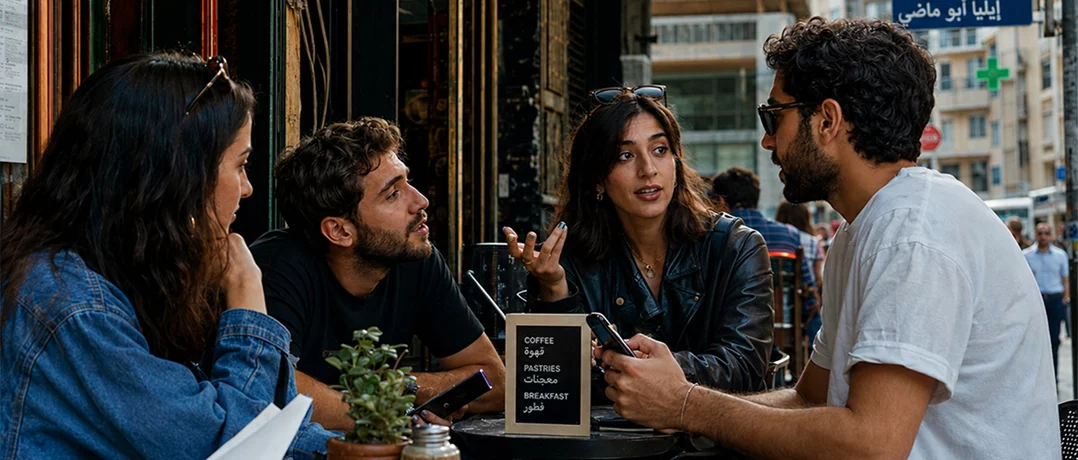
Lebanese conversations often sound confusing to outsiders.
“Charrajet l telephone?” “Ana mdapras.” “Sayyav l file.”
To most Lebanese people, however, these sentences sound completely normal. They are part of a way of speaking so common that many barely notice it anymore: the constant blending of Arabic and English into a hybrid form often referred to as “Arabinglizi.”
At first glance, it may sound chaotic or improvised. Linguistically, however, something much more interesting is happening. Lebanese speakers are not simply inserting English words into Arabic sentences. They are reshaping English itself through Arabic grammar, pronunciation, and speech patterns.
In other words, English words enter Lebanese speech, but they do not stay fully English for very long.
Linguists often describe Lebanon as a “high-contact multilingual society,” where multiple languages constantly coexist and interact in everyday life. Lebanese people move fluidly between spoken Lebanese Arabic, Modern Standard Arabic, English, French, and in some communities Armenian and Spanish as well.
As a result, language switching became natural. Linguists call this phenomenon “code-switching,” the practice of moving between languages within the same sentence or conversation.
In his 2000 study Multilingual Education in Lebanon: “Arabinglizi” and Other Challenges of Multilingualism, linguist Ingo Thonhauser described code-switching as “an eminent feature of urban Lebanese communication.”
Examples are everywhere:
“Ana literally ma fhemet shi.”
“Baddak ta3mel delete lal file?”
For Lebanese speakers, these shifts happen unconsciously. The brain is not separating languages rigidly. Instead, it draws vocabulary from multiple linguistic systems at once.
But Arabinglizi goes even further than code-switching.
One of the most fascinating aspects of Arabinglizi is what linguists call “morphological integration,” the process through which foreign words become grammatically absorbed into another language.
In Lebanon, English words are often treated as if they were native Lebanese Arabic verbs. Speakers unconsciously apply Arabic grammar, tense, and pronouns to English vocabulary roots, creating hybrid words that function linguistically like Lebanese Arabic.
Take examples such as: “Kansalet” “Ballakne” “Sayyavto”
The vocabulary roots themselves come from English: cancel, block, save. But the grammatical structure surrounding them is Lebanese Arabic.
In “ballakne,” for example, “block” remains the English root, while “-ne” is an Arabic object pronoun meaning “me.” The word is therefore conjugated and used the way a Lebanese Arabic verb would be.
The same applies to tense. Lebanese speakers frequently apply Arabic past tense structures to English roots:
“kansalet” comes from the English verb “cancel,” but Lebanese speakers place it into an Arabic past tense pattern. Instead of saying “I canceled,” the English root itself is reshaped to fit the rhythm and structure of Lebanese Arabic speech.
This adaptation can also extend to plurals. A word like “like” may become “liket,” following Lebanese plural pronunciation and structure.
Linguistically, the speaker is no longer simply borrowing English vocabulary. The word has been grammatically naturalized into Lebanese speech.
The transformation of English inside Lebanese speech is also deeply phonetic. As English words enter Lebanese conversations, their sounds are gradually reshaped to fit Lebanese pronunciation patterns and speech rhythm.
Linguists refer to this process as “phonetic adaptation,” where foreign words unconsciously change sound in order to fit the phonological system of another language.
These transformations happen through several linguistic processes.
One of them is consonant reshaping, where certain English consonants are softened, shifted, or adapted into sounds that feel more natural within Lebanese Arabic pronunciation. For example, the English word “printer” is often pronounced closer to “brinter,” because the “p” sound naturally shifts toward “b” in Arabic speech patterns.
Another is vowel insertion. Lebanese Arabic generally prefers smoother sound flow between consonants, so speakers often insert vowels into English words unconsciously to make them easier to pronounce within Lebanese speech rhythm. For example, “screen” often becomes closer to “sikreen,” while “screenshot” may become “iscreenshot,” with added vowels softening the consonant-heavy transitions and adapting the words to Lebanese pronunciation flow.
There is also stress shifting, where emphasis changes position inside the word to match Lebanese intonation patterns rather than the original English pronunciation.
Finally, all of this happens through adaptation to Arabic phonology, meaning the borrowed word slowly becomes filtered through the sound system of Lebanese Arabic itself.
Put simply, Lebanese speakers are not consciously “mispronouncing” English. They are naturally domesticating foreign sounds into local speech patterns until the words feel linguistically familiar.
This phenomenon exists in multilingual societies around the world. What makes Lebanon particularly unique is the intensity of the mixing and how deeply integrated it became into everyday communication.
Arabinglizi did not begin with social media. The internet only accelerated a much older linguistic reality.
Lebanon’s multilingualism was shaped by decades of historical and educational influences: the French mandate, missionary schools, American universities, private education systems, diaspora culture, and globalization.
Over time, this constant interaction produced hybrid speech patterns.
This is also why many Lebanese switch languages depending on context. A person may discuss work in English, joke in Lebanese Arabic, consume media in French, and read official documents in Modern Standard Arabic all within the same day.
The result is not linguistic confusion as much as linguistic flexibility.
For years, some critics viewed Arabinglizi as evidence that younger generations were becoming detached from their linguistic identity. Yet linguistically, hybrid speech is not necessarily a sign of decline as much as adaptation. Languages have always borrowed from one another.
What is happening in Lebanon today is part of that same long process of linguistic evolution, accelerated by globalization, media, and digital communication.
Arabinglizi is therefore more than internet slang. It offers a glimpse into how Lebanese society functions linguistically: layered, multilingual, and constantly moving between different cultural worlds. And it is only one part of a much larger story about the languages of Lebanon, their histories, and how they continue to shape the country’s identity today.