



On World Arabic Language Day, students from across Lebanon filled Sanayeh’s National Library with words, wit and wonder, in a lively competition hosted by the Ministries of Culture and Education.
When Arabic took the mic at the National Library
When Arabic took the mic at the National Library
By Rayanne Tawil | December 21, 2025

Reading time: 4 min
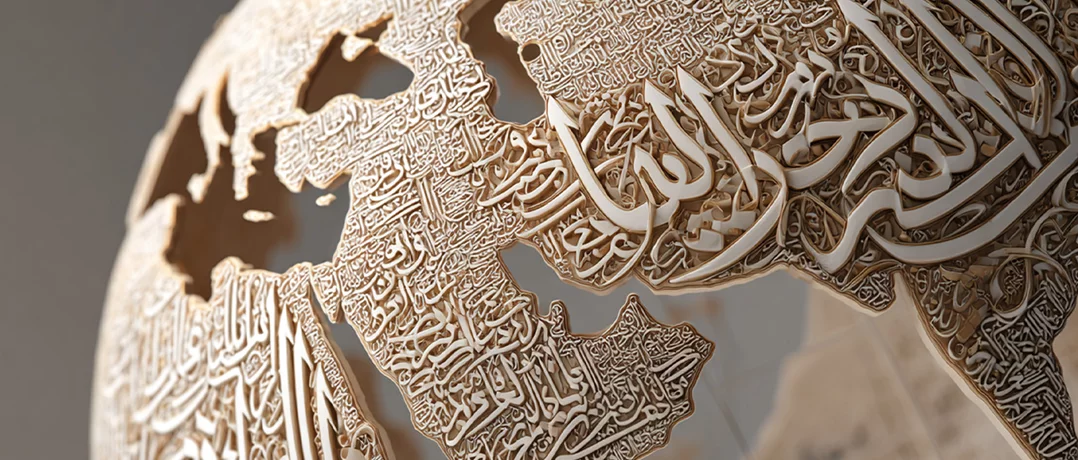
Noon on a weekday saw the National Library in Sanayeh being more alive than usual. The scene was not silent, and not reverent in the traditional sense, but rather with hands raised, answers given in half whispers, and young voices trying to find the power of words. The Arabic language was celebrated by the Ministries of Culture and Education, who turned the library into a place where Arabic was not just some memorization but a thing to act out, ask about, and even fool around with.
The architecture did part of the work. The area was decorated by magnificent arches, which led to an interior courtyard, and there was a modern cantilevered balcony on the top of the old library hall. The balcony provided a view down the hall full of students sitting below, some concentrated while others fidgeted.
Students had come from throughout the country. From northern regions like Tripoli and Akkar, to Beirut, and the Bekaa and South, public and private schools. Different accents and different uniforms, all in one place. Ages ranged from 10-15 years, but the large room and the two ministers did not silence them much. On the contrary, it seemed to enhance their energy.
Present were Culture Minister Ghassan Salameh and Education Minister Rima Karami, both leaning into the day not as a formality, but as an exchange. The event centered on a friendly competition across the arts of the Arabic language: public speaking, poetry, recitation, listening, and what organizers called “painting with words” writing not for correctness alone, but for beauty.
A language that still competes
At one point, a question hung in the air, the kind that sounds simple, but isn’t. How do initiatives like this actually empower students in Arabic, at a time when English and French dominate classrooms, screens and aspirations?
Salameh didn’t dodge the tension. He leaned into it, almost conversationally, acknowledging the obvious before reframing it. Yes, he told The Beiruter, English has become the world’s dominant language. Everyone speaks it. But that dominance, he explained, is precisely why other languages, especially Arabic matter. Their value lies in the “positive attributes” they carry, attributes that cannot be replicated elsewhere.
Arabic, he reminded the room, is not only the national language, but the language of work and opportunity for young people, particularly in the Gulf and beyond. It is also, he noted with a hint of irony, increasingly dominant even within international organizations. The message landed softly but clearly: “Arabic is not a nostalgic attachment. It is a living, working language, with relevance that stretches far beyond the classroom,” he stated.
Hands in the air, words on the spot
If Salameh framed the why, Karami embodied the how. One of the liveliest moments of the day came when she turned the competition into a challenge. She invited a few students up on stage and began calling out letters of the Arabic alphabet. Instantly, hands shot up across the room. Each letter was met with a word, shouted back with confidence, sometimes overlapping, sometimes corrected by laughter.
The atmosphere shifted from formal to electric. Students weren’t waiting to be chosen; they were insisting on being part of it. During a rapid-fire session on synonyms, the entire hall leaned forward, voices colliding as answers flew. Teachers, unable to resist, jumped in to help technically cheating, admittedly but no one minded. It felt communal, playful, and generous.
Then came the question that quieted the room just enough: Why is Arabic called the language of the daad? A pause. A few whispers. And then the answer surfaced, because of the letter daad itself, unique in its sound, a marker of identity embedded in pronunciation.
Another round followed, this time tracing how English and French have borrowed from Arabic. Words were thrown out camel, coffee, and students were quick to trace them back to Jamal and Qahwa. The exercise was subtle but powerful: Arabic was no longer on the defensive. It was a source.
From listening to writing
The program moved fluidly between listening, speaking and cultural knowledge before arriving at writing, not spelling tests or rigid grammar drills, but an invitation to write artistically. The goal wasn’t perfection. It was expression. To see language not as a rulebook, but as material.
Throughout, the setting amplified the moment. The old library shelves watched quietly as new generations filled the space with their voices. Above them, the modern balcony held parents, teachers and guests, observing a scene that felt both ceremonial and spontaneous.
By the end, certificates were handed out, smiles exchanged, and a group photo gathered students alongside Salameh and Karami, a visual reminder of who the day belonged to. Not the ministers, not the institutions, but the students who had traveled from across Lebanon to claim Arabic as something active and theirs.
For a few hours in Sanayeh, Arabic wasn’t competing with other languages. It was simply doing what it does best gathering people, carrying history, and making room for new voices to step in.
-
-
-
Rayanne TawilCultural writer
-
