For 80 years, the Lebanese Red Cross has remained one of Lebanon’s few enduring institutions, serving the country through wars, crises, and disasters without discrimination.




For 80 years, the Lebanese Red Cross has remained one of Lebanon’s few enduring institutions, serving the country through wars, crises, and disasters without discrimination.

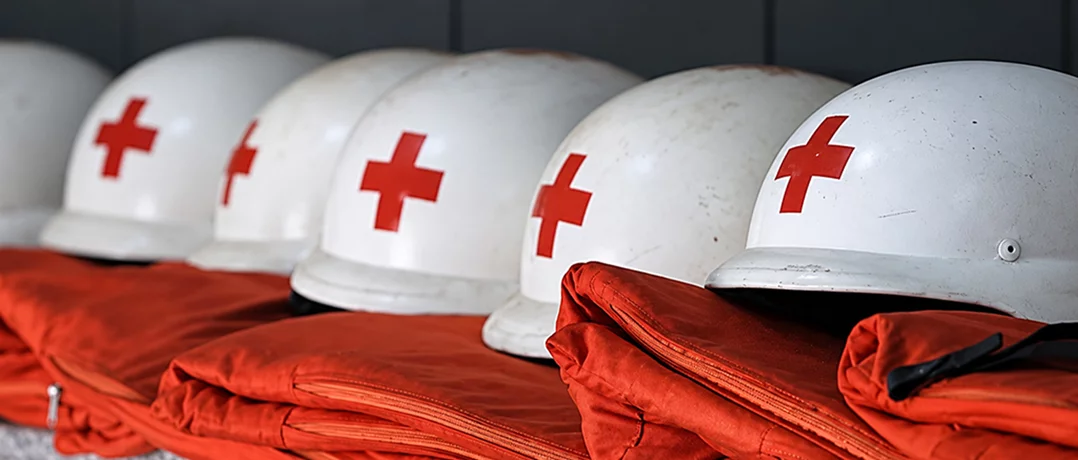
For eight decades, the Lebanese Red Cross has been the conscience of a country in perpetual crisis. Founded on July 9, 1945, it has outlasted civil wars, occupations, economic collapses, explosions, and epidemics. It is one of the few constants in Lebanese life, a presence that arrives in moments of panic, grief, and devastation, carrying with it the reassurance that someone has come to help. Through every chapter of modern Lebanese history, it has never stopped.
The numbers alone are staggering. The Lebanese Red Cross operates a fleet of more than 300 fully equipped ambulances, staffed by over 3,000 emergency medical technicians, responding to upwards of 140,000 emergencies and patient transports every single year, all provided entirely free of charge. Every one of those calls is answered at no cost to the patient.
Every year more than half a million people benefit from free healthcare services provided by the Lebanese Red Cross across the country. The organization runs 36 Primary Health Centers nationwide and is Lebanon's primary provider of blood transfusion services, having gathered, tested, and processed over 50,000 units of blood to supply hospitals, clinics, and mobile intensive care units during the recent escalation of conflict alone.
Between October 2021 and April 2025, Lebanese Red Cross volunteers vaccinated over 700,000 children through mobile clinics reaching remote and underserved communities, including, at the height of the COVID-19 infodemic, deploying 33 mobile units to combat misinformation and restore public trust in vaccines.
What makes the Lebanese Red Cross singular is not just its scale, it is its moral consistency. During Lebanon's civil war, the organization built its reputation by providing neutral and impartial services to all communities in the country, a feat of humanity in a conflict that tore neighbors apart along sectarian lines. That reputation has never been surrendered.
The Lebanese Red Cross is the primary provider of ambulance care and blood transfusion services in the country, and both are delivered free of charge to those in need. In a healthcare system fracturing under economic pressure, this is not a service, it is a lifeline.
In the 2023-2024 escalation of hostilities, the Lebanese Red Cross deployed 254 ambulances and 810 emergency medical volunteers around the clock to respond to mounting casualties. Before that escalation had even peaked, they had already supported approximately 10,000 people with medical services, distributed food parcels to 18,500 families, and provided hygiene kits to 11,000 families.
They paid a price in blood. Sixteen paramedics were injured and seven ambulances were damaged during active response operations. In one incident in Tyre, a team responding to airstrike casualties came under direct fire; in Nabatieh, three paramedics were struck by shrapnel while attempting to rescue the wounded. They did not retreat.
None of this happens without people. The Lebanese Red Cross comprises approximately 7,000 members and volunteers alongside 200 staff, ordinary Lebanese who have chosen extraordinary commitment. They are students, professionals, parents, who answer the call at all hours because someone has to. The Lebanese Red Cross is playing a vital role in bridging gaps in healthcare access.
Previous Red Cross member Michel Tawk tells The Beiruter, “it has been the most enriching experience I have ever had. It carries deep social and cultural dimensions on every level.”
He continues, “The more you give of yourself, the more you receive. Through it, you truly realize how much the society we live in gives to each of us. At the same time, you make the choice to give back. Because if you don’t give, who will?”
And when Lebanon bleeds, they answer. Not because it is easy, safe, or rewarded, but because they have made a decision, again and again, for eighty years: that no life should be abandoned in its most vulnerable moment. Through smoke, collapse, fear, and grief, they continue to choose humanity over division, duty over danger, and compassion over despair. Lebanon owes them more than gratitude. It owes them protection, dignity, and remembrance.