



From drums and dabke to Brazilian flags and roaring crowds, the World Cup Festival brought football, food and a new energy to the historic fairgrounds.
When Tripoli became Lebanon's biggest stadium

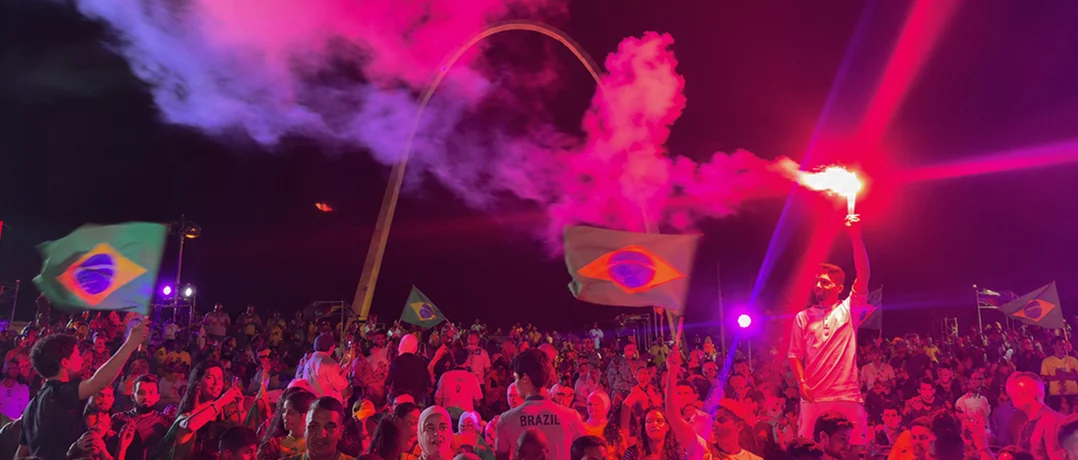
As the sun started disappearing behind Tripoli’s skyline, the lights of the Rachid Karami International Fair (RKIF) began glowing. Families walked through the gates waving flags, children held miniature drums, fans wore their favorite players’ shirts and the sound of horns and chants slowly filled a place that had spent years waiting for crowds to return.
For nine days, from June 11 to June 19, the RKIF became something unexpected: a football stadium without a football pitch.
The World Cup Festival, organized in partnership with MTV and supported by sponsors including Vienna 1683 Coffee House, Toters, Snips, Lays, Prewhat Agency, Green Protection and NDP, transformed the iconic fairgrounds into a full fan experience where matches were watched under the famous architecture of Oscar Niemeyer.
And if there is one thing Tripoli knows how to do, it is cheer.
The Brazil versus Morocco match proved it. A sea of green shirts filled the seats, a few Moroccan flags waved proudly and every goal attempt came with a wave of screams. The playful rivalry was everywhere. Brazilian supporters teased German fans, German fans answered back, and everyone seemed to know the unwritten Lebanese football tradition: if your rival loses, you make sure they hear about it.
Walking into a World Cup dream
Entering from the main gate, visitors were welcomed by a view of the Fair’s famous pyramid standing in the distance. The organizers designed the experience in different zones, making the journey feel like walking through a mini football city.
First came the entertainment zone, where sponsors created games and activities for children and adults. Visitors stopped for challenges, took photos and joined interactive games before moving into the food area.
The food zone became a meeting point throughout the night. Wooden tables were filled with families and groups of friends, while kiosks, food trucks, coffee stands, snacks and argileh completed the Lebanese football atmosphere.
Because in Lebanon, a match is rarely watched without something to share.
Among the crowd was Maya, who came with her friends wearing football shirts and carrying flags. She told The Beiruter that the event felt different from watching games at home. “Everyone is here together. You have families, young people, older people. You feel like you are part of something bigger,” she said.
Nearby, Hassim, a father watching the match with his children, explained that bringing them was about more than football. “They will remember this. They will remember cheering with people they don’t even know.”
Where football met Tripoli’s culture
Every evening brought a different atmosphere. The opening night featured fireworks, music, drums, and a fire performance that immediately drew crowds to the stage.
On Saturday, a dabke group entered the scene, and within minutes, the crowd became part of the performance. Young people danced beside older men and women, Lebanese songs played, and the football festival turned into a celebration of local culture.
For many visitors, it was a reminder that public spaces in Lebanon can still create spontaneous moments of connection.
Hani Chaarani, director of the Rachid Karami International Fair, said this was exactly the purpose of bringing people back to the site. “The Fair was conceived as a national space that brings people together beyond regional, social, or political differences,” he told The Beiruter. “Seeing visitors from across Lebanon gathering in one place to celebrate football demonstrates the power of sport to create connections and shared experiences.”
He added that events like this help reconnect people with the fairgrounds' heritage.
“The best way to preserve heritage is to keep it connected to people’s daily lives. The Fair is not only an architectural landmark; it is a public asset that should be experienced and enjoyed by the community.”
Under Niemeyer’s arch, the match begins
The most memorable part of the festival came after passing the entertainment and food zones.
Visitors walked up the steep slope to RKIF’s iconic arch. Standing beneath it felt like entering a football tunnel before a match. The structure framed the sky above, and for a moment, the feeling was similar to walking toward a stadium pitch.
Then the open theater appeared.
The massive screen stood in front of Niemeyer’s built-in seats, transformed into a comfortable viewing area where hundreds watched every match together. Under the arch, a replica of the FIFA trophy became one of the most photographed spots of the night.
Raed Shalak, architect and organizer of the event, said the goal was to recreate the feeling of international fan zones. “I’m a football fan first of all,” he said. “I worked with FIFA in Qatar for two years, from 2020 to 2022, on championships including the World Cup. One of the things we worked on was the stadiums and fan zones. I wanted to bring that experience here.”
The choice of RKIF was intentional. “The open theater is there, it has a large capacity of 1,200 seats. We always wondered why we don’t do the same in Maarad (RKIF),” he explained.
According to Shalak, every detail was considered, from entrances and security to lighting and sound systems.
“We took everything into consideration: safety, organization, entrance, exits, lighting system, sound system.”
A city showing itself
The festival also became a chance for Tripoli to welcome visitors from outside the North.
Shalak said many sponsors from Beirut were initially hesitant about coming to Tripoli, yet changed their minds after seeing the organization and vision behind the project. “When they saw the presentation and branding, it was an easy yes. They saw something they had never seen before from an organizational point of view,” he said.
For Chaarani, the event represented a larger vision for the fairgrounds.
“We want people to see the Fair as a place where culture, sports, education, innovation, exhibitions and community life come together,” he said.
Throughout the nights, the festival welcomed families, young fans and people with disabilities, with accessible areas allowing everyone to participate.
Children beat drums beside their parents. Fans shouted with strangers. Flags moved above the crowd as the screen showed the world’s biggest teams competing.
And by the end of the night, the seats beneath Niemeyer’s arch were filled, the drums were louder and the green field on the screen reflected across hundreds of faces watching together.
-
-
-
Rayanne TawilCultural writer
-
