



Expired chemicals meant to be exported for specialized treatment were instead moved to Zahle and Marj Bisri, raising questions over responsibility and their disposal.
Who changed Lebanon’s plan for its expired chemicals?
Who changed Lebanon’s plan for its expired chemicals?
By Natalie Durham | September 08, 2026

Reading time: 5 min
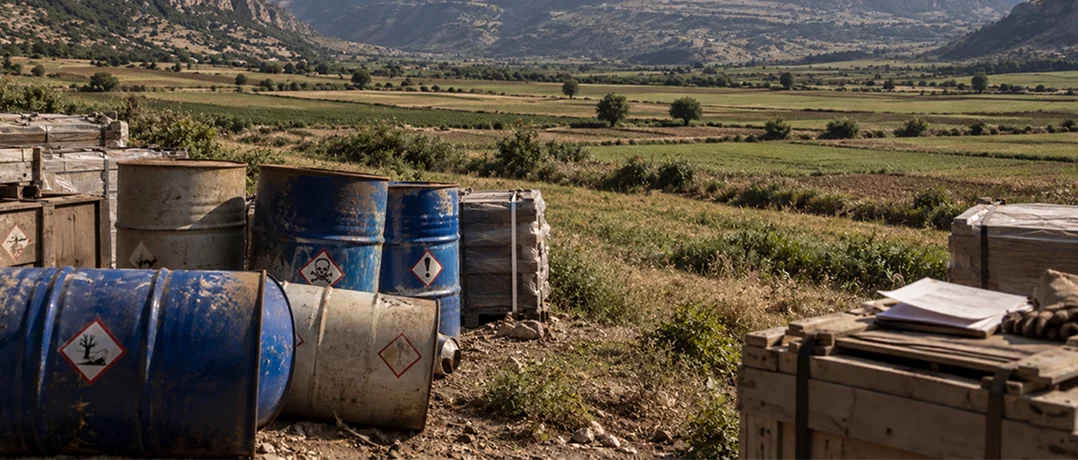
For years, the plan seemed straightforward: expired chemicals stored at Lebanon’s Zouk and Jiyeh power plants would be packed, removed and shipped abroad for specialized treatment. Instead, some materials were sent to the Zahle landfill, while trisodium phosphate was transported to Marj Bisri. The shift raises a basic question that remains unanswered: who decided that waste once considered unsuitable for treatment in Lebanon could instead be handled inside the country?
A plan that began with Europe
The file dates back to October 2020, when the Internal Security Forces’ Information Branch and the Lebanese Atomic Energy Commission inspected chemicals stored at the Zouk power plant. Electricité du Liban (EDL) said the materials were stored in a way that reduced leakage and fire risks. EDL contracted German company Combilift to package expired materials and move them to European countries. By May 2021, packaging was complete, but the required export approvals had not been secured.
The quantities were significant. In April 2022, EDL said around 80 tonnes of different chemicals were present at Zouk for normal operations. Of that total, about 13 tonnes of expired trisodium phosphate and sodium metasilicate were specifically awaiting removal. EDL said the material had already been packaged for export but could not leave Lebanon because the necessary government approvals were incomplete.
By June 2024, the chemicals were still in Lebanon, and so the issue returned to Cabinet. EDL said materials at both Zouk and Jiyeh had been professionally packaged but that Tecmo, representing Combilift, had not obtained the necessary approvals to remove them.The government ordered the materials moved from Zouk to a safe, uninhabited location pending disposal. The Ministry of Environment said Lebanon lacked the infrastructure to treat this chemical waste in an environmentally sound manner. The Basel Convention process remained the official route for sending the chemicals abroad for treatment and disposal.
But the Ministry of Environment provided an important clarification in August 2026: it said that it had never received a formal export application from EDL accompanied by a Basel Convention file for these chemicals. According to the ministry, what it received in 2024 was instead a request to examine the possibility of treating the materials locally.
The plan changed
On September 4, 2024, EDL signed a new contract with Tecmo to dispose of the chemicals. The utility said no materials were handed over until the company had obtained the required permits.
The file moved forward again in 2025. On June 20, Lebanon's Minister of Information Paul Morcos announced after a Cabinet session that approval had been granted for the removal of chemical materials from the Jiyeh and Zouk plants. The original arrangement, however, had been to send the expired materials abroad. In June 2024, then-caretaker Prime Minister Najib Mikati’s office, citing information provided by EDL, said the 2021 contract with Tecmo, representing Combilift, required the materials to be packaged, removed from the plant and disposed of abroad.
Some of the materials were then handled inside Lebanon. According to EDL, sodium metasilicate, Rodine & Hydrogale and Positive Resin were transferred to the Zahle landfill after Tecmo received approval from the Environment Ministry and written approval from the head of Zahle-Maallaqa Municipality. EDL said the municipal president later changed his position.
Trisodium phosphate followed a different route to Marj Bisri. EDL said Tecmo submitted a formal request to the Ministry of Environment concerning the transfer and that the company obtained the ministry’s approval.
Bisri becomes the new problem
On May 26, 2026, EDL received a letter from the Lebanese Army’s Intelligence Directorate attaching a letter from the Ministry of Agriculture dated April 14, 2026.The Ministry instructed that the remaining trisodium phosphate in Marj Bisri should not be used or moved.
EDL then sent Tecmo two letters, on June 25 and July 6, ordering the company not to take any further action involving the remaining material without approval from Army Intelligence and without complying with the requirements of both the Environment and Agriculture ministries.
In August, however, the Ministry of Environment challenged part of EDL’s account. It said its approval concerned a proposed treatment method and possible agricultural use on privately owned land, subject to the Ministry of Agriculture approval, not simply moving the material to Marj Bisri.
The ministry then rejected using the trisodium phosphate as fertilizer, saying its sodium content was too high. The Ministry of Environment asked EDL to retrieve the remaining material and submit another treatment method, or export it if safe treatment in Lebanon was impossible.
Zahle is still unresolved
On August 12, Zahle Municipality said about 7.5 tonnes of material had arrived at its landfill on September 19, 2025. It said the containers remained sealed and had not been treated or buried, and that it had asked the relevant ministries and EDL to remove them in October 2025.
A Litani River Authority inspection the next day said the stock included about five tonnes of sodium metasilicate from Zouk, 2,140 kilograms of Hydrogel and 560 kilograms of Resin from Jiyeh. It called for the materials to be moved to an approved site.
On September 5, Zahle Municipality said it had filed case 461/2026 before the civil judge handling urgent matters because the materials had still not been removed. It said the containers remain sealed.
Six years after the problem was first identified, the chemicals file remains unresolved. What began as an export plan has turned into years of delays, new contracts and conflicting instructions between state institutions. With materials still stored in Zahle and Bisri, who is responsible for safely closing the file, and why has it taken Lebanon this long?
-
-

-
Natalie DurhamResearcher/Writer
Junior research writer focusing on politics, public policy and international affairs.
-
