



Why does everyone feel burned out?

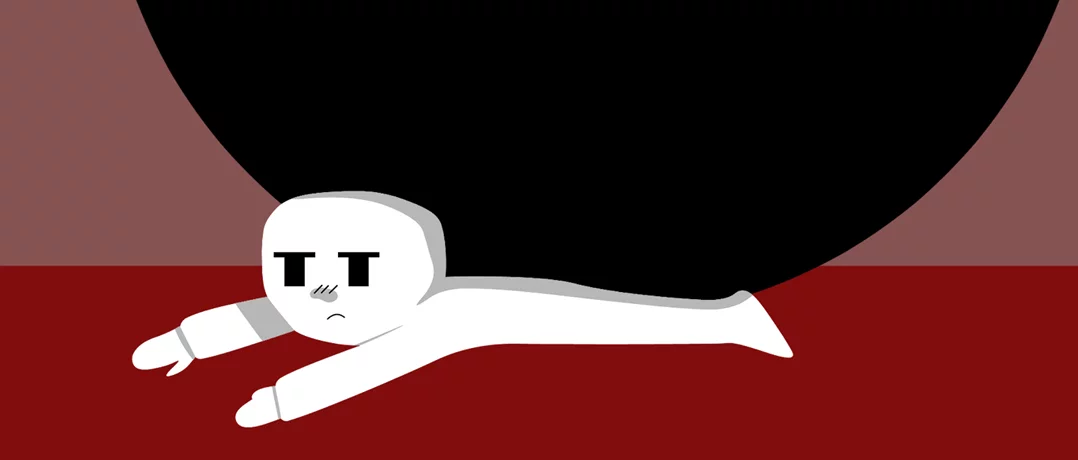
Illustration by Karim Dagher
Burnout has become one of the defining words of modern exhaustion. It is used to describe everything from a bad week at work to the feeling of waking up already depleted, but the term has a far more precise meaning than everyday conversation suggests. Burnout is not simply tiredness, and it is not merely a failure to manage stress. It is a recognized psychological phenomenon shaped by prolonged exposure to demands that eventually begin to outpace a person’s capacity to recover. It has a clinical history and, according to psychologist and psychoanalyst Dr. Randa Chaghoury, a specific set of conditions that produce it.
Burnout has a precise clinical definition
"People use the word burnout loosely, but it has a formal definition, and that matters," Chaghoury said. She traced the term to psychoanalyst Herbert Freudenberger, who coined it in the early 1970s observing idealistic professionals collapsing under their own commitment. "His clients weren't lazy. They were often the most dedicated people in the room. That's part of what made burnout counterintuitive when it was first described."
The concept was later formalized by psychologist Christina Maslach, whose researjennach identified three dimensions, emotional exhaustion, depersonalization, and diminished personal accomplishment. "Maslach's framework is still the gold standard," Chaghoury explained. "Burnout is exhaustion combined with growing cynicism, feeling detached from the work, plus a creeping sense that nothing you do matters. All three tend to show up together."
Why it's not the same as depression
One question Chaghoury hears constantly is whether burnout is simply depression with a different name. "There's real debate about this," she said. "Some argue the two overlap so heavily that burnout isn't distinct. I don't fully agree."
Her clinical read is that burnout is contextual. "Depression tends to follow you everywhere, into relationships, hobbies, your sense of self. Burnout, in its cleaner form, is often tied specifically to the stressor. Someone can be burned out at work and still feel like themselves at home. That context-dependence is a meaningful clue, even though the two can coexist."
The body keeps the score of chronic stress
What makes burnout different from ordinary tiredness, Chaghoury said, is that it reflects a physiological process, not just a psychological one. "Chronic stress produces measurable changes in the body," she explained, pointing to research on allostatic load, the cumulative physiological wear caused by prolonged stress exposure. "We're talking dysregulation across the cardiovascular, metabolic, and immune systems. It's biological."
She was particularly emphatic about financial stress as an underappreciated driver. "People file financial stress separately from work stress, as if unrelated. The research doesn't support that separation. Studies on allostatic load identify financial strain as one of the chronic stress domains most strongly associated with physiological dysregulation, right alongside work and caregiving stress. Financial instability keeps the body in a low-grade state of threat, day after day, and that adds up."
Why this generation feels it so acutely
Chaghoury pointed to a compounding effect rather than a single cause. "It's rarely just workload," she said. "I see people carrying job pressure, financial precarity, and often a caregiving responsibility simultaneously, with very little genuine recovery time built into any of it. Each stressor on its own might be manageable. Stacked together, without recovery, they create exactly the conditions burnout was first described in, except now it's not confined to idealistic professionals in caregiving fields. It's showing up in nearly every occupation."
She also flagged something less discussed, the erosion of a clear boundary between work and rest. "Constant connectivity means the nervous system rarely gets a genuine signal that the stressor has ended. If your phone can reach you at any hour with a work demand, part of your body stays braced for it even during supposed downtime. That's a recipe for chronic, unresolved activation."
Is Lebanon making burnout worse?
In Lebanon, burnout cannot always be separated from the wider conditions people are living through. Economic insecurity, war, political uncertainty and chronic instability can create a level of prolonged stress that extends far beyond the workplace.
"Lebanon is a particular context because people often don't have a clear period of recovery," Chaghoury said. "You finish work, but you're still thinking about money, your family's safety, what might happen next. The stressor doesn't necessarily end when the workday does."
For many, this means the nervous system remains in a state of anticipation even during supposed downtime. "When you've lived through repeated crises or war, uncertainty itself becomes exhausting," she explained. "You're not only dealing with what is happening now; you're constantly preparing yourself for what might happen next."
That does not mean every case of burnout is caused by Lebanon's circumstances, but chronic instability can add another layer to the financial, professional and personal pressures already driving exhaustion.
What actually helps
Chaghoury was blunt that burnout isn't primarily solved through individual willpower or better time management, though those things can help at the margins. "The uncomfortable truth is that burnout is often a structural problem being experienced individually," she said. "Rest helps, but it treats a symptom. If someone returns to the exact same unsustainable conditions, the exhaustion comes back, often faster the second time." Where change isn't structurally possible, she emphasized building in genuine recovery windows and paying attention early. "The earlier someone recognizes the pattern, exhaustion, cynicism, disconnection from meaning, the more options they still have. Waiting until full collapse narrows the path back considerably."
A warning the body keeps sending
What emerges from Chaghoury’s account is a picture of burnout as neither weakness nor simple overwork. Rather, it is a predictable physiological and psychological response to the conditions many people now face simultaneously, from financial pressure and unrelenting connectivity to stress with nowhere left to drain.
As she put it, closing the conversation, "Burnout isn't a personal failure to cope. It's information. The exhausted, cynical, disconnected feeling is the body and mind telling you, quite accurately, that something in the current arrangement is unsustainable."
-
-

-
Jenna GeageaReporter/Writer
-
