

Lebanese women have always danced dabke. Today, they are reshaping tradition, visibility, and leadership on and off the stage.
Women and Dabke a story to be told

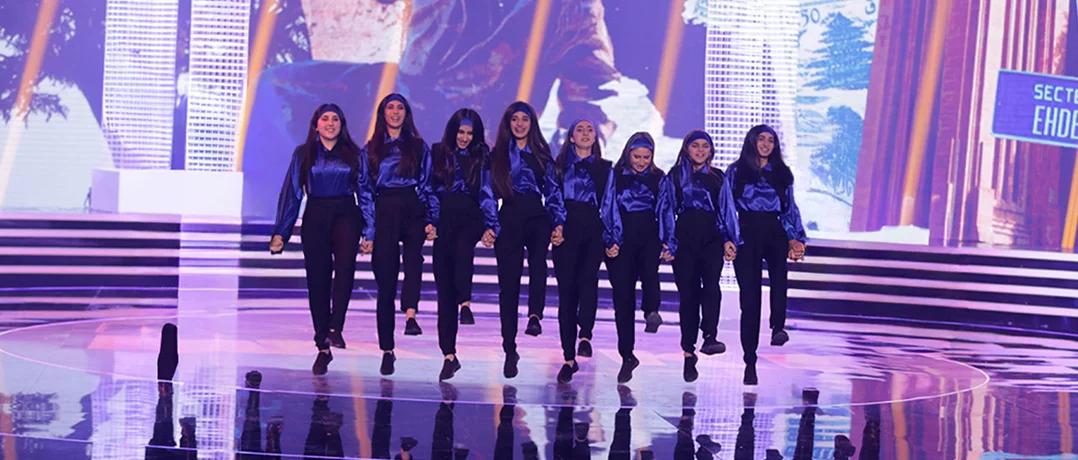
For decades, dabke has been imagined as a man’s dance. Heavy steps striking the ground. A display of strength, stamina, and command. In Lebanon’s collective imagination, dabke belongs to men. But this image has never told the full story. Because Lebanese women have always danced dabke.
Long before competitive stages and television shows, women danced dabke in village courtyards, family homes, and wedding circles. They danced during harvest seasons, celebrations, and long nights that ended with music echoing through stone houses. Their steps were framed as performance, participation, a natural extension of communal life.
Nadra Assaf: “The dance reflects what society is like”
In an exclusive interview with dancer, choreographer, and judge Nadra Assaf, she explains that “Dabke itself is a piece of folklore”. And within that folklore, women were never absent, but they danced differently.
“There is a women’s dance,” Assaf explains. “So to say that women didn’t dance isn’t accurate. Together, these form the Lebanese style of dance.” Traditionally, women did not dance in the same line as men. “For it to be dabke, there needs to be lines. There needs to be commonalities where everyone is together,” she says.
Within those lines, gender distinctions were clear. “The muwashahat is a dabke specifically for women,” she notes. “The hands are held differently. The feet are smaller. It’s like classical ballet, the male roles and the female roles.” Men performed the heavy stomping, the jumps, the drops to the knees. “Women don’t do that. The women stay up. Most of the time, they would have a veil.”
Even moments of exchange, what some describe as tahaddeh, or challenge, were structured. “The girls do their thing, and then the guys do their thing,” she says. “Women’s moves were unmatched to the men’s moves. They jump high, they go down, they get on their knees.” When women and men shared a line, however, the movements became common ground: “Intricate footwork with delicate stomping.”
That balance has shifted. “We don’t see it like that anymore,” Assaf says. “We see the girls taking on just as much of a prowess move.” Today’s dancers, she adds, are bolder than ever. “The younger generations would do anything. They flip on their heads. They take risks.”
Still, progress does not mean forgetting. “When we talk about culture and heritage, it’s extremely important that we never forget the past,” Assaf says. “A lot of the problems we see in Lebanon, even politically, are because we tend to forget.” Resilience, she adds, is both Lebanon’s strength and its weakness. “By forgetting, we are doomed to repeat things we shouldn’t have.”
Her message to young girls watching “Let’s Dabke” is both grounding and liberating. “Take into consideration everything that happened before, know it, understand it, respect it, but also own your present and your future.” Today’s women, she says, are stronger than ever. “Young women are taking care of their bodies like never before. They’re carrying weights. They’re building strong, capable bodies. Then they should be able to do what they want to do.”
Her final wish extends beyond performance. “Most of the leaders of dance companies are men,” she says. “I would love to see more women, as leaders, choreographers, artistic directors. Not just performing. The creative and directing part.”
“Let’s dabke” and the shift in representation
This shift has reached mainstream audiences through MTV’s “Let’s Dabke”. What stands out is not just the presence of female dancers, but the diversity among them. Women from different regions, age groups, and backgrounds take the stage, including younger women whose confidence and authenticity feel especially powerful. Their participation is not treated as novelty or exception, but as something entirely natural.
Beyond the judges’ debates, the dances themselves spoke volumes. In the latest episodes, one performance told the story of a wedding, featuring a bride and her bridesmaids moving through the line together. The choreography celebrated women’s roles as central figures in life’s most important moments.
Another performance staged a playful battle between men and women, only to end with everyone joining hands, dancing in unison. The moment was choreography and metaphor for life itself, showing how tradition, rivalry, and gendered expectations can be transformed into unity and shared rhythm. The program also features an all-women group of young dancers in vibrant, modern costumes, signaling a generation that respects tradition while fearlessly reshaping it. Through them, dabke evolves.
More than a dance
Dabke has always been about unity, a line moving together, grounded in shared rhythm and memory. Excluding women from that line was never part of its essence. It was a social choice, not a cultural necessity. And as they step forward, they expand the line, reminding us that tradition is not something fixed in the past, but something reshaped by that brave enough to claim their place within it. Because dabke was never just a man’s dance. It was always a Lebanese one.
-
-

-
The Beiruter
-
