



On a quadrilateral bike painted with Beirut’s memories, Rouba Houssami invites the city to slow down, pedal together, and see familiar streets with fresh eyes.
Yalla Pedal

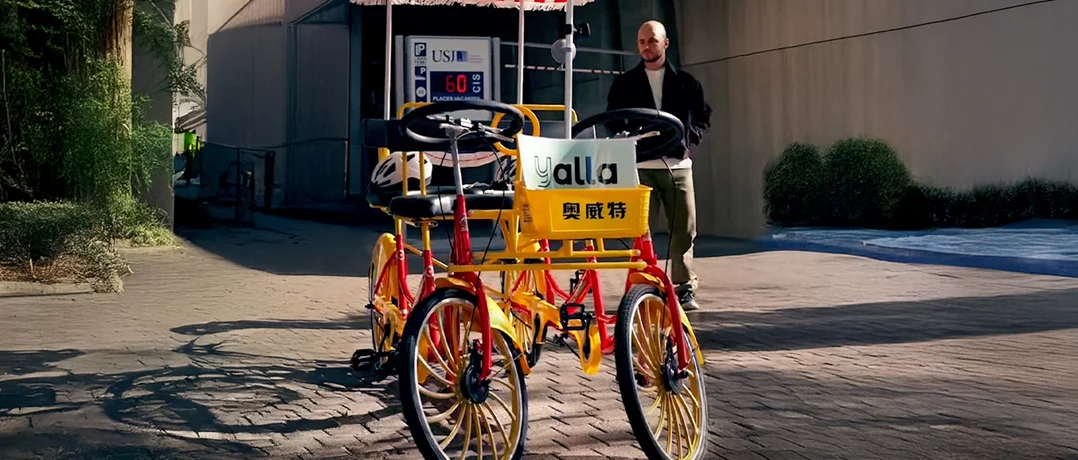
On a calm Sunday afternoon, Beirut briefly slowed down in front of the MIM Museum. Not with traffic, but with anticipation. Parked by the USJ entrance was a bright yellow-and-red four-seater bike, part playground ride, part moving archive. Two seats in front, two in back, four wheels steadying the pace. A red-and-white tarp fabric shaded the riders, while the back of the bike was covered with images of Beirut’s landmarks: Raouche Rock, the Downtown clock, the National Museum, an aerial view of the city. At the front, a green sign made its mission clear: Yalla Pedal.
Standing beside it was Rouba Houssami, founder of the initiative, adjusting the bike and greeting everyone with an easy warmth. She wore a Yalla Pedal hoodie and the kind of excitement that spreads fast. Two more riders joined us, helmets on, curiosity switched fully on. With a ring of the bell and a cheerful “Yalla pedal,” we began.
Where the ride begins
Yalla Pedal is a guided bike tour offering an eco-friendly, cultural way to explore Beirut. The initiative runs every Saturday and Sunday at 10:30 am and 12:30 pm free of charge until January 11, with official permission from the Beirut Municipality. Recently, it was selected by Berytech’s IdeaLab and OIF as a project supporting sustainable cultural mobility in the city. The route connects key landmarks, from the MIM Museum and Saint Joseph University to Beit Beirut and the National Museum, all within a 45-minute to one-hour ride. The aim, Houssami says, is not speed, but reconnection.
“Our life is so fast-paced all the time,” she explained. “So it’s good to take one hour just to reconnect with the city, to slow down and discover new things as well.”
We began at the MIM Museum, which is considered one of the most important mineral museums in the Middle East. As we pedaled slowly, Houssami explained how its rare collection of gemstones and minerals from more than 60 countries blends science with beauty through modern, interactive displays. “It’s not an ordinary museum,” she said. “I wanted to highlight it because people usually overlook it.”
In the same building, Saint Joseph University: Lebanon’s oldest Francophone university, founded in 1875, is a cornerstone of the country’s academic and cultural life. Pedaling past its campus, Houssami pointed out details often missed from a car: the architecture, the layered history, the quiet authority the institution still holds in the neighborhood.
Pedaling through memory, monuments, and the city’s pulse
As we moved forward, Houssami gestured toward the three neighboring cemeteries: Maronite, Orthodox, and Islamic standing side by side. She spoke about coexistence not as an abstract idea, but as lived geography. Whenever the traffic got denser, she would ring the bell and repeat her phrase “Yalla pedal” encouraging us to move on. The ride was more than surprisingly safe, though; Beirut's notorious reputation as a cyclist-unfriendly city seemed to be overruled by the ride. Cars slowed. Drivers waved. Some stopped to ask what this colorful bike was.
“I didn’t expect that,” Houssami admitted. “People were encouraging. They weren’t bothering us, they were happy to see it.”
Beit Beirut soon appeared, still bearing the visible bullet holes of the civil war. As we pedaled past, Houssami explained how the building once sat on the Green Line dividing the city, its scars intentionally preserved as part of its story. She pointed out surrounding buildings too those marked by war and those untouched all while steering, narrating, and keeping pace with the street.
One of the ride’s quietest moments came at the Famine Tree, a landmark many pass daily without noticing. Houssami slowed the bike and told its story: a living witness to the Great Famine of 1915–1918, now a symbol of collective memory and resilience. “If someone didn’t emphasize it,” she said, “you would think it’s just a normal tree.” That, in many ways, defines Yalla Pedal’s purpose to make the invisible visible.
For Houssami, the idea grew from both education and instinct. Being an enthusiastic traveler herself with a master’s degree in tourism and hospitality, and living in Beirut, she wanted to create something sustainable, local, and joyful. “I wanted people to have fun again,” she said. “To revive Beirut, to give its cultural identity through sustainable tourism and entertainment.”
Why biking, in a city rarely described as bike-friendly?
“Because it’s more immersive and more fun,” she explained. “You burn calories while discovering your city.” It’s culture, exercise, and a form of meditation rolled into one slow-moving experience.
The journey concluded at the National Museum, where we stopped to appreciate the structure and take a breather. At that moment, we were all grinning, a bit exhausted, and obviously more lively.
Houssami hopes riders leave with curiosity lingering. “I want them to say, ‘I want to come back and visit this place,’” she said. “To feel that our city is beautiful. That we have something worth seeing and sharing.”
Yalla Pedal is still in trial phase and is taking feedback while dreaming of what could be adding more cities or stopping at shops and bakeries. For now, it stands as a small, hopeful gesture, one powered not by engines, but by shared effort, open streets, and four people pedaling together.
As we rolled to a stop, Houssami rang the bell once more, smiling wide. Not a command, but an invitation: Yalla pedal.
-
-

-
Rayanne TawilCultural writer
-
