“Birds of War” traces a love story born in conflict, following two journalists whose lives and relationship were shaped by war, exile, and storytelling.


“Birds of War” traces a love story born in conflict, following two journalists whose lives and relationship were shaped by war, exile, and storytelling.

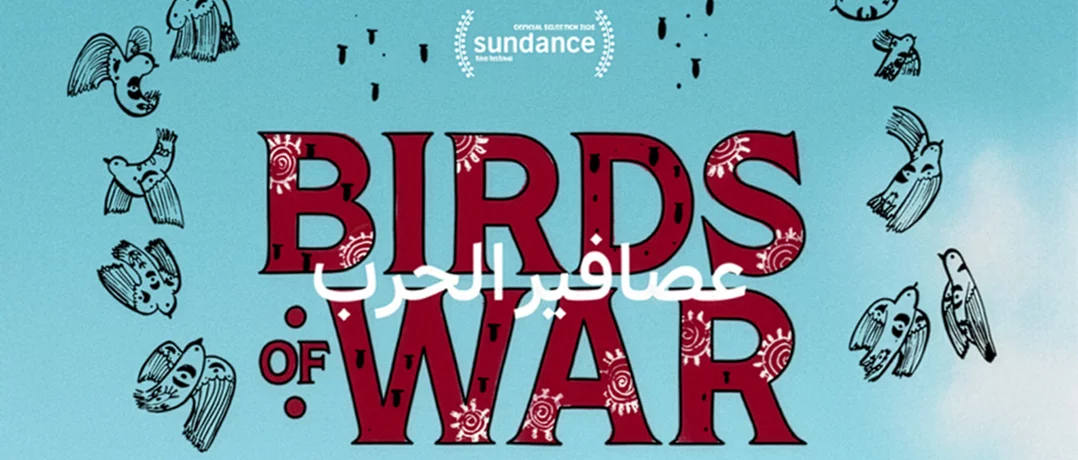
Across 13 tumultuous years marked by revolution, war and life in exile, the documentary feature “Birds of War” follows London-based Lebanese journalist Janay Boulos and Syrian activist-videographer Abd Alkader Habak (“Habak”) as their connection deepens into a love story. Drawn from their personal archives, the film begins as a professional exchange between Boulos in London and Habak in the trenches of a besieged Aleppo and unfolds into an intimate partnership shaped at every turn by war.
Boulos was born and raised in the seaside town of Byblos, north of Beirut with family roots in the southern village of Tebnine. She studied journalism in Lebanon and then moved to London in 2010 to further pursue a master’s degree in journalism. A year later, as the Arab Spring erupted, she joined the BBC Arabic newsroom, covering breaking and daily news across the region. Over the next decade, she became an on-camera reporter, field producer and news producer, later transitioning to the BBC News English website to focus on digital and social video before moving into the BBC investigations unit, where she worked on documentary investigations.
From the start of the Syrian revolution in 2011, her work depended on those willing to document events from the inside. With Bashar al-Assad’s regime restricting access and controlling narratives, international media turned to activists and citizen journalists posting footage on Facebook, YouTube and other platforms. “We were relying on citizen journalists and activists to get the news because the regime was denying everything happening in Syria,” Boulos recalls.
Producers in London would connect with people like Habak to obtain material from protests, bomb sites and everyday life under threat. Their paths crossed more directly in 2016, during the final months of the four-year battle for Aleppo. “We started looking for activists inside the siege to send us stories from there. That’s how I connected with Habak – he was one of those activists documenting the day-to-day life in the Siege of Aleppo – and we started working together,” she says. At first the relationship was purely transactional: she commissioned footage and chased him for files on deadline, even as he navigated airstrikes and chemical attacks. “He was in a war zone, so I would often feel uneasy about chasing him, but I had a job to do,” she adds.
That dynamic shifted as the war intensified. After the evacuation of Aleppo, Boulos lost contact with Habak for a while. When he resurfaced in 2017, displaced from Aleppo to Idlib, he wanted to move beyond stories solely focused on war. They began working on different topics, messaging more frequently, a bond developing between them and deepening their connection. She found herself worrying whether he made it home alive after each assignment. “I started to ethically think – am I putting this person in danger?”
At the same time, she was becoming disillusioned with how quickly the news cycle turned away from Syria. By 2017, what had once led broadcasts became a hard sell in editorial meetings. “One day the headline is Syria, and then suddenly we don’t care about that anymore,” she says, noting how this pattern repeats with conflicts in Gaza, Ukraine and Afghanistan. That disconnect pushed her to question her role as a journalist and to fight harder to get his work on air — “just for the sake of helping him,” she says — so his voice could be heard.
For Habak, the path to becoming a frontline videographer was born out of necessity, not design. “Being a videographer in the war zone was something I never thought about when I was growing up,” he says. When the regime shut out foreign media and sought to control what images left the country, Syrian citizens stepped in. “We were forced to be like this – to be photojournalists, to be people who take responsibility,” he explains, describing his decision to document events as an attempt “to deliver what was really happening in our city.” The experiences, he says, are “still stuck in my mind,” but they also fuel his determination to keep going. “Everything that I lived through, I don’t regret anything at all. And if time could go back, I will do the same thing or do more than what I did.”
A single act of compassion would alter Habak’s trajectory. A photograph of him rescuing a child after the bombing of the Four Cities Exchange went viral worldwide, putting him at risk and forcing him to flee Syria. He eventually reached Turkey, where he and Boulos met face to face for the first time after years of messages, video exchanges and voice notes. The relationship, strengthened by shared danger and distance, quickly led to marriage. He later moved to London, where the couple began to navigate the disorienting process of building a new life in exile while remaining tethered to the wars still tearing apart Syria and Lebanon. In 2021, Boulos left the BBC, and together they launched Habak Films to pursue independent storytelling.
Birds of War captures an interplay of intimacy and conflict, culminating in a closing exchange that lands with force. On camera, Habak asks, “How long can we keep doing this?” and Boulos responds, “Just until the wars finish.” The line resonates even more sharply against the current violence in the Middle East and escalating tensions in Lebanon. “Sadly, I wish I can talk about what’s happening right now without mentioning the whole history of the region. I think this is all one big war, since 1948 – since the Balfour Agreement,” she says, describing an unbroken chain of conflicts, destroyed homes and inherited trauma.
Habak zeroes in on how that conflict is being turned inward in the region today. “They [political leaders] are trying to create more separation within our region, which is more hate inside our society and inside our community,” he says. “It is a bigger war than the war that’s happening with the rockets because that hate is going to live for many years, and the people are going to fight each other because of that hate.” Their relationship, dissolving lines of nationality, faith and community, becomes a quiet counterpoint. “There is a chance to try and show that there can be something different in our region,” says Habak. “We are from different backgrounds, different religions, different communities, different societies – but we are with each other.”
Even the title carries the layers the couple were reaching for. “Bird is the nickname Habak and I used to call each other – ‘My Bird,’” says Boulos. “It is also a play on the Arabic title of the film because the word ‘war’ and ‘love’ in Arabic have one letter difference. Love is ‘hob’ and war is ‘harb.’ There’s an ‘R’ in war, and so it kind of is ‘love war birds’ – instead of ‘love birds’ – when you read it in Arabic.”
Premiering at the 2026 Sundance Film Festival, Birds of War won the World Cinema Documentary Special Jury Award for Journalistic Impact, signaling early recognition of both its emotional force and its critique of how media frames war.
The film then traveled to the Thessaloniki Film Festival in Greece this month, where it continued its momentum with a sweep of key awards: the Silver Alexander in the International Competition, the FIPRESCI Prize from the International Federation of Film Critics, the Human Rights in Motion Award from the Parliamentary Assembly of the Council of Europe (PACE), and the WIFT GR Award from the Women in Film and Television Greece chapter. “This recognition is profoundly important to me, especially in light of the ongoing Israeli assault on Lebanon,” Boulos says. “Our film sheds light on the individual human lives that are being sacrificed amid this war. I hope these awards amplify these critical stories and reminds us of the humanity behind the headlines.” Adds Habak, “Receiving this recognition on the anniversary of the Syrian revolution is deeply meaningful. It tells me that personal stories — when told with honesty — can resonate far beyond borders and headlines.”
The recognition at Sundance and Thessaloniki has strengthened the couple’s resolve to build a wider engagement around the film. “We’re also starting an impact campaign for the film, which will be twofold,” Boulos says, “with impact screenings to communities, targeting Arab diaspora and people with interest in the Middle East; a focus on journalism and its role during these times, and how actually journalism and media are polarizing people even more – especially with the hate we see on social media.”
Equally important for Boulos and Habak is ensuring the film’s legacy opens doors for the storytellers who come after them. “We have another side of the impact campaign,” says Boulos, “we’re currently working with several of our colleagues and different NGOs to find a way to develop training programs in Lebanon and Syria to aspiring filmmakers on how to market documentaries internationally – how to actually produce, co-produce, pitch, and how to present – based on the experiences with Birds of War and what we did on this journey. We would like to give back to the community and empower local people to tell their stories and show them what are the rules and how do you get to festivals like Sundance and Thessaloniki, and others.”
