



At DAF, “Leaves from the Theater of War” brings together 242 drawings created over 12 years, allowing Nabil Kanso’s meditation on conflict, power and the human condition to be seen as one continuous work for the first time.
Nabil Kanso’s human history in ink

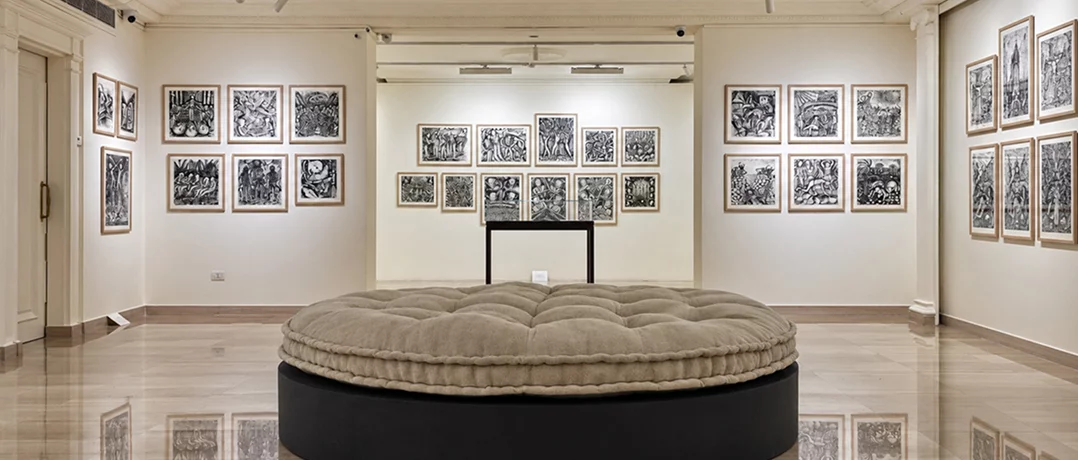
Two hundred and forty-two drawings cover the walls of the Dalloul Art Foundation, each one carrying its own small world of figures, violence, intimacy and strange moments of humor. Seen together, they stop feeling like individual works. They become a procession.
This is “Leaves from the Theater of War,” Nabil Kanso’s 12-year series created between 1980 and 1992, now presented in its entirety for the first time. The exhibition opened at DAF on July 29 and remains on view until Sept. 25, bringing together a body of work Kanso never saw exhibited in full during his lifetime.
Daniel Kanso, the artist’s son and co-curator, describes the complete series as a chance to enter the visual universe his father constructed over years. “Seeing the complete series together allows viewers to experience the works as a tragicomedy and to immerse themselves completely into the visual universe the artist created,” he tells The Beiruter.
A history written in ink
Kanso structured “Leaves from the Theater of War” as a journey. It begins with five title works in Arabic, English, French, German and Spanish, followed by six preamble works and 231 ink drawings.
Its first reference is Cain and Abel.
From there, Kanso moves across centuries, civilizations and human behavior, drawing connections between ancient stories and the conflicts that continued to surround him. The series was created while he traveled internationally with his “Journey of Art for Peace” exhibitions, which ran from 1984 to 1993. At the same time, he was developing “The Split of Life,” his series of 88 mural-scale paintings examining destruction, regeneration and the human condition.
For Basel Dalloul, founder of DAF and Dalloul Artist Collective, the drawings were never intended as isolated images of particular wars.
“This is an artist who was not documenting individual battles or historical scenes but was instead searching for the truth about what makes us human,” Dalloul says. “He was inquiring into the meaning of life, traveling across the globe, and deeply educating himself to understand how patterns of conflict, destruction, and regeneration have repeated over time.”
Daniel says his father saw his purpose “as revealing what makes us human through his art,” believing his work could serve as “a force for peace and connection.”
The space between the lines
There is an intimacy to the drawings that changes the way Kanso’s larger questions are approached.
At DAC, where “Darkness and Light (Part I)” opened earlier this summer, visitors encounter his monumental paintings: works that surround the body with color, movement and scale.
At DAF, Part II moves in closer.
“In the second part of the exhibition at DAF, you are again transported, but this time into a completely different, more intimate side of the artist’s universe,” Dalloul says. “From his earliest exhibitions in the 1970s, critics called Kanso ‘a born portraitist’ and commented on his ability to reveal innumerable expressions and emotions in his works.”
Daniel says the relationship between the two exhibitions is essential. Kanso produced drawings and paintings simultaneously throughout much of his career, using each medium to explore composition, mark-making, color, scale and theme.
In the drawings, Daniel says, Kanso’s balance between mark-making and negative space became central to the visual language he developed “to establish an emotional connection that transcends time and place.”
He also discovered something new while seeing all 242 drawings hung sequentially for the first time. “Seeing the works on the wall is a completely unique experience that adds a lot of depth to the individual pages,” he says.
Where darkness meets humor
The title “Darkness and Light” becomes especially visible in Part II.
The drawings contain violence and grief, although Kanso repeatedly interrupts that darkness with humor. The absurd appears beside the horrific. Intimacy sits beside brutality. The result is a work that refuses to present humanity as a single, fixed thing.
Dalloul calls the series “deeply complex and multilayered,” despite its reliance on ink and paper.
“When you see the full “Leaves from the Theater of War series,” you are exposed to the many contradictions that are inherent to human beings,” he says. “We are capable of unspeakable acts of violence but also of remarkable instances of beauty and selfless expressions of love.”
Lina Fansa, communications manager at DAC, sees the same layered quality across both exhibitions. “There are so many layers to Nabil Kanso, both as an artist and as a human being, and those same layers are embedded in his work,” she says.
A series that waited to be seen
“Leaves from the Theater of War” was never exhibited in its entirety while Kanso was alive. According to Daniel, he intended to publish it as a book, believing it was an essential body of work that deserved a global audience.
Parts of the series were shown in New York in 2024–25 and Michigan in 2025. The DAF exhibition marks its first complete presentation.
Limited resources prevented Kanso from publishing the series as he had designed it. His family and estate have since continued efforts to bring the work into the world in the form he envisioned.
The presentation also completes the conversation begun at DAC with Part I. Together, the two exhibitions reveal the monumental and intimate dimensions of an artist who spent decades examining conflict, history and what makes people human.
For Dalloul, that homecoming was long overdue. “This is the first solo exhibition of Kanso’s work in the nation where he was born and raised until the age of 21,” he says, “and it remains just the beginning of revealing the immense legacy and profound message of an artist whom many people are discovering for the first time.”
-
-

-
Rayanne TawilCultural writer
-
