



At the 13th Tripoli Film Festival, films about family, separation, identity and survival met audiences alongside a program built around the region’s emerging filmmakers.
The stories that stayed after the screen went dark
The stories that stayed after the screen went dark
By Rayanne Tawil | September 27, 2026

Reading time: 5 min
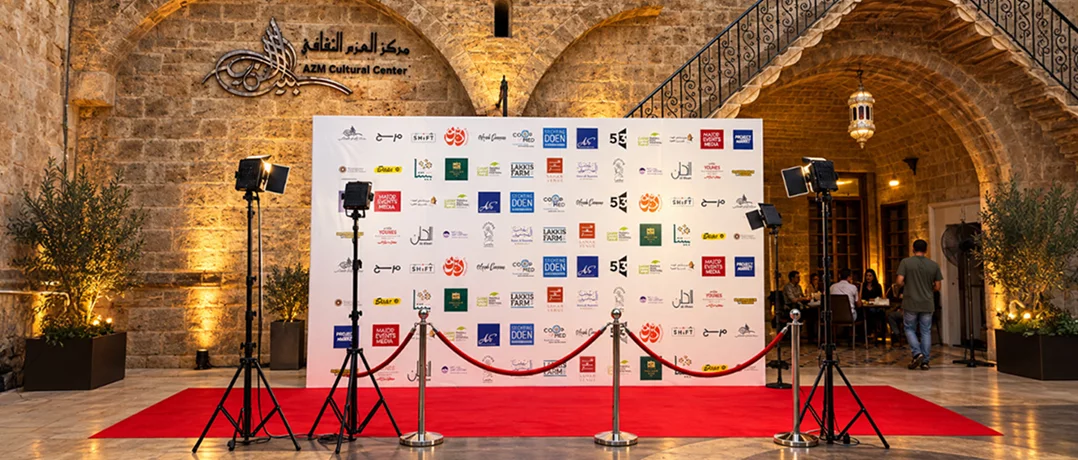
The old stone walls of Beit El-Fan at the AZM Cultural Center framed the 13th edition of the Tripoli Film Festival, with its red carpet laid across the courtyard and a program stretching across fiction, documentary, animation and short films. From Sept. 17 to 23, screenings moved alongside workshops, panels, masterclasses and industry days, bringing filmmakers and film professionals into the same spaces as audiences.
For founder and organizer Elias Khlat, the rhythm of the festival has remained familiar across its 13 editions.
“We have film screenings for seven days, six days, and we have an opening ceremony, closing ceremony, we have a jury that selects the best film,” he tells The Beiruter. “We have all kinds of films, feature films, narrative, feature films, documentary, short films, animation.”
The festival also hosts industry days, a platform designed around emerging filmmakers, with pitching opportunities, prizes, workshops and conversations with professionals from Lebanon and the wider region.
“We look at everything together,” Khlat says.
Where films meet the people making them
That meeting point became particularly visible through the Arab Short Pitching Program, where six projects were presented before a jury.
Lebanese cinematographer and filmmaker Chris Akoury was among those pitching his project, “In Attempt to Make Sense of Things That Already Ended” (originally called Little Death), a dark comedy about Kamil, a 78-year-old coffin maker who decides to rehearse his own funeral.
The idea had stayed with Akoury for years, beginning with a conversation during the making of a documentary about a coffin maker and funeral director. The film took on another meaning when Akoury’s father died unexpectedly shortly after he had written it.
“I understood the film more than I wrote it,” he says. “I've been writing a film for two years; the last time it happened was with me.”
For Akoury, Tripoli is also familiar territory. He has participated in the festival for years and previously won a pitching opportunity there.
“Tripoli has a special flavor, because you feel more like a family, you feel more like a group,” he says. “We are going and coming together.”
That sense of connection is precisely what the festival’s Industry Days are built around.
A bra size, a father and a room full of laughter
Some of the strongest moments came from films that took an ordinary family situation and opened it into something much larger.
Egyptian filmmaker Mohamed Taher’s “32B” follows a single father trying to navigate an uncomfortable conversation with his teenage daughter. The title initially sounds like a code. Its meaning becomes clear through the story, as a seemingly awkward problem exposes years of things left unsaid between them.
The film had the audience laughing throughout its screening, while its emotional turns gave those laughs another weight.
“I was drawn to the contradiction at the heart of it,” Taher says. “The father genuinely wants to do the right thing, but he has no idea how to communicate with his daughter.”
The film’s bra-shopping sequence became one of its most memorable moments, placing the father in a world he clearly does not understand while making his concern for his daughter impossible to miss.
“What I love about the scene is that the audience can laugh at his discomfort while also understanding where it comes from,” Taher says.
Its journey across festivals has shown Taher how widely that relationship can travel. “The cultural context may be specific, but the emotions are universal,” he says.
A story that came home
Lebanese filmmaker Aya Sophia Fakhry’s “Scotch” brought another kind of family separation to the screen.
The 2025 university project follows eight-year-old Samir, who suffered severe burns in an accident and is sent from his Lebanese village to Switzerland for treatment. Years later, he returns home carrying the distance of a childhood spent away, including the loss of his native language. His parents attempt to find their way back to him.
Fakhry wanted the film to carry something recognizably hers: the accent, geography, clothes, family dynamics and Lebanese sense of place.
“I didn't want to do a film that I wasn't in,” she says. “My feelings weren't in it, my identity wasn't in it, my accent, my way of speaking, the Lebanese way of speaking.”
She had also waited specifically for Tripoli. “I didn't submit to any festival just to put it in Tripoli,” she says. “I felt Tripoli really looked like me as a festival.”
When “Scotch” screened as the closing film of Tuesday’s program, its Q&A was followed by a long, warm round of applause.
Stories crossing borders
The program stretched well beyond Lebanon and the Arab world.
One of the standout animated shorts, “All We Have” written and produced by Palestinian-Australian author, playwright and scholar Dr. Samah Sabawi, follows a Palestinian couple through marriage, forced separation, imprisonment, childbirth and the psychological weight of detention.
Its 16-minute animated form carries an intimate story shaped by displacement and occupation, while placing love, family and resilience at the center.
For Khlat, this international range is part of what gives the festival its role in Tripoli. “If we don't bring the films to Tripoli, we won't know what's going on in the world,” he says.
A film festival as a city visit
The festival extends beyond the cinema itself, with tours and events encouraging visitors to see Tripoli alongside its film program. This year, its visual identity also drew from the city’s modern heritage, including the Rachid Karami International Fair, the train station and Nawfal Palace.
Khlat describes the experience as “a trip first.”
“You are going to discover a city, a welcoming city,” he says.
That exchange also feeds the local economy, bringing filmmakers, guests and industry professionals into hotels, restaurants and transportation services across the city.
Khlat believes that continuing the festival is itself an act of persistence. “Those who work in cinema, they keep making cinema, they can't do anything else,” he says. “So, just like those who open a restaurant, they keep selling their restaurant. We open a cinema, we keep making cinema.”
-
-
-
Rayanne TawilCultural writer
-
