



Ghosta is a historic Maronite village whose monasteries, schools and cultural figures helped shape the religious and intellectual life of Mount Lebanon.
Ghosta, a village of faith and education

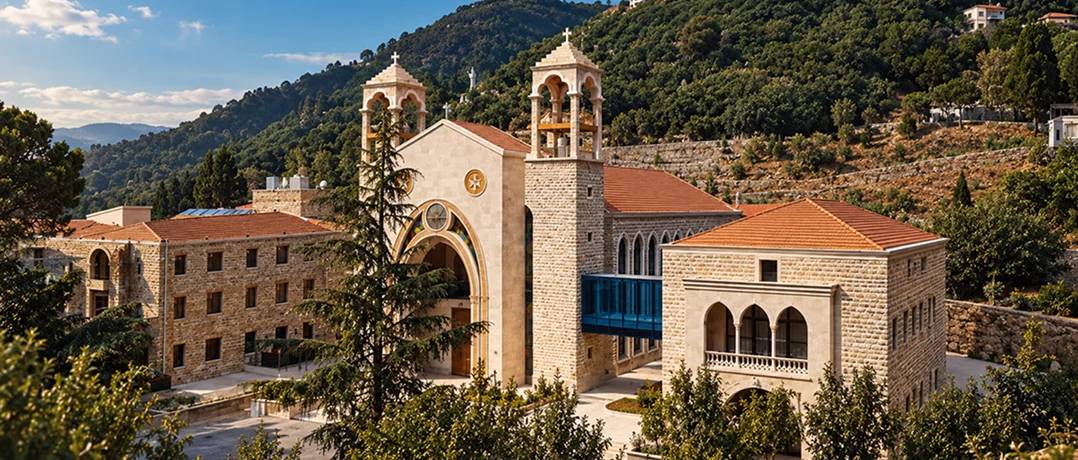
In the Keserwan mountains, 36 kilometers north of Beirut and 950 meters above the sea, the village of Ghosta, above Harissa, commands a sweeping view over the Bay of Jounieh. Its stone houses climb the hillside beneath a canopy of pine and oak, and its skyline is dominated by monasteries, church bell towers, and, since recent years, Lebanon's tallest statue of Christ. But Ghosta's real distinction lies less in its scenery than in what happened inside its walls. For three centuries, this Maronite village functioned as one of the intellectual and spiritual engines of Mount Lebanon.
Ghosta's own name is one of its oldest unsolved questions. Proposed origins include the Latin Augusta, tying the village to the Roman imperial title; a Syriac root meaning refuge or shelter; and separate local traditions linking the word to an aromatic plant or to concepts of justice and measure. The Lebanese Army's historical account of the village preserves several of these explanations and also cites the nineteenth-century French scholar Ernest Renan, who observed that a number of place names along the Keserwan coast seemed to carry echoes of Greek or Latin, Ghosta among them.
The making of Maronite Keserwan
Ghosta’s historical narratives reach back further, describing a Phoenician sacred site on the village's ground, later succeeded by a Roman temple or military post. Massive worked stones built into later religious structures are sometimes pointed to as physical traces of this older layer, and church sources at Deir al-Kreim themselves state that the monastery appears to sit atop the remains of an earlier fortress or temple. A separate strand of village memory reaches into the Crusader era, associating Ghosta's name with Philippe Auguste, Philip II of France, a leader of the Third Crusade, through a story of a companion who settled in the heights above the coast.
That documented history begins early. After the Ottomans absorbed Syria and Mount Lebanon following their defeat of the Mamluks in 1516-1517, Ghosta appears within just a few years in Ottoman fiscal records, 11 Christian households in 1523, 12 households and one bachelor in 1530, and 15 households and one bachelor by 1543. Ottoman registers tallied taxable households and certain categories of men, not full census totals. A settled Christian community existed there from the first periods of Ottoman rule, and the growth visible between 1523 and 1543 points to a small village already expanding.
That expansion did not happen in isolation. The Khazen family, one of Keserwan's most powerful Maronite notable houses, combined landholding with local political authority and sustained patronage of the Maronite Church throughout the Ottoman centuries. Ghosta offers unusually visible evidence of exactly this alliance between noble families and church institutions, it was Khazen sheikhly backing that helped found the Ain Warka monastery in 1660, and a Khazen land grant in 1716 that let Armenian Catholic monks establish what became the Monastery of the Holy Savior. Ghosta's religious rise, in other words, was inseparable from the political architecture of Maronite Keserwan.
The "Sorbonne of the East"
Ain Warka itself became the village's defining institution. Founded in 1660 by Bishop Jirjis Khayr Allah Istifan, its church was consecrated in 1698 by Patriarch Stephen Doueihi. In 1789, Patriarch Joseph Estephan converted it into a formal clerical seminary, with classes beginning in 1797–98 under Patriarch Joseph Tyan, modeled on the Maronite College in Rome. Notably, Ain Warka predated most of the well-known nineteenth-century missionary schools, it was an indigenous Maronite response to the need for higher education, built before European and American institutions expanded into the region.
The school's reputation grew so quickly that it rivaled the great seminaries of Europe, teaching five languages alongside theology, philosophy, and science, earning it the nickname "the Sorbonne of the East" from the writer Maroun Abboud. It produced four Maronite patriarchs and twenty bishops and helped seed the school networks that trained many figures of the nineteenth-century Arab Nahda.
But that golden age did not last forever. As Lebanon's educational landscape grew crowded with Jesuit, Protestant, Catholic, Orthodox, and Armenian institutions, and as the Syrian Protestant College (later the American University of Beirut) and Saint Joseph University began operating on a scale the old seminary couldn't match, Ain Warka's ecclesiastical school gradually declined, finally closing in 1952. The site did not simply become a relic. In 1956 it became home to the Young Girl of Lebanon social institution, serving students and people in difficult circumstances, and on September 14, 1966, eight novices received the habit there, founding the Missionary Sisters of the Very Holy Sacrament, the order that still runs the building as an orphanage today. A site built for seventeenth-century monasticism and eighteenth-century reform kept reinventing itself well into the twentieth century.
Deir al-Kreim and the Missionaries
The second great monastery, in the Wadi Ghosta below the village, followed its own arc. Armenian Catholic monks settled there after the 1716 Khazen land grant, building the monastery and church complex through 1733. When the Armenians later relocated to Bzoummar, the priest Youhanna Habib, later honorary bishop of Nazareth, bought the property in 1865 and, with priests including Estephan Qozzah, founded the Congregation of the Maronite Lebanese Missionaries there. From this mother house, missionaries fanned out across Lebanon and Syria to preach and do pastoral work, and the congregation later expanded abroad alongside the great waves of Lebanese and Maronite emigration. A new church honoring Habib was added to the site in 2018, with his tomb inside it.
Ghosta's cultural output matched its religious weight. The village was the birthplace of Daoud Corm (1852-1930), a founding figure of modern Lebanese painting who trained in Rome, painted Pope Pius IX, and later mentored a young Khalil Gibran, and of Philippe Ziade (1909-2005), a pioneering Lebanese journalist and news-agency founder.
Footprints from the age of dinosaurs
Ghosta is the country's first confirmed dinosaur tracksite. On the road
linking Harissa to Ghosta, at the nearby locality of Batha, researchers
documented around ten distinct trackways preserved across limestone surfaces
from the Lower Cretaceous period, likely left by sauropods alongside either
theropods or ornithopods. The find was significant enough to be published as
the first scientific record of its kind in Lebanon. In 2022, Lebanon's
Directorate General of Antiquities confirmed the discovery to the Ministry of
Culture, describing footprint traces stretching along roughly 500 meters of
rock face and dating to about 125 million years ago, likely belonging to
ornithopods, theropods, and sauropods.
Ghosta traces Keserwan's transformation from scattered mountain settlements into the heartland of Maronite ecclesiastical power, shows the tight bond between landed families and the Church, preserves the memory of Maronite-Armenian Catholic cooperation, and produced a school that shaped the intellectual life of an entire century. Today the village carries pine forests, hiking trails, old wooden bridges, and a towering statue of Christ alongside its two historic monasteries, a village that has spent four centuries evolving, yet still maintaining its spirit.
-
-

-
Jenna GeageaReporter/Writer
-
