



Lebanon’s apple harvest faces a season of uncertainty
Lebanon’s apple harvest faces a season of uncertainty
By Jenna Geagea | October 04, 2026

Reading time 4 min
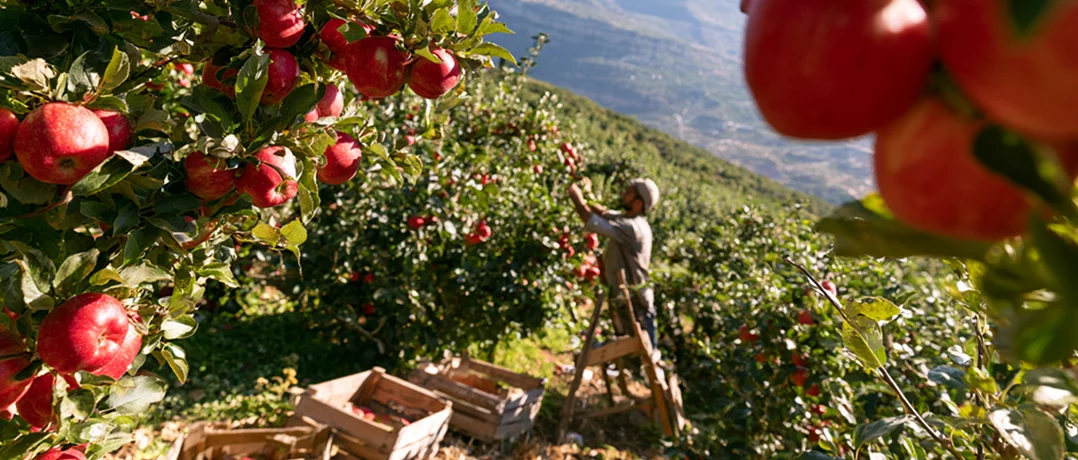
During this time, the high orchards of Lebanon grow heavy with fruit, and the work that follows has barely changed within living memory. Pickers climb ladders at first light, twist each apple from its branch so the stem stays intact, and lay it gently into padded crates before the midday heat softens the skin.
According to the Agriculture Ministry, the country has more than 26,000 apple growers working some 16,500 hectares. This season the ministry puts the crop near 200,000 tons. The local market absorbs only a quarter to a third of that, so the harvest becomes a race from branch to crate, from crate to cold store, and from cold store to a truck bound for a buyer abroad.
Bsharri: "A full tree, an empty pocket"
Victor Seba has worked the same terraces in Bsharri since boyhood, and this year his branches are bowed. "Almost every blossom became a fruit," he told The Beiruter. "In my father's time, that was a blessing. Today it makes me nervous."
His nerves have a basis. Heavy loads push prices down, with crates opening at roughly $6 to $10, while cooling costs could reach two- or three-times last year's. Victor recites his own bill. "Fertilizer, diesel for the pump, tankers when the spring dries up, the pickers, the crates. Then the trader arrives and offers a price that barely covers the pickers."
Victor rejects overpricing. "Nobody in Bsharri is greedy. We ask for what the fruit cost us." Timing is another source of pressure. Victor warned that if everyone harvests the same variety at the same moment, the market floods and selling becomes harder. "But an apple picked early does not taste right, and a buyer remembers that." Picking too early without checking sugar levels risks bland fruit, while waiting too long leaves it overripe, poor for storage, and likely to drop to the ground.
Saida and the south: "We farm on top of a question"
Hussein Fakhreddine tends an orchard in the hills behind Saida, and his troubles began long before the picking. Between October 2023 and July 2024, Lebanon's National Council for Scientific Research counted 175 white phosphorus attacks in the south. Many started fires that damaged more than 600 hectares of farmland. The Ministry of Environment later tested soil from sites hit by artillery and white phosphorus and found heavy metals and phosphorus at around 900 times the normal level.
The agronomy explains why this matters to a grower. Excess phosphorus blocks crops from absorbing nutrients and can seep down into groundwater. "The tree does not care who is right politically," Hussein explained. "If the roots cannot take what they need, the fruit stays small. If the well is touched, everything is touched."
The science is also incomplete, and he acknowledges it. Researchers note there is little data on how the chemical behaves in Lebanese soil and no evidence so far that it has entered the food chain. "That is exactly the trouble," he told The Beiruter. "Nobody can promise me the fruit is dangerous, and nobody can promise me it is safe. A buyer at the Saida wholesale market only needs doubt to walk away."
Reports from this year add to the worry. Aircraft sprayed glyphosate along a 17-kilometer border strip in February at concentrations 20 to 30 times the usual. The ministry's own May report counts about 56,000 hectares affected by the fighting, around 18,500 of them directly damaged, with irrigation networks hit in 64 towns. Hussein points to what that means on his slope. "I could not prune on time. I could not spray on time. Some days I could not reach the lower rows at all.”
Testing is where the doubt can be answered. In Lebanon, laboratories test fruit for pesticide residues, and according to Hussein, demand for these tests keeps growing. A residue test is not a soil analysis, and it cannot clear a field of white phosphorus or heavy metals. Still, Hussein sees its value. "If a buyer holds a paper that says the fruit is clean, he has something to stand on," he said. "Right now, all I can offer is my word and my father's name."
Aqoura: "The middleman sets the price"
In Jbeil, Joseph Khoueiry has the opposite fear. Aqoura and its neighbors produce around a million crates in a normal year, and most of the families picking them own plots inherited from their fathers. About nine in ten Lebanese apple growers produce fewer than 1,000 crates.
"Small holdings mean small power," Joseph explained. He sells to brokers because the nearest cold store, in Qartaba, runs older equipment and charges accordingly. "If I store, I pay twice and wait for a buyer who may not come. If I sell now, I lose money in a different way." A hot, dry summer and failing springs forced him to buy water by the tanker, which pushed his costs higher still.
Quality rules add another burden. Joseph explained that brokers often push growers to pick early, before the sugar levels are right, because early fruit means an early sale. Testing is not optional, since apples headed for export are sometimes rejected or even destroyed over pesticide residue. "A rejected shipment is not the trader's loss alone," Joseph pointed out. "It is the price of the whole village's crop, because the next buyer starts to doubt every Lebanese box."
Beyond the orchards, the apple remains one of Lebanon's most valuable crops. It stores well, travels reasonably, and turns into vinegar, molasses, juice, and preserves when the fresh market fails. Its future depends on things no single grower controls. For the farmers who depend on it, the apple is a livelihood, a tradition and a vital part of Lebanon's agricultural economy.
-
-

-
Jenna GeageaReporter/Writer
-
