



Lebanon’s Constitution centenary invites citizens, especially younger generations, to explore its history, understand their rights and engage in shaping the country’s future.
A century of the Constitution at a pivotal moment
A century of the Constitution at a pivotal moment
By Joanne Naoum | October 06, 2026

Reading time: 7 min
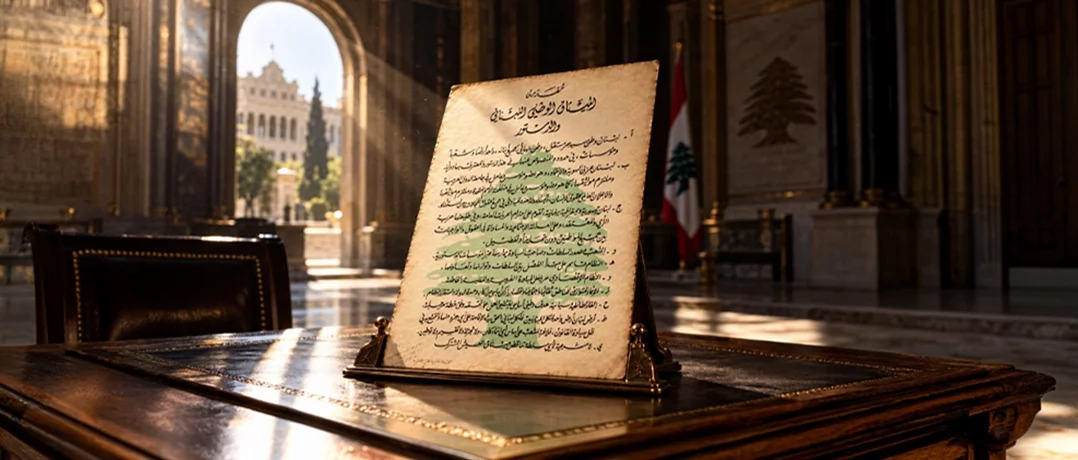
“The centenary should not simply commemorate the Republic’s first hundred years; it should help Lebanon begin the next hundred with a stronger understanding of its own history, its institutions and the experiences that have shaped them,” with these words Lebanon’s ministry of Culture Ghassan Salame described the purpose behind the centenary of the Lebanese Constitution.
Coinciding with a pivotal moment for the country, the exhibition marking the Constitution’s 100th anniversary on October 8 carries particular significance. “A centenary naturally invites us to look backwards, but it is perhaps even more important as an opportunity to look forward”, Salame told The Beiruter.
He pointed out that the Lebanese Constitution has accompanied the country through a century of profound political, social and institutional transformations. It has been amended, tested by crises, and sometimes applied in ways that have generated debate. Yet it remains, Salame noted “the fundamental framework of our common political life.”
This is precisely the meaning of “Between the Lines of the Constitution”, he said. The exhibition seek to return to the documents, the debates and the historical record: how the Constitution was written, who participated in its formation, how it evolved, how it is linked to citizen's daily lives and fundamental rights, and how constitutional practice developed alongside the written text.
The Constitution is not simply a document that belongs to the past. It structures the relationship between citizens and the State and between the institutions themselves. Understanding what is written in it, is an essential starting point for any serious discussion about Lebanon’s future.
To the young generation
A significant initiative initiated by Lebanon’s president Joseph Aoun earlier this year was when he announced that the commemoration was intended to promote a better understanding of the constitutional principles and the parliamentary democratic system, and to help Lebanese citizens, particularly the younger generation, understand the characteristics of their political system and their role in the democratic process.
“Young people are particularly important because the Constitution should not remain the preserve of constitutional lawyers or political leaders,” Salame explained, “It ultimately concerns every citizen.”
For many young Lebanese, he noted, constitutional questions are encountered primarily through political crises such as a presidential vacancy, the formation of a government, the functioning of Parliament, or disputes over the powers of institutions.
One of our objectives is to make the Constitution understandable outside these moments of crisis and to reconnect it with everyday citizenship. Meaningful participation therefore begins with access to knowledge.
That is why an exhibition of this kind matters, Salame said, by bringing original documents, archives, photographs and historical debates into a public space, we are trying to transform constitutional history from an abstract subject into something accessible and tangible.
The longer-term objective, Lebanon’s culture minister emphasized that it should be “to create opportunities for students and young citizens to question and engage critically with this history.” Their role, he noted, should not be to reproduce established positions, but to acquire the knowledge necessary to form their own.”
A stronger constitutional culture is ultimately built through citizens who know their institutions, understand their rights and responsibilities, and are capable of distinguishing between what the Constitution actually says and what political practice has made of it.
The supreme law of the land
The centenary comes at a pivotal moment for Lebanon, amid one of the most severe crises in its history. The Constitution has witnessed, and at times stood at the center of, many of the country’s disputes and conflicts since its adoption.
Me Antoine Sfeir, advisor to the President and national coordinator of the Centenary of the Lebanese Constitution, told The Beiruter that this year’s centenary is an invitation by the President to commemorate the 100th anniversary of the establishment and adoption of the Lebanese Constitution and the proclamation of the Lebanese Republic in 1926.
Sfeir said the President’s call rests on three fundamental elements, beginning with the need to recognize the significance of the Constitution itself.
We should take pride in having a constitution that, from the onset, was among the most modern constitutions in the region and one of the earliest of its kind,
stressing that it is “a secular constitution that does not derive legislation from any religious law or faith, but rather from civil laws established in accordance with international standards.”
“Despite the tragedies, difficulties and crises that have affected Lebanon, a Constitution remains in force,” Sfeir said. He pointed to its guarantees of “public freedoms, freedom of expression and freedom of belief,” as well as its principle that “no authority can derive legitimacy from an exercise of power that contradicts the National Pact and the principles of coexistence.” He also highlighted the Constitution’s commitment to “a free economy, individual initiative and private property,” as well as the continued existence of constitutional institutions.
The second element, Sfeir said, is to make the centenary an opportunity to bring the Constitution closer to the public, particularly younger generations. He noted that the President has called on “schools, municipalities, universities, professional associations and others” to mark the occasion through seminars, round tables, conferences and other initiatives.
The aim, he said, is not only to generate material for academic research, but also to ensure that young people become familiar with the Constitution “both in its text and in its spirit.” This, he stressed, “is directly linked to the very identity of Lebanon, because no country can exist without a constitution.”
The third element is to ensure that these discussions produce something that extends beyond the centenary itself. “The discussions, debates and conferences held throughout this year” should provide a basis for future reflection on “the development, modernization and possible updating” of constitutional provisions, so that they remain responsive to the needs of society and better serve future generations.
But the centenary also raises the question of how the Constitution is applied in practice. According to the national coordinator of the centenary of the Lebanese constitution, the starting point is clear: “The Constitution as it stands must be respected and implemented in accordance with the standards and principles it establishes and in keeping with the spirit in which it was adopted.”
This, Sfeir said, means avoiding constitutional vacuums and delays in constitutional deadlines. “There should be no constitutional vacuum, nor should constitutional deadlines be postponed,” he said, pointing for example to presidential elections. The constitutional legislators, he argued, “certainly did not envisage the possibility of a prolonged vacancy,” having established safeguards to ensure continuity in the constitutional process.
The Constitution must therefore be implemented “in good faith,” Sfeir told The Beiruter. Where provisions require development or amendment, this should be done through the mechanisms provided by the Constitution itself and through Parliament.
At the same time, he stressed that the Constitution must not become a political instrument. “The Constitution must not be politicized or made subject to changing political circumstances,” he said, describing it as “the supreme law of the land.”
Nonetheless, he cautioned against treating it as untouchable.
It cannot remain permanently rigid, as the passage of time may reveal shortcomings or provisions that no longer respond to society’s needs. It is a natural development in any constitutional system.
The centenary events begin with "Between the Lines of the Constitution" on October 8. Lebanon’s culture minister pointed out that the exhibition is intended as a starting point rather than an isolated commemorative event. “We would like the centenary to create a broader public conversation around the Constitution, its history and its place in Lebanese civic life”, he told The Beiruter.
Salame explained that the intention is “to develop a program around the exhibition bringing together historians, constitutional experts, universities, students and the wider public. We also want to use the archival and research work undertaken for the exhibition beyond the physical exhibition itself, so that this material remains accessible and useful after the centenary”.
He pointed out that this exhibition is part of a larger effort by the Ministry to preserve and make accessible Lebanon’s national memory. “The centenary of the Constitution is also the centenary of the Republic’s institutional history, and it provides an opportunity to begin documenting that history in a more systematic way,” he concluded.
-
-
-
Joanne NaoumHead of Political Desk
-
