



Lebanon’s record-breaking freediver dives against the odds
Lebanon’s record-breaking freediver dives against the odds

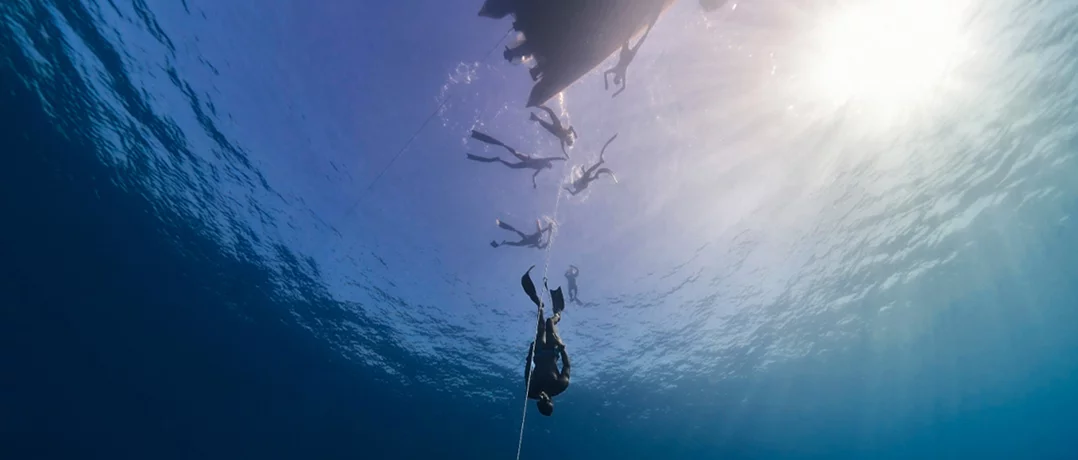
On a single breath, Marc Bou Mansour can descend to 81 meters underwater, a depth comparable to the height of a 25-storey building. Once he surfaces, another part of his work begins, training others to follow in his footsteps. With 14 national records to his name and a personal best of 81 meters, Bou Mansour has established himself as one of Lebanon’s leading freedivers. He has built his career largely independently, without the backing of a federation or sponsors, while maintaining a full-time job.
The sea has always been part of his life. “I grew up by the sea,” he told The Beiruter. As a boy he hunted fish with a speargun, going down ten and then twenty meters. “I had no technique. I was doing it all on my own.”
From spearfishing to world championships
Eventually he learned that freediving existed as a sport and signed up for a course. The results were immediate. “I had very good adaptation from the spearfishing I was doing,” he explained. “When I learned the right technique and the knowledge I didn’t have, it showed that I had very good results.”
His first competition came in 2021, at the World Championship. “I broke all the records that existed then” he remembered. He has not stopped since. “I’m still breaking records.” He now holds 14 national records, the deepest being the 81 meters he reached in his most recent competition. At the latest world championship, he was ranked number 13 in the A team.
However, records do not pay the bills. Freediving is Marc’s full-time job, as he runs his own school. “Three quarters of my time, I’m teaching in the morning,” he explained. He trains whenever he can, often squeezing in “a dive or two” when an advanced free diver is available to act as his safety. For most of the year he is barely training at all. This September, he paused teaching for a month to train with his teammates.
“It’s extremely difficult,” he admitted. “Either you’re an athlete or you’re a coach. But I’m trying to do both.” He believes the cost is real. “My target is to reach 100 meters within a year with the right training, but I also need to earn a living.”
Freediving may appear frightening to those unfamiliar with the sport, particularly given the depths athletes reach while holding their breath. Marc acknowledges that it is an extreme sport, but stresses the importance of proper safety measures. “The greatest risk arises when freediving is practiced alone. In the event of an emergency, there may be no one available to perform a rescue.”
When practiced under appropriate conditions, with a trained safety team in place, the risks can be managed. The main danger is hypoxia, or oxygen deprivation, which can cause a diver to lose consciousness briefly. “In the event of hypoxia, a diver may lose consciousness for a few seconds. With a timely rescue, they can regain consciousness and recover,” he explained. Unlike injuries commonly associated with other sports, such as fractures, the immediate risk he describes is a loss of consciousness caused by a lack of oxygen.
His own record backs it up. “In competition, or anywhere it’s done properly, it is one of the safest sports. I’ve never had an accident, and neither has anyone on my team.”
An uphill climb in Lebanon
In Lebanon, athletes in the sport work largely alone. Two organizations oversee freediving, CMAS and AIDA. The local CMAS federation, Marc explained, exists “in name only.” Its only real supporter, a man who used to help the team with logistics, has died. Today the team competes through AIDA, the international body, which only requires a representative in Lebanon to send its athletes.
Funding is the harder problem. Marc tried to find sponsors and ultimately gave up. “I thought it would be easier,” he reflected. “Then I found out it wasn’t. This is not basketball or football.” Without media coverage, brands see little reason to invest.
The team finances itself, with one exception this year. “We found someone who helped us, a private company, because we know them in person.” The cost is more than money. “If we had some coverage, I could be doing only freediving, training in a way that would put us on the podium at this championship.”
The sport has taught him much about himself. He has become calmer. “In a dive, you have a hundred problems to solve, and you have to stay relaxed at the same time. You simply cannot panic.”
Meanwhile, his mind must coordinate everything at once. “We keep going. We learn to stay calm under this pressure.” He said the lessons extend beyond the water. “Freediving teaches you to approach everyday problems from a different perspective and to manage pressure more effectively.”
Marc’s next priority is to make more room for training. He hopes to restructure his freediving school to reduce the time and physical demands of teaching, allowing him to devote more energy to his own performance. He knows that his peak competitive years will not last indefinitely. “I still have a few years in which I can perform at my best,” he explained. “Eventually, I will get older, so I want to make the most of this time.” Over the next decade, he hopes to find a more sustainable balance between earning a living and pursuing the sport at the highest level.
Reaching his target depth of 100 meters will depend on having the time, resources and discipline to train consistently. His ambition is powerful, the challenge is creating the conditions to pursue it.
-
-
-
Jenna GeageaReporter/Writer
-
