



As Lebanon’s public institutions struggle to meet citizens’ needs, NGOs, political groups and international donors are gaining a larger role in delivering services and shaping priorities.
When the Lebanese state disappears, who governs?
When the Lebanese state disappears, who governs?
By Christiane Gemayel | October 13, 2026

Reading time: 5 min
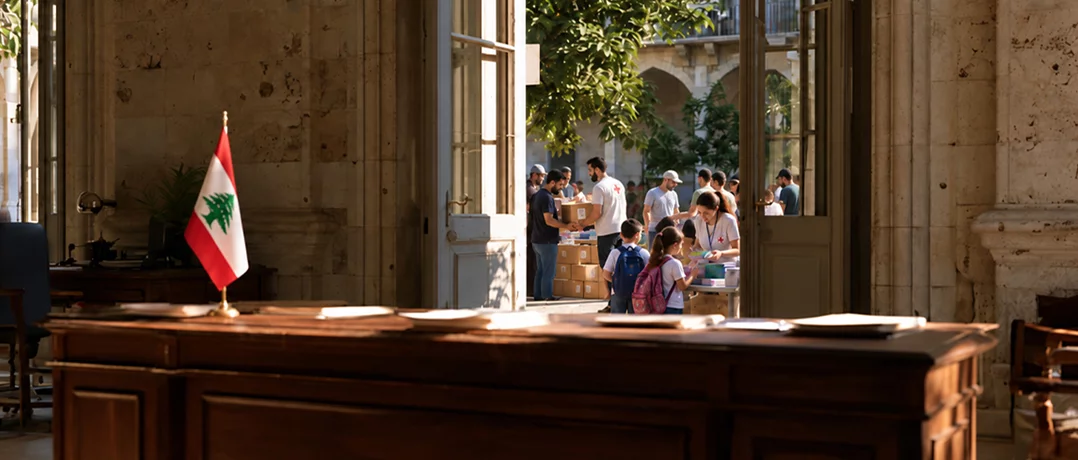
There is a quiet transformation taking place in Lebanon. No law announced it. No government voted for it. No parliament approved it. But look at what happens when a Lebanese citizen needs help. A medical bill. A scholarship. A rebuilt house. Food. Legal assistance. Social protection. Increasingly, the answer is not always the Lebanese state. It is an NGO. A charity. A political movement. An international organisation. A foreign-funded programme. And that raises a question we rarely ask: When the state cannot provide, who takes its place? Because whoever fills the gap does more than provide a service. They can also gain influence.
When assistance becomes power
Lebanese citizens have spent years learning not to wait for their state. Need healthcare? Find a connection. Need education? Find an organisation. Need reconstruction? Find a party or charity. Need social assistance? Find a donor-funded programme. There is nothing wrong with helping people. On the contrary, Lebanon needs every organisation, institution and individual willing to help. Many NGOs are doing genuinely valuable work. They support vulnerable families, provide healthcare, defend victims, assist children, respond to emergencies and help communities where public resources are limited. Their contribution should not be dismissed. But there is another side to the story. When citizens receive essential services not only as rights guaranteed by the state, but increasingly through outside organisations, dependency can replace citizenship. And dependency can become political capital. A hospital is not simply a hospital when the state cannot provide affordable healthcare. A rebuilt home is not simply reconstruction when the government response is limited. A scholarship is not simply education when families have no alternative. The service creates a relationship. The relationship can create influence. This is where the NGO story becomes political.
Hezbollah understood the model
Hezbollah did not build its influence through weapons and politics alone. It also developed a vast social infrastructure: Jihad al-Binaa, the Islamic Health Organization, Al-Imdad, the Martyrs Foundation and the Imam al-Mahdi Scouts, among others. Healthcare. Reconstruction. Welfare. Education. Youth activities. The message does not need to be stated: The state cannot help you. We can. When that message is repeated for years, social assistance becomes part of a larger system of influence. This is how parallel authority grows. The weaker the state's presence becomes in people's daily lives, the more important alternative networks can become.
But the story does not end with Hezbollah
Lebanon has another enormous ecosystem: internationalised civil society. NGOs and international organisations now operate across healthcare, education, humanitarian assistance, human rights, governance, refugees, gender, environment, social protection and many other fields. Again, much of this work is necessary. Some organisations provide services that the Lebanese state, because of limited resources and institutional pressures, cannot always provide alone. The question is not whether they should exist. The question is who sets the priorities? When foreign donors finance programmes, their priorities naturally shape what receives money, research, attention and advocacy. One donor focuses on gender. Another on refugees. Another on governance. Another on climate. Another on human rights. Another on electoral reform. These issues may all be legitimate. But when the Lebanese state is struggling to define, finance and implement its own national social priorities, something changes: The priorities of those who finance programmes can begin to influence the priorities of the country itself. That is the hidden political dimension of the NGO phenomenon.
Influence does not require a conspiracy
This does not mean every NGO is political. It does not mean every foreign-funded organisation is serving a foreign agenda. And it certainly does not mean civil society should be attacked or shut down. On the contrary, a healthy country needs a strong civil society working alongside strong public institutions. The issue is balance. Influence works in a much simpler way: Money creates programmes. Programmes create advocacy. Advocacy creates pressure. Pressure can influence policy. Ideas travel through institutions. And when organisations are sometimes better funded and better organised than public institutions, their ability to shape public debate can become considerable. So the questions should be straightforward: Who funds the organisation? What does that funding prioritise? Who benefits from its advocacy? And how much influence does it have over public policy? These are questions of transparency, not hostility.
The unelected power
A government can be questioned. A parliamentarian can be voted out. A political party can lose an election. But what mechanism allows Lebanese citizens to hold an international donor accountable for the priorities it finances inside Lebanon? And who holds an NGO accountable when its advocacy begins influencing legislation, education or public policy? These questions do not diminish the important work of NGOs. They simply remind us that public influence should come with transparency and accountability. A strong civil society and a strong state should not be competing for the same space. They should be reinforcing each other.
The real problem is the gap
The danger is not that Lebanon has NGOs. The danger is that there are areas where the state has not been able to fully meet the needs of its citizens. And when there is a gap, someone inevitably steps in. Political parties provide patronage. Hezbollah maintains its social infrastructure. International organisations provide humanitarian assistance. NGOs provide services and advocacy. Foreign donors finance programmes. Charities provide welfare. Each may be responding to a real need. But when too many essential functions are carried outside the state's institutional framework, the state can gradually become less central to the citizen's daily life. This does not require one grand conspiracy. It requires only one thing: A gap. And gaps are always filled.
Lebanon cannot outsource sovereignty
The answer is not to shut down NGOs. Lebanon needs civil society. It needs humanitarian organisations. It needs international assistance. And it needs the many Lebanese and international organisations that are genuinely helping people every day. But assistance should ultimately strengthen Lebanese institutions, not permanently replace them. NGOs should support institutions, not become parallel ministries. Foreign donors can help Lebanon, but they should not quietly become the authors of Lebanon's national priorities. Political parties should compete for votes, not dependency. And social rights should belong to citizens because they are citizens — not because they belong to a particular political, sectarian or ideological network. Because ultimately, this is not a debate about whether NGOs are good or bad. It is a debate about where responsibility lies. The government? The elected institutions? Civil society? Or the growing network of political movements, charities, NGOs, international organisations and donors filling the spaces that public institutions cannot always fill? Lebanon does not have too many NGOs. It needs a stronger state alongside a strong civil society. Because NGOs can help citizens. They can protect them. They can empower them. But the ultimate responsibility for guaranteeing their rights must remain with the state. Otherwise, citizens slowly stop experiencing rights as something guaranteed by their country. They experience them as something provided by whoever happens to be there. And when dependency replaces citizenship, sovereignty begins to disappear. Not at the border. Inside everyday life.
