



From emergency training in the southern village of Toura to displacement tracking in Tyre, The Beiruter reports from inside the Lebanese Red Cross’s Disaster Risk Reduction unit as South Lebanon struggles to recover amid persistent conflict.
Inside the Red Cross’s Disaster Risk Reduction unit in Tyre
Inside the Red Cross’s Disaster Risk Reduction unit in Tyre
By Katharine Sorensen | October 13, 2026

Reading time: 7 min
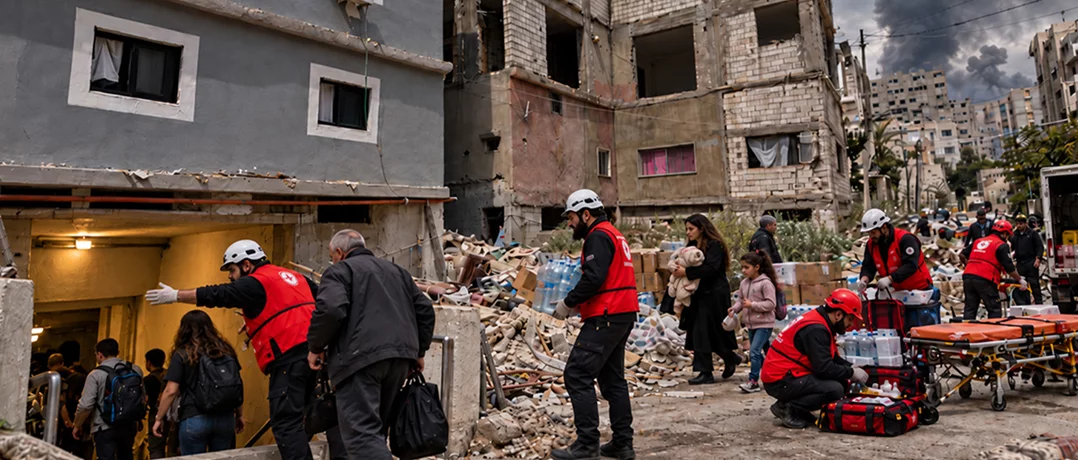
Eleven volunteers sat in a classroom studying seven laminated photographs. Primarily in their late teens or early twenties, still young enough to be in school or university.
Except the photographs before them were not material for an academic exercise. They were images depicting scenes of war.
As members of the first response team of the Islamic Risala Scout Association, the group had gathered for a training session with the Disaster Risk Reduction Unit (DRR) of the Lebanese Red Cross.
The photographs made for an unsettling collection.
One showed a building caught in the middle of an airstrike. Another captured a young girl standing amid rubble on a deserted street. In a third, a woman stood with her eyes shut and her hands pressed against her ears, as an explosion erupted behind her.
The last in the pile depicted three armed men walking along a road in broad daylight. They bore none of the insignia of the Lebanese Armed Forces (LAF). And yet each carried a gun, and two of them were masked.
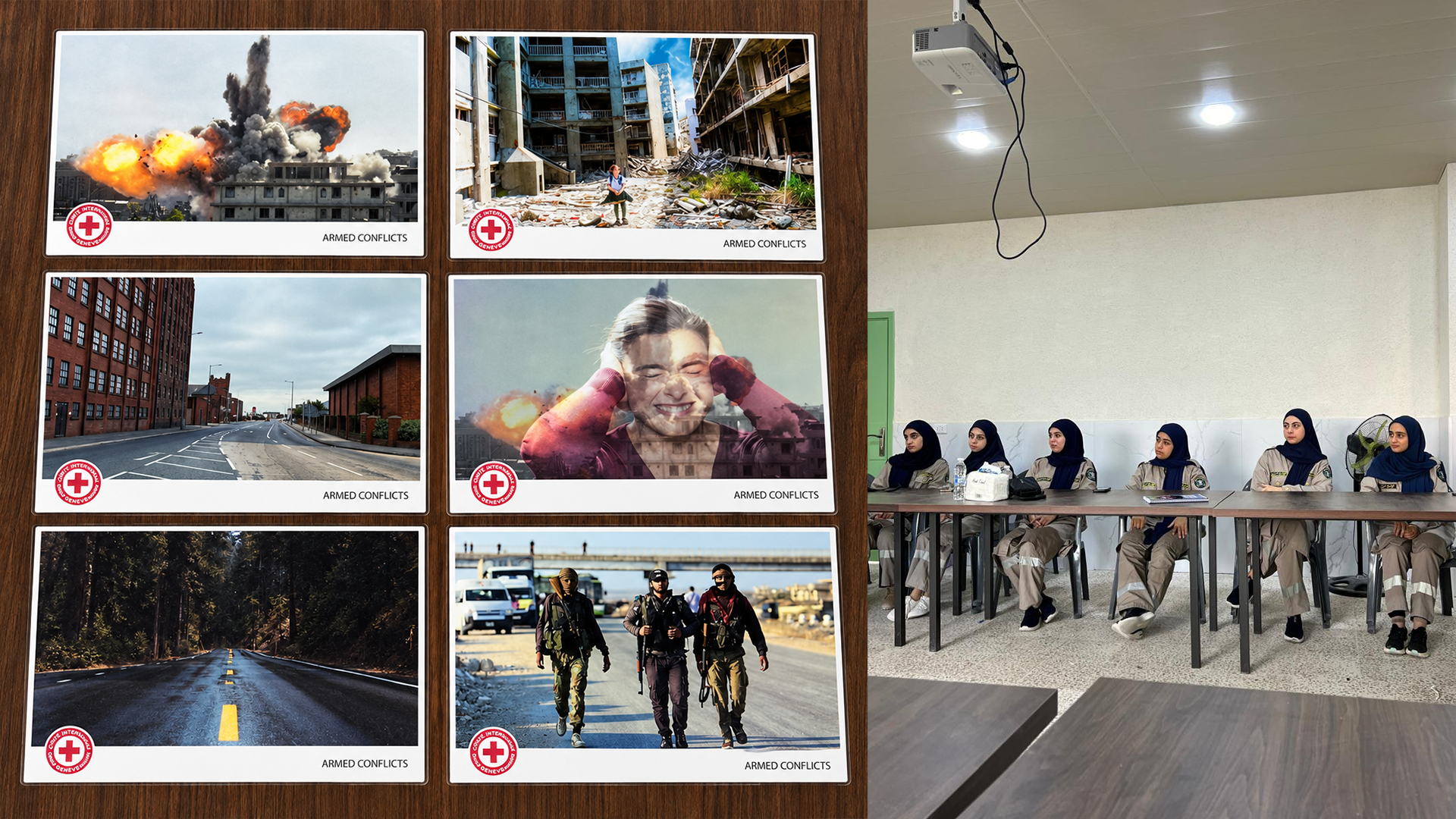
Training materials depicting armed conflict scenarios (left) and members of the Islamic Risala Scout Association's first response team attending a Lebanese Red Cross DRR session in Toura (right). Source: The Beiruter
For the participants in the room, the scenarios described were eerily familiar. The majority of them were born and raised in Toura, a 20-minute drive inland from the southern city of Tyre, in a region battered by successive rounds of fighting between Israel and Hezbollah since the war first broke out in March.
This was far safer and more controlled than encountering the same dangers in real life. Here, they could process each scenario without the fear and confusion that might overwhelm them in an actual emergency.
“You have every right to be afraid,” Kamal, the session’s instructor, said, as he moved through the photographs. “It’s completely normal, especially during war.”
“But when I'm screaming, I can't hear the people around me,” he continued. “I can't hear them telling me, “Lie down. Stay here.””
I'm not listening to them because I'm screaming.
A Lebanese Red Cross veteran of 48 years and former head of its DRR unit in Tyre, Kamal was accustomed to explaining how people should respond when danger strikes. His instructions were brief and practical:
Don't put yourself in a situation where your vehicle could be mistaken for a military target. Immediately rinse the affected skin with water if exposed to white phosphorus, and then go to the hospital. And do not stop to film or photograph the immediate aftermath of an airstrike. Getting yourself to safety comes first. The media can wait.
“Is that understood?” he asked.
The training session continued for approximately 45 minutes. The participants were attentive, with many jotting down notes or leaning forward to study the photographs spread on the table before them.
Before the training began, all eleven participants had signed an attendance sheet, recording their names, organizations, sex, positions, ages, nationalities and phone numbers. The information would later be used to keep a record of those who had completed the session.
“The goal is to master the technical skills of emergency missions,” said Mohammad, one of the participants.
How else will we be able to help ourselves and others?
Between recovery and conflict
The ambulances of the Lebanese Red Cross are a familiar sight across the country, particularly during the wars of 2024 and 2026. For many people, the organization is therefore associated, often exclusively, with emergency medical services and the treatment of the wounded.
While these operations remain indispensable to communities across Lebanon, another part of the organization, its Disaster Risk Reduction (DRR) unit, works to reduce the risks communities face before, during and after crises.
And Lebanon has faced no shortage of them.
Over the past six years, the country has endured an economic collapse, the Beirut port explosion, successive rounds of conflict and widespread displacement, often with little opportunity to recover before the next emergency.
The unit operates through 15 branches across Lebanon, with approximately 600 to 700 volunteers nationwide, including a team of around 20 in Tyre. Since 2010, the Red Cross has worked with the Union of Tyre Municipalities (UoTM) to develop local disaster management committees, train community response teams and establish contingency plans, according to Kassem Chaalan, Director of Lebanon’s DRR.
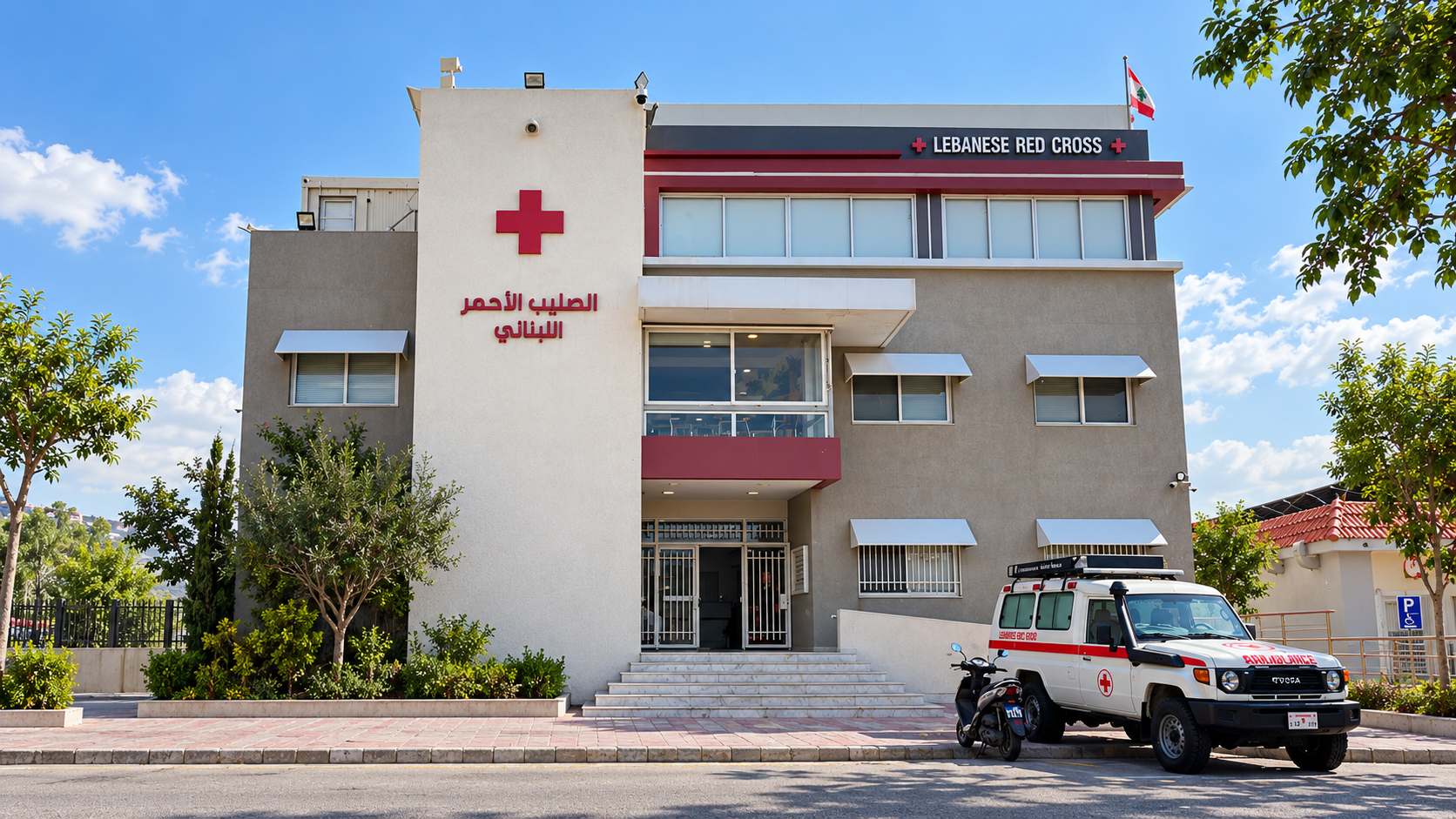 The Lebanese Red Cross center in Tyre, southern Lebanon. Source: The Beiruter.
“Communities move between displacement, return and recovery, often before the previous cycle is complete,” Chaalan told The Beiruter.
Risk today is recurrent and overlapping, and preparedness can no longer be designed around isolated events.
Nor do the region's other hazards disappear during wartime. Wildfires, floods, and extreme weather can compound the effects of damaged infrastructure and displacement, Chaalan explained, leaving communities to confront several emergencies at once.
“The DRR focuses on preparedness before the crisis hits,” said Lara Abdallah, a member of Tyre’s DRR since 2023.
But this recovery period is difficult because we are not fully recovering. People are afraid the escalation will rearise.
Driving through Tyre’s district, it is easy to see the physical consequences of successive rounds of fighting. While the drive from Toura back to Tyre is particularly scenic, taking you past hills lined with rows of southern Lebanon's famous olive trees, fragments of destroyed infrastructure periodically appear along the way, disrupting the otherwise peaceful landscape.
Several minutes north from the Red Cross’s center in Tyre, a makeshift graveyard has taken form in an old abandoned lot, now overgrown with weeds. Amid the overgrowth lie 14 graves, most marked simply with flowers and cinder blocks, with some also bearing small Lebanese flags.
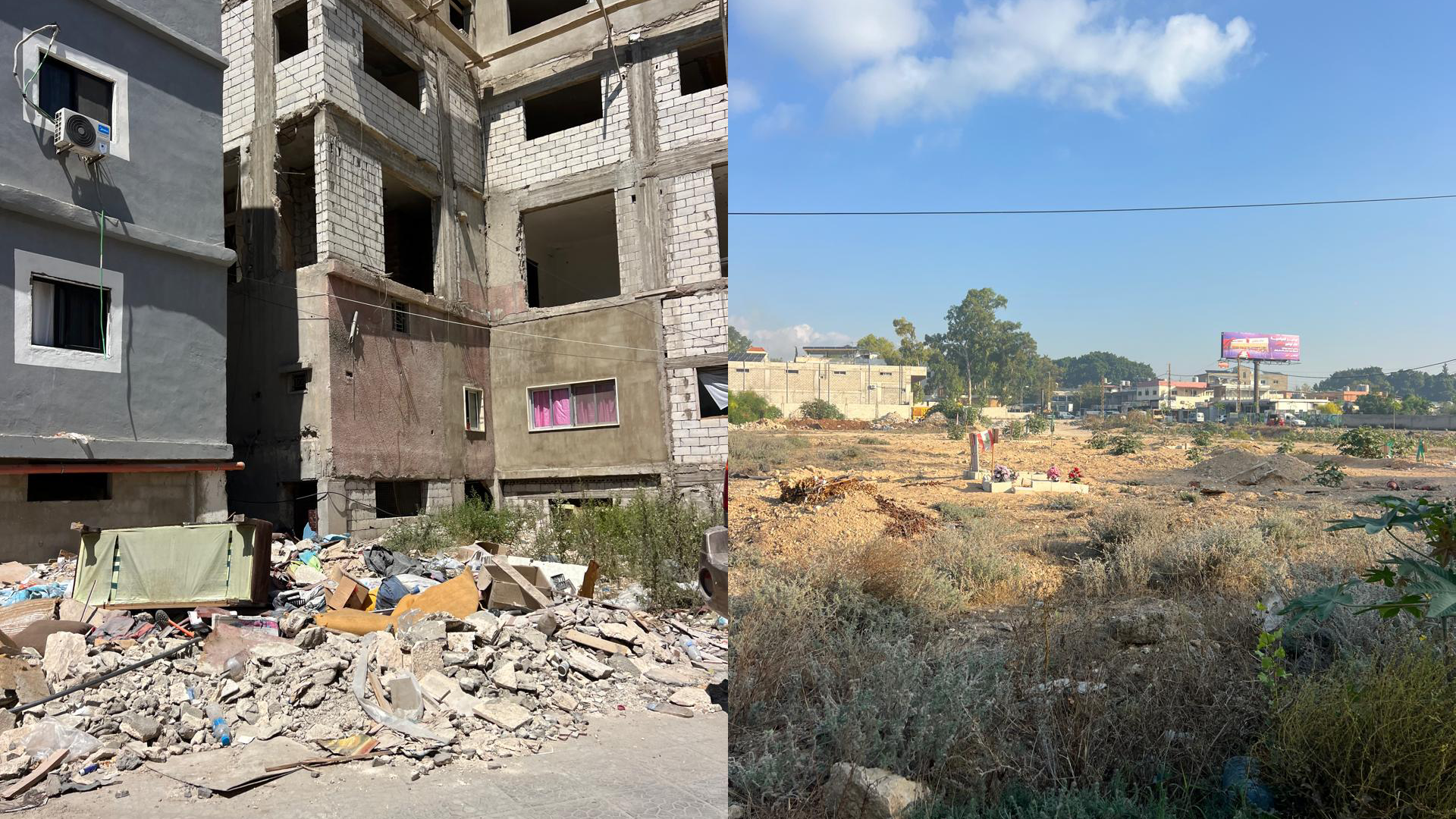 A damaged building surrounded by rubble (left) and a makeshift burial site in an overgrown lot near Tyre (right). Source: The Beiruter.
For some, the war has made returning home impossible, even for burial.
A district in numbers
Documenting the damage in Tyre has become a daily part of the DRR’s response to war.
Across six months, The Beiruter has returned three times to the DRR’s center in the Union of Tyre Municipalities, observing how DRR volunteers collect, organize, and update information about displaced families and the needs of communities across the district.
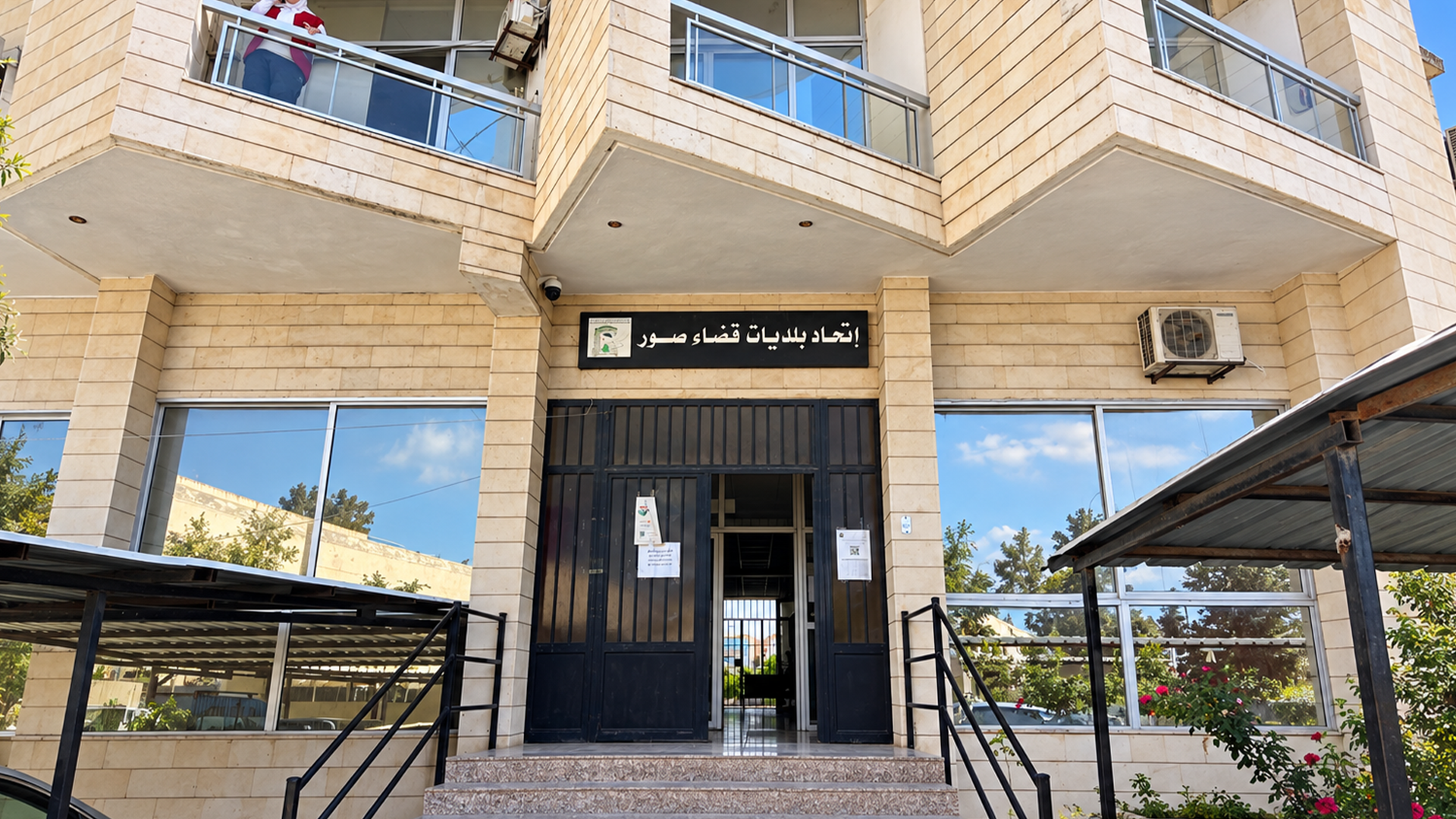 The headquarters of the Union of Tyre Municipalities, where Lebanese Red Cross disaster risk reduction volunteers support municipal authorities. Source: The Beiruter.
Displaced residents provide their household details to DRR volunteers, who record the information before passing the paperwork to a municipal official for review and a stamp. Eligible families can then collect assistance from a warehouse next door.
Over an hour and a half at the office, approximately 35 people passed through the registration area. The displaced typically arrive between 10 a.m. and 2 p.m., although municipal and DRR staff work beyond those hours. During emergencies, volunteers operate around the clock, taking turns on shifts to maintain the response.
Five Red Cross volunteers support the Union's emergency operations room each day, collecting, verifying and analyzing information through government-owned systems that inform municipal decisions, according to Chaalan.
The constant registration, at times, might seem monotonous. Many of the people who enter are confused and fatigued, unsure of how to begin navigating the registration process. But the DRR volunteers take the time to explain each step, responding to the oft-repeated questions with clarity and care.
“The value of the system is that it connects communities with authorities at the municipal, district, governorate, and national levels,” Chaalan said.
Communities are partners, not recipients.
Behind the registration area, two televisions mounted on the wall display dashboards tracking displacement, shelter occupancy and vulnerable populations, alongside the damage to housing and essential infrastructure across Tyre's municipalities. The figures are broken down by municipality, offering a detailed account of where people have fled, what has been destroyed and which services remain operational.
“The data is fundamental for decision making,” Abdallah said. Both dashboards, she pointed out, were made by DRR members.
The sheer scale of the statistics is staggering, and they paint a bleak picture of the damage across Tyre's district:
An estimated 102,825 people, or 21.5 percent of the population, have left the area.
Of the 62 municipalities surveyed, only 12.9 percent reported fully operational electricity networks, compared with 8 percent for telephone networks, 9.7 percent for water networks and 16.13 percent for sewerage systems.
Another 42,424 houses are partially or fully damaged or in need of rehabilitation.
There are 283 unaccompanied children, 696 widows, 500 single parents, and 315 pregnant women within Tyre’s registration system.
And 14/65 (21.5%) of Tyre’s municipalities are currently under Israeli occupation.
Mortada Mhanna, Director of the Union of Tyre Municipalities, said the destruction had left the areas in the occupied zone almost entirely unrecognizable.
There are no villages, no houses. They destroyed it completely. The land is like a football field.
For the municipalities outside the areas under Israeli occupation, the UoTM and DRR have asked them to identify their five most urgent priorities as they attempt to restore essential services.
“The municipalities need to recover to serve the people,” Mhanna said.
At the top of the list is repairing solar-powered systems that operate water wells, many of which were damaged during the war, alongside waste management. According to Mhanna, approximately 16,400 garbage bins have been damaged or destroyed, leaving municipalities struggling to collect household waste.
Clearing rubble and reopening roads are also urgent priorities. Of the 62 municipalities surveyed, only one reported a fully operational road network.
“One of the biggest operational challenges is access,” Chaalan said, explaining that damaged or unsafe roads can isolate communities and delay the arrival of volunteers and emergency assistance.
Mohammad, back in Toura, knew the consequences of destroyed infrastructure hindering emergency response well. When the village was first struck in this war, he had used his own car to transport someone to the local hospital before an ambulance could reach them.
Sometimes, he said, help from the outside doesn’t come quickly enough.
-
-

-
Katharine SorensenReporterSpecializing in global affairs, technology and economics, with a focus on on-the-ground investigative reporting.
-
