



A look at the 19th-century pioneers who transformed Lebanese painting from religious iconography into a professional art form shaped by local traditions and European influences.
The pioneers of 19th century Lebanese painting
The pioneers of 19th century Lebanese painting
By Jenna Geagea | October 14, 2026

Reading time: 5 min
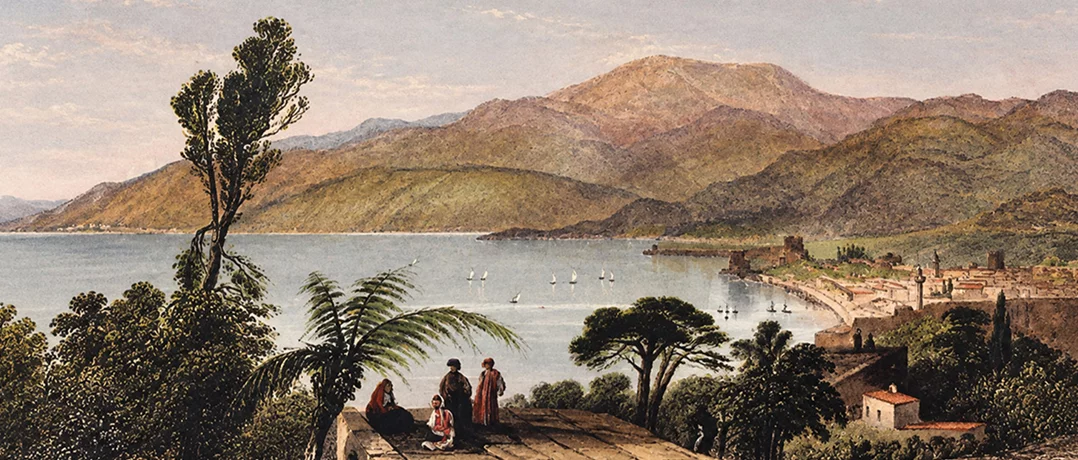
In the nineteenth century, painting in Lebanon moved from the monastery workshop to the professional studio. The change was gradual and uneven, and it shows a society negotiating between East and West.
The ground was laid earlier. In the early 1600s, Emir Fakhr al-Din II returned from exile in Tuscany and brought Italian artisans to build palaces with fountains, gardens and statues. In the same period, convents in the mountains became centers of learning, and printing arrived at Mar Qozhaya in 1610. Gothic-inspired religious imagery filled the churches. By the late 1700s, imported Italian and Austrian oil paintings and European statues were circulating as models. Emir Bashir II’s Beiteddine Palace combined arabesque, mosaic and calligraphic inscription with Western structure.
The cleric-painters
The first identifiable painters were churchmen. From the 17th century, priests studied painting, and some traveled to Italy to refine their skills. Before Daoud Corm, oil painting was largely confined to clerics trained by Italian missionaries and at the Maronite College of Rome, founded in 1584.
The best-known lineage is the Dib family. Moussa Dib ran a workshop in Beirut’s Mousaitbeh quarter, painted for churches across Mount Lebanon, and was called on to restore the frescoes at Qannoubin. His saints keep the rigid poses and golden haloes of Byzantine tradition, but with more expressive faces and more modeled bodies. His nephew Kanaan went further. Kanaan and Corm both trained with Constantin Giusti, an Italian painter who came to Mount Lebanon with the Jesuits in 1831. Kanaan gave his saints psychological weight and set them against landscapes and architecture instead of timeless gold. He also painted portraits, including one of Khalil Khoury, publisher of the early Arabic newspaper Hadiqat al-Akhbar in1859.
Two contemporaries leaned more toward Europe. Naamatallah Maadi emphasized chiaroscuro and anatomical modeling, with richly patterned drapery and Renaissance or Baroque-style backgrounds. Mahdi al-Musawwir (“the painter”) absorbed Italian Baroque movement and perspective while keeping the devotional structure of Eastern iconography. As Rami el hafez’s Anthology of Visual Arts in Lebanon describes it, his style was Western in technique and Eastern in spirit. Others joined them, including Salim Haddad, who became well known in Egypt.
The Levant also drew foreign artists. William Henry Bartlett set up his easel on Beirut’s shore in 1834 and painted minarets, fig trees and figures in traditional dress. Pierre Vignal later made intimate watercolor landscapes. Their picturesque view encouraged local painters to treat their own surroundings as worthy subjects.
From this exchange came a “marine school” in Beirut and Tripoli, specializing in seascapes and boats, with Turkish influence visible in battle scenes and crowded compositions. Ibrahim Serbay’s ( 1835-1931) luminous water and light recalled Canaletto, and his large painting of Kaiser Wilhelm II’s arrival in Beirut is a notable work. Ali Jammal combined a naval career with painting Bosphorus scenes. He is also remembered as a sculptor, and his bronze “Sailor” stood for decades on a rock at Ramlet al-Baida. Most of his work is now lost. Beirut’s Sunni painters first appeared with Ottoman army topography cadets early in the century, but a true “School of Beirut” emerged only in the second half.
The professionals: Corm, Srour, Saleeby
The late century produced a trio often credited with founding modern Lebanese painting. Daoud Corm (1852-1930) is the most celebrated. He went to Rome in his teens and was repeatedly turned away by Roberto Bompiani’s servants. Bompiani finally took him on after seeing his rejected sketches. Corm studied for five years in Italy, absorbing Renaissance masters, and painted religious works for churches in Lebanon, Syria, Egypt and Palestine. He also served as one of the official painters to the Belgian royal family under Leopold II. He settled in Beirut in 1878.
Corm’s patrons were not only the Church. The wealthy Greek Orthodox Sursock family commissioned portraits from him in 1882, 1892 and 1897. That shows how a new merchant elite used art to display cultural standing. He moved Lebanese religious art away from a local neo-Gothic style by introducing classical painting, which started academic art-making in Beirut. His work went beyond painting, he illustrated novels for L’Illustration, designed Lebanese stamps, and created new Arabic printing characters. He taught Khalil Saleeby and Habib Srour, and also the young Khalil Gibran.
Habib Srour (1860-1938) worked with confident line and solid form. His portraits of priests and peasants, and his mountain landscapes, applied European training to local subjects. Raif Shedoody, a portraitist, was admired for strong drawing and vivid color.
Khalil Saleeby (1870-1928) took the most radical path. Trained in London and Paris, he adopted impressionist and post-impressionist looseness and color, which was out of step with a public used to devotional and classical art. Some now consider him the founder of modern Lebanese art. Whatever the label, he is a prophet of modernism who arrived early.
Despite the new professionalism, nineteenth-century painters were still mostly seen as craftsmen. Only after Independence did artists gain official status in Lebanese society. Still, the century set up themes that recur in later Lebanese art, East against West, pride in landscape and people, engagement with history, and openness to outside influence.
-
-

-
Jenna GeageaReporter/Writer
-
