



Hundreds of buildings in Tripoli remain at risk of collapse despite years of warnings. Political divisions, lack of funding, and limited coordination between authorities have delayed solutions, while many families remain in unsafe homes with no affordable alternatives.
Why has Tripoli failed to address its dangerous buildings crisis?
Why has Tripoli failed to address its dangerous buildings crisis?
By Natalie Durham | October 14, 2026

Reading time : 6 min
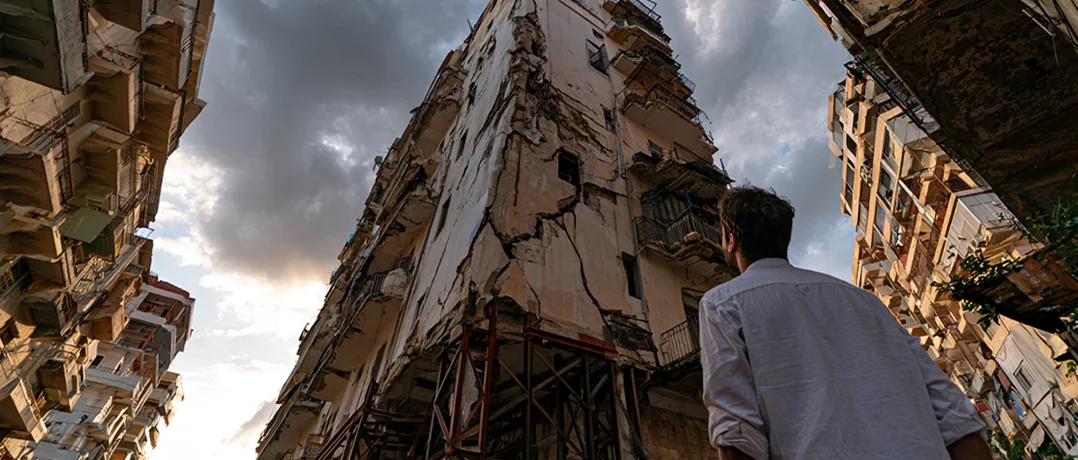
Years of warnings about unsafe buildings in Tripoli have raised questions about the responsibility of local authorities, political divisions, and the lack of funding needed to protect residents. Despite repeated reports identifying buildings at risk of collapse, the crisis remains unresolved.
On February 8, 2026, the collapse of residential buildings in Bab al-Tabbaneh killed 15 people, and prompted the government to order the evacuation of 114 buildings considered at risk. The incident brought renewed attention to a problem that authorities had known about for years.
Political divisions and lack of funding
MP Elias Khoury told The Beiruter that Tripoli's dangerous buildings crisis is not the result of one failure, but several problems that have prevented authorities from taking action.
He explained that Lebanon's financial collapse in 2019, followed by the COVID-19 pandemic, weakened state institutions and left municipalities without the resources needed to address the problem. However, Khoury stressed that the lack of funding was not the only obstacle. Political disagreements within Tripoli Municipality also affected its ability to function.
Political disagreements between municipal members paralyzed the municipality for more than two years
He explained that divisions between municipal council members and the municipality's president were often linked to the city's political groups, each of which had representatives within the council. According to Khoury, these disagreements repeatedly disrupted municipal work, leaving dangerous buildings outside the authorities' priorities.
Nobody pays attention to this issue until a building collapses and a catastrophe happens
Khoury also recalled holding a press conference around two years ago, that highlighted the problem, particularly in Tripoli.
His objective, he said, was to "ring the alarm bell that nobody was ringing."
Yet the issue continued to receive limited attention.
All these reasons combined made this issue not a priority, placed on the shelf, with nobody dealing with it
Former Tripoli Mayor Ryad Yamak also pointed to financial difficulties, explaining that the municipality had repeatedly informed the government about buildings damaged by years of bombardment and conflict.
According to Yamak, the municipality submitted reports to the Prime Minister's Office, the Ministry of Interior, the Ministry of Public Works and the Higher Relief Commission, warning that buildings required repairs and restoration.
However, he claimed that the $3 million in assistance promised by the government following the earthquake never reached Tripoli.
Although decisions were taken by the Council of Ministers, Tripoli did not receive a single penny
Yamak explained that the situation worsened after Lebanon's financial collapse, as the municipality was unable to convert its deposits held at Banque du Liban into dollars or obtain financial advances. "For that reason, the municipality was practically bankrupt," he said.
Around 600 buildings at risk, but families have nowhere to go
Khoury also pointed to the scale of the problem, citing assessments from the Order of Engineers and the Ministry of Public Works. According to him, reports from these bodies collectively identify approximately 600 buildings at risk, including at least 170 that should be evacuated.
He stressed that these warnings are not new, explaining that the information has been available for more than three or four years.
Yamak confirmed that the municipality had previously conducted building inspections in cooperation with the Order of Engineers, identifying thousands of buildings requiring repairs or structural reinforcement. He also pointed to damaged foundations caused by leaking sewage and wastewater, as well as illegal construction, as factors contributing to the deterioration of buildings.
According to Yamak, some older buildings designed to support two floors had additional floors constructed on top of them, despite already having suffered damage from past conflicts.
There has clearly been negligence by both the municipality and the internal security forces regarding construction violations
He recalled stopping illegal construction near a riverbed in Tripoli's Al-Shalfeh area during his time as mayor. However, when he returned to office after an absence of approximately a year and a half, he said he found five or six buildings had been constructed illegally in the same area.
Yamak acknowledged that the municipality is legally responsible for monitoring dangerous buildings, issuing warnings and carrying out necessary repairs when owners fail to act.
Legally, the municipality is responsible, but in practice, it does not have the capacity to act
Beyond the municipality’s legal responsibilities and the failure to address construction violations, Khoury also raised the issue of when a building should be evacuated. He explained that, underinternational safety standards, authorities are expected to act as soon as a building is considere dangerous, even if its collapse is not imminent."The building may still remain standing for three, four, five, or even six years. But international standards, as soon as they see that danger exists, do not give you another three or five years. They tell you to evacuate now," he said. However, these preventive measures had not been properly implemented.
He acknowledged as well that evacuation presents another major challenge for residents who cannot afford alternative accommodation. Many families living in dangerous buildings face difficult economic conditions and lack the resources to rent another home.
People are being asked to leave their homes and move somewhere else, but their economic situation does not allow it
What have Tripoli's MPs done?
Khoury acknowledged that meetings and discussions have not produced the collective action needed.
"There were several meetings about the issue, but this did not produce teamwork or group work" he told The Beiruter.
He explained that MPs had participated in meetings with religious and economic figures in Tripoli to discuss possible solutions. A fund was also established to support affected families, but according to him, it has not provided assistance on the scale required.
These meetings did not produce any practical steps, even though a fund was established
On a personal level, Khoury said he contacted international organizations, including the United Nations, as well as several embassies. His objective was to bring the crisis to the attention of international partners and encourage them to consider financial assistance for residents living in dangerous buildings.
He referred to international aid programs, including USAID, UNDP, and assistance provided through nongovernmental organizations.
However, he explained that many available funding mechanisms operate through small grants, which are insufficient to address the scale of Tripoli's housing problem.
They are not enough, they are not sufficient, and they are not at the level of the problem
Khoury explained that meaningful assistance would require providing families with sufficient financial support to leave dangerous buildings and secure alternative accommodation, potentially by covering a year's rent. He acknowledged that this level of assistance had not materialized through the initiatives he described. He also acknowledged the difficulty of turning discussions into concrete results.
There are many things that are proposed as an idea and start as an idea, but they don't end up taking off
With hundreds of buildings identified as potentially dangerous and residents continuing to face difficult living conditions, the question remains whether the authorities can turn existing assessments, meetings, and proposed initiatives into practical measures that protect families before another collapse occurs.
-
-

-
Natalie DurhamResearcher/Writer
Junior research writer focusing on politics, public policy and international affairs.
-
