



Deir El Ahmar, one of Lebanon’s oldest Maronite communities, preserves centuries of religious history, from Roman temples and ancient churches to the renowned pilgrimage shrine of Our Lady of Bechouat and the world’s largest rosary.
The red monastery of the Beqaa

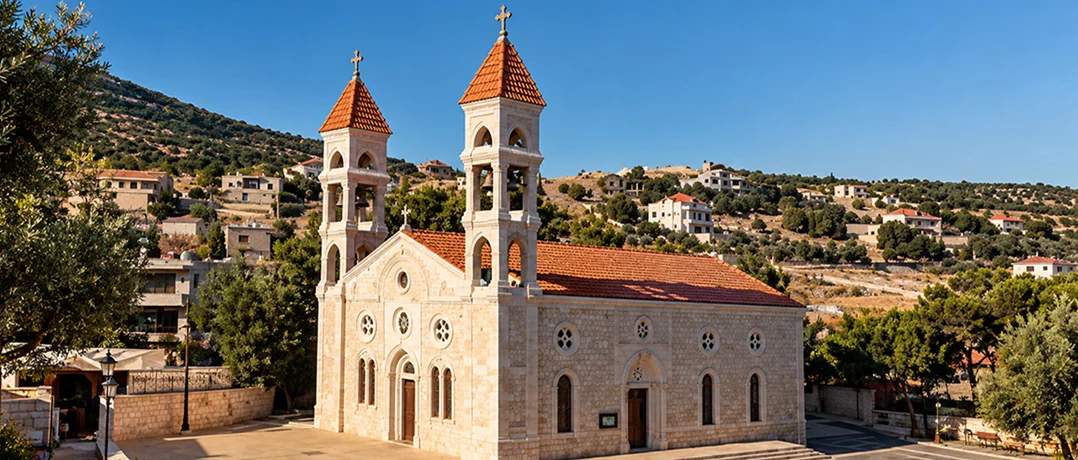
Where the northern Beqaa Valley rises toward the western mountains, a few kilometers from the great ruins of Baalbek, sits one of Lebanon’s oldest Maronite communities. Deir El Ahmar, “the Red Monastery” in Arabic, is a farming town of stone houses and old churches. Its history reaches from Roman Heliopolis to the Maronite patriarchate.
Deir el Ahmar is about 100 km from Beirut and 12 km northeast of Baalbek. Baalbek was the Roman city of Heliopolis, and its temples drew pilgrims from across the empire. Deir El Ahmar shared in that religious world. The village has the remnants of a Roman-era temple, and its stones were reused in the church of Our Lady. The evidence is carved into one of them. A large altar among the stones bears a dedication to Jupiter of Heliopolis. The temple was part of the cult of Baalbek’s great god, and one older account credits the emperor Caracalla with building it in the third century, though that attribution is not firmly established.
At its heart is one of Lebanon’s most visited Marian shrines, Our Lady of Bechouat. The sanctuary’s origin story dates to the 18th century. In 1741, a Byzantine wooden icon of the Virgin Mary was discovered in one of the deep caves. A church was built above the cave, and the place has been a pilgrimage site ever since. The setting is ancient. The church was built over the ruins of a Roman temple in the 18th century, and an old oak tree shades its small courtyard. That pattern, a pagan sanctuary turned into a Christian one, repeats across the region, including at Deir el Ahmar’s own Roman temple of Heliopolitan Jupiter. The sanctuary’s reputation rests on reported miracles. Thousands of worshippers visit and walk from the village to the old church, where a blue and white statue of the Virgin stands. The statue is a replica of the one at Our Lady of Pontmain in France. Some worshippers spend the night in prayer or meditation at the church door.
The area is rich in remains. The village has oil mills, statues and sarcophagi dating to Phoenician, Roman, Byzantine and Arab times. Funerary caves and rock-cut tombs have yielded jars and pottery, and a votive altar showing the Heliopolitan Triad was found in the village. People worshipped here long before the icon was found.
Bechouat’s inhabitants are Maronites, and their ancestors came from Bsharri at the beginning of the 17th century. The name has Aramaic roots, said to mean “initiation” or “facilitator.” A local tradition gives another origin. It holds that the village was named after the Egyptian Saint Anba Bishey, and that the old church was dedicated to Our Lady of the Shepherds, a fitting title in a region settled by highland shepherds.
The Rosary of Lebanon
Deir El Ahmar is also home to one of the most unusual pilgrimage projects in the Middle East, the Rosary of Lebanon, billed as the largest rosary in the world. It sits near the main road between Deir El Ahmar and Beshouat, on land owned by the Lebanese Maronite Order, which built a convent there in 2006. The rosary is 600 meters long and made up of 59 illuminated beads, six Our Fathers for confession and 53 Hail Marys for prayer and contemplation. Each bead is built as a small concrete chapel about 4.9 meters long and 3.5 meters wide, where worshippers can stop to pray. The path leads to the cross of the resurrection and a large amphitheater for prayer and outdoor celebrations, and a space under the cross is set aside for contemplation of the Blessed Sacrament. Pilgrims walk from bead to bead reciting the prayers, and the finished loop is meant to glow at night and be visible from the sky.
Seat of an Eparchy
Deir El Ahmar also became a center of Church administration. The Maronite eparchy of Baalbek was united with that of Zahleh in 1977, and on 9 June 1990 the two were separated again and the Baalbek eparchy took its present name, Baalbek-Deir El Ahmar. The eparchial seat is in Deir el Ahmar, where the Saint George Cathedral stands. The eparchy has 34 parishes and, as of 2012, 45,000 Maronite Catholics. So a small town in the northern Beqaa serves a Christian community spread across Baalbek, Hermel and the surrounding villages.
Deir El Ahmar has eight historic churches, including Saint Joseph Church, completed on September 15, 1914. Together they give the town a spiritual landscape out of proportion to its size. Community life is organized as well. The Women’s Association of Deir El Ahmar (WADA) is a Lebanese non-profit founded by volunteers from the town.
Deir El Ahmar is a village of profound history and faith. A Roman sanctuary to a Heliopolitan god became a fortress, then a monastery, then a parish church, and the community around it was built by shepherds and farmers who came down from the northern mountains. Its story is a small version of Lebanon’s own, continuity through changing rulers and faiths, sustained by land, church and family.
-
-

-
Jenna GeageaReporter/Writer
-
