



Qatar’s Prime Minister Mohammed bin Abdulrahman Al Thani’s visit to Beirut focused on electricity investments, support for the Lebanese Army, reconstruction efforts, and diplomatic efforts to prevent further regional escalation.
Qatar's plan to improve Lebanon's electricity supply
Qatar's plan to improve Lebanon's electricity supply
By Anthony Chamoun - Natalie Durham | October 20, 2026

Reading time : 6 min
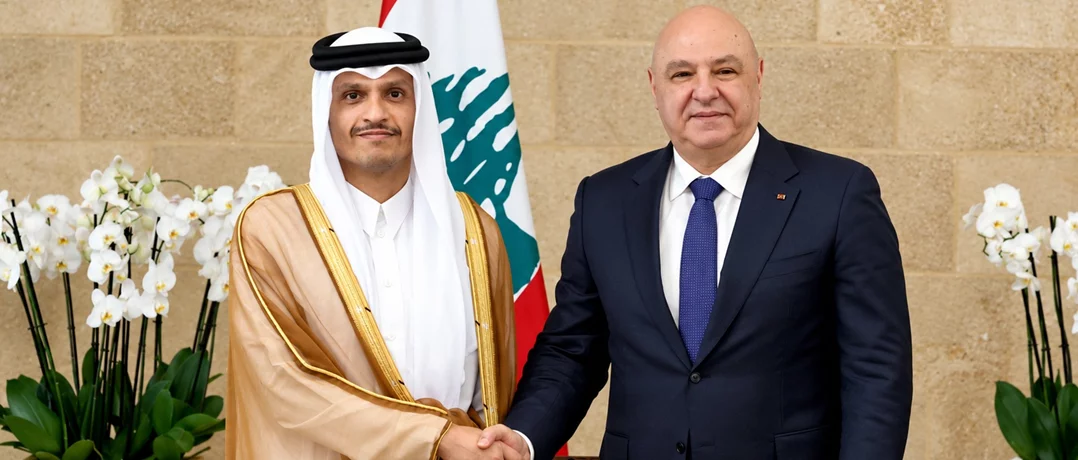
Qatari Prime Minister (PM) and Minister of Foreign Affairs Sheikh Mohammed bin Abdulrahman Al Thani visited Lebanon on Friday 16 October 2026, holding meetings with President Joseph Aoun, Parliament Speaker Nabih Berri, Prime Minister Nawaf Salam and Lebanese Army Commander General Rodolphe Haykal.
The visit focused on strengthening cooperation between the two countries, with discussions covering a preliminary agreement to develop Lebanon’s electricity sector, new renewable energy projects, continued support for the Lebanese Armed Forces (LAF) and reconstruction efforts in southern Lebanon. Security developments were also addressed, with Qatar calling for an end to Israeli attacks and the withdrawal of Israeli forces from Lebanese territory.
Qatar’s plan to improve Lebanon’s electricity supply
Electricity was one of the main subjects discussed during the visit. Following Salam’s meeting with the Qatari PM at the Grand Serail, he announced that the two governments were close to reaching an agreement on a comprehensive project to rehabilitate, develop and modernize Lebanon’s electricity infrastructure.
Under the proposed arrangement, Qatar would finance, implement and operate the project without requiring the Lebanese Treasury to cover initial investment costs. The initiative would follow a build-operate-transfer (BOT) model, under which the investor develops and operates the infrastructure before transferring ownership under agreed conditions.
Salam stressed that the project was not intended to be another partial solution or a temporary intervention, but rather a comprehensive approach addressing electricity generation, infrastructure development, diversification of energy sources and improved sector management. He said the objective was to increase production capacity, reduce costs and establish a more sustainable electricity system.
Meanwhile, Lebanese Minister of Energy and Water Joe Saddi provided further details about the proposed cooperation. He explained that the plan includes importing liquefied natural gas (LNG) over a period of 20 years, generating electricity through natural gas-powered plants, solar energy and wind power, and importing electricity through an interconnection with Syria.
The proposed investment also includes the construction of two power plants, one in Deir Ammar in northern Lebanon and another in Zahrani in the south, each with a capacity of 825 megawatts. LNG would be supplied through a floating storage and regasification unit with a capacity of 3.5 million cubic metres per day, alongside the Arab Gas Pipeline through Syria, with a capacity of 4.5 million cubic metres per day.
The plan also includes 800 megawatts of solar energy, 440 megawatts of wind power, and battery storage facilities. Electricity imports from Syria would initially reach 300 megawatts through two separate routes. The two power plants are expected to be completed within three years, although the project still requires government approvals and agreement on financial arrangements.
Saddi also announced plans for a solar power plant to be developed by QatarEnergy on land allocated to the LAF. The project would have a production capacity of between 100 and 150 megawatts and had already received Cabinet approval. Separately, QatarEnergy announced an agreement with French company TotalEnergies to jointly develop a solar power project in Lebanon.
According to Saddi, cooperation between Lebanon and Qatar will be organized through a framework agreement that will be submitted to Parliament. The Ministry of Energy and Water also intends to request assistance from the International Finance Corporation (IFC), which has been working with the ministry for several months, to evaluate the proposed arrangement. Salam expressed hope that the agreement would soon be presented to the Lebanese Cabinet for further consideration.
Despite progress on the long-term project, Saddi stressed that Lebanon’s immediate electricity problems still needed to be addressed. He called on the government to settle unpaid electricity bills owed by public institutions, compensate Électricité du Liban (EDL) for exemptions granted in southern Lebanon, cover war-related repairs and approve an appropriate electricity tariff to secure fuel supplies and increase electricity production.
In a statement following the announcement, Saddi described the agreement as the result of months of work with Qatar, saying that while the project represented a sustainable medium- and long-term solution, addressing the immediate crisis remained the responsibility of the Lebanese government. He called for the payment of outstanding public sector electricity bills, compensation for southern Lebanon exemptions and the adoption of a flexible tariff system to secure fuel supplies and improve electricity availability in the coming months.
Lebanese Minister of State for Technology and Artificial Intelligence (MITAI) Kamal Shehadeh also welcomed the preliminary agreement, congratulating Saddi and describing the proposed investment as a step toward improving electricity production and infrastructure.
Continued support for Lebanese sovereignty, the Lebanese Armed Forces, and reconstruction
Beyond electricity, The Qatari PM reaffirmed his country’s support for Lebanese sovereignty and the Lebanese state’s efforts to restore stability. During his meeting with President Joseph Aoun, discussions addressed Israeli attacks in southern Lebanon, with Aoun calling on Qatar to continue its diplomatic efforts with Arab and international partners to pressure Israel to stop its attacks.
In this context, the Qatari PM reiterated that Doha supported the implementation of United Nations Security Council (UNSC) Resolution 1701 (2006) by all parties, the withdrawal of Israeli forces from occupied Lebanese territory and the strengthening of the LAF’s role in maintaining security in the south.
Indeed, Qatar reaffirmed its commitment to supporting Lebanon’s legitimate state institutions, particularly the LAF. During the joint press conference, Al Thani stressed that supporting the LAF remained a priority for Doha, describing it as a national institution that plays a central role in preserving Lebanon’s security, sovereignty and stability. Discussions with President Joseph Aoun and LAF Commander General Haykal focused on mechanisms to strengthen future cooperation and expand assistance to the military. It is worth noting that Qatar has provided financial support to the LAF for several years, particularly following the economic crisis that began in 2019. Doha has contributed tens of millions of dollars to the military during this period.
Separately, the Qatari Prime Minister had conveyed warnings about the consequences of Hezbollah becoming involved in another regional confrontation. Al Thani expressed concern about the possibility of renewed conflict involving Israel, the U.S. and Iran, while indicating Qatar’s willingness to play a mediating role. Doha warned that renewed escalation could have serious consequences for both Lebanon and its institutions, while highlighting that Qatar was prepared to contribute diplomatically given its relations with various regional and international actors.
Reconstruction in southern Lebanon was another subject discussed during the visit. Al Thani said Qatar was coordinating with the United States (U.S.) on future reconstruction efforts to help displaced residents return to their homes. He added that Doha remained committed to supporting development projects in Lebanon, including in sectors such as education and healthcare, while continuing discussions with international partners regarding reconstruction in areas affected by conflict.
While the electricity project remains subject to technical, legal and parliamentary procedures, the visit demonstrated Qatar’s continued engagement with Lebanon through a combination of investment, institutional support and diplomatic efforts aimed at preserving stability during a period of regional uncertainty.
-
-

-
Anthony ChamounResearcher/WriterFocusing on Political Science and International Affairs.
-
-
-

-
Natalie DurhamResearcher/Writer
Junior research writer focusing on politics, public policy and international affairs.
-
