



Lebanese coin and banknote collectors preserve the country’s monetary history, revealing the stories, symbols and transformations behind the money people once used every day.
What do you know about Lebanon’s monetary past?
What do you know about Lebanon’s monetary past?
By Jenna Geagea | October 26, 2026

Reading time: 5 min
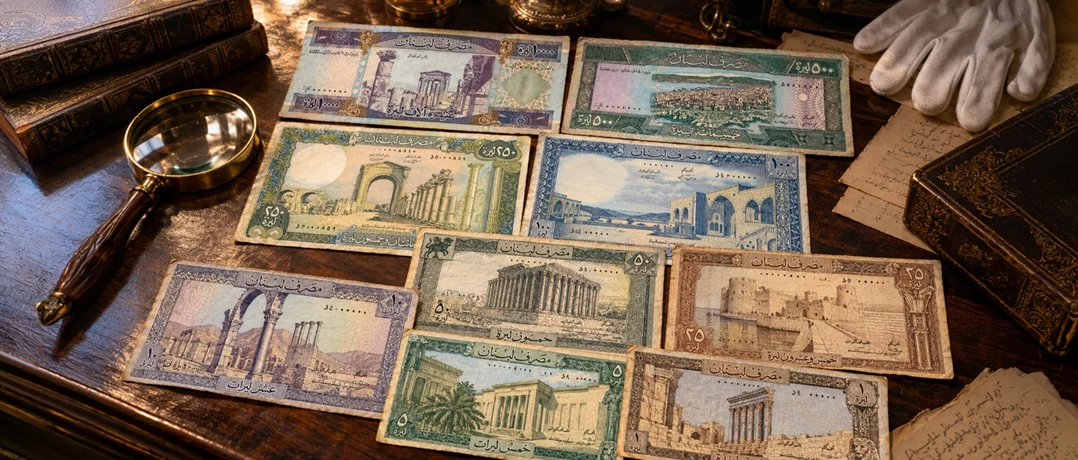
Money is the most ordinary object people handle, which is why it tends to be overlooked until something changes. Coins and banknotes carry the names of the authorities that issued them, the symbols a state chose to represent itself and the languages a society used to do business. Collectors treat them as documents.
Lebanon’s monetary story begins early. The first coins used in what is now Lebanon were introduced by Phoenician city-states in the 5th century BC. Paper arrived much later. The earliest banknotes used in Lebanon came under the Ottoman Empire and date from 1861 to 1918. After the empire’s defeat, Lebanon relied on the Egyptian pound before the French Mandate introduced its own arrangements.
Under the Mandate, a series of banks issued the notes. Banque de Syrie issued them from 1919 to 1924, Banque de Syrie et du Grand Liban until 1939, and Banque de Syrie et du Liban until 1964. The Second World War left its own mark the British printed the currency for a time, because the war prevented printing in France. In 1964, Banque du Liban was established as the central bank and began issuing Lebanese pounds.
For years the pound was remarkably steady. It held at about 1,500 to the dollar, which made the 100,000-pound note worth roughly 70 dollars. After the financial collapse, the same note, now the largest in circulation, came to be worth about one dollar.
Since 2013, the story has had a home in Beirut. The Banque du Liban Museum opened to the public in November 2013, with Ottoman banknotes, Lebanese notes dating from 1919 and coins going back to the 5th century BC. Its international section holds 280 notes from 21 Arab countries and 833 from 225 other countries. The institution has also reached toward private hobbyists, its director once expressed the hope that Lebanese amateur collectors with rich collections would display them through the museum.
Curiosity turned research
Anis Matta, 52, a high-school history teacher from Zahlé, can trace his collection to a single afternoon. As a teenager, he found a handful of worn Mandate-era notes in a drawer at his grandmother’s house, and he has been hunting ever since. “It started with curiosity,” he recalled. “At first, I was interested in the objects themselves, their appearance, their age and the details you could find on them.” Understanding came later. “With time, I began to understand that every coin and banknote represents a particular moment in history. Something that might seem insignificant to another person could tell you a great deal about the period in which it was produced.”
His favorite find is a 1942 Lebanese Republic note he bought from an elderly antiques dealer in Tripoli. The dealer had kept it for years inside a prayer book, and its condition was nearly flawless. He paid far less than it was worth, and he still thinks about the dealer who let it go, “I told myself I would repay him by taking care of it properly.”
His definition of value has little to do with price. “Value is not always about money,” he explains. “A piece can be valuable because it is rare, because very few examples have survived, or because of the historical circumstances surrounding its production.” When he evaluates a piece, he reads it closely: “I pay attention to the date, the inscriptions, the design and the condition. Sometimes, the smallest detail is what makes a piece interesting. You have to research it rather than simply look at it.”
He also brings the hobby into his classroom, passing notes around so students can see how handwriting, language and symbols changed from one era to the next. What he wants them to take away is a change of perspective. “I hope they look beyond the object,” he explained. “A banknote was once part of someone’s everyday life. People used it to buy food, pay for services or save money. Today, it can become a historical document. An object that was ordinary at one point in time can become an important piece of history.”
Patience and preservation
Jeanette Succar, 47, an interior designer based in Jounieh, first caught the habit from the old coins her father kept in a tin box. “I have always been fascinated by objects that carry a history,” she told The Beiruter. “When you hold an old coin or banknote, you begin to wonder where it came from, who used it and what life was like at the time.” The wondering feeds itself. “The more you discover, the more questions you have.”
Her most memorable find came after two years of searching, a 1925 note from the early Banque de Syrie et du Grand Liban era, which she finally tracked down at a collectors’ fair in Beirut. She keeps it in a protective sleeve in a flat drawer, away from light. “Finding a particular piece is not always easy,” she noted.
“Currency reflects the period in which it was issued,” she noted. “The symbols, portraits, inscriptions and denominations all tell us something about the society and institutions of that time.” Lebanon offers plenty of material. “The country has experienced so many changes. Looking at older coins and banknotes allows you to approach this history through something tangible.”
A coin or a note is a witness, to out country’s political and economic history. Each carries pieces of an era’s stories.
-
-

-
Jenna GeageaReporter/Writer
-
