



Young Lebanese chefs are blending local flavors with French, Spanish and Greek culinary traditions, creating innovative dishes that celebrate cultural exchange while preserving their roots.
When Lebanese cuisine meets the world

Modern cuisine has become a conversation between cultures. Chefs travel more, ingredients cross borders in a matter of days, and diners arrive at restaurants curious about flavors they have never met in the same plate. Fusion, once a risky label, is now part of how many kitchens think about creativity.
Lebanese cuisine has always absorbed and exchanged ideas with its neighbors. Today young chefs are making that exchange, pairing Lebanese ingredients with the methods of France, Spain and Greece. The best of these cooks want dishes that keep their roots visible.
France: Discipline and generosity
Jennifer Bou Eid, 25, learned traditional dishes from her grandmother and mother, then trained in French cuisine at Le Cordon Bleu, where technique and consistency came first.
She sees the two traditions as complementary opposites. “French cuisine is often very structured and precise in its techniques and presentation, whereas Lebanese cuisine tends to be more relaxed in its preparation and plating, yet incredibly rich and expressive in flavor,” she told The Beiruter.
Her aim is to let French rigor elevate Lebanese character. She points to how the pantry translates, “sumac can introduce a fresh acidity to a French sauce, while pomegranate molasses can add depth and complexity to a glaze.”
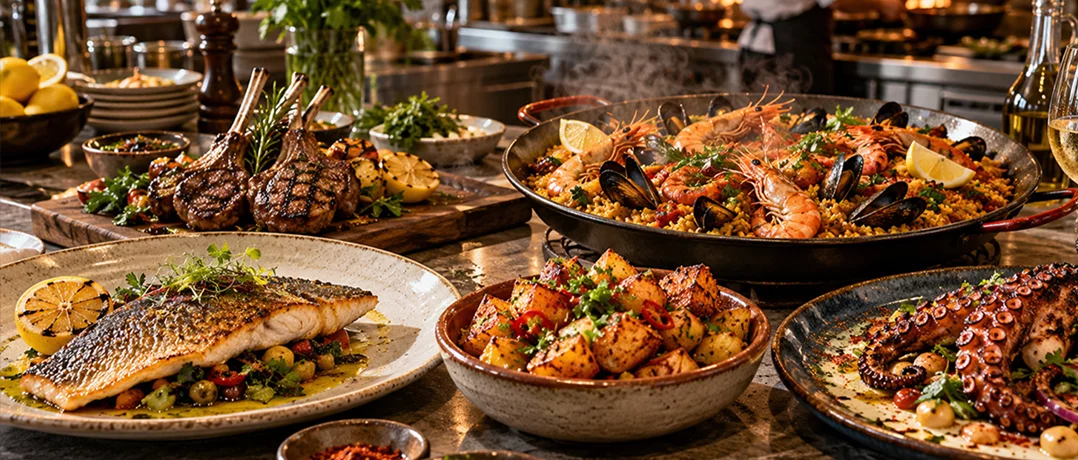
Her signature example is pan-seared sea bass with a Lebanese-inspired beurre blanc, made with tahini, sumac, lemon and fresh herbs. The skin is crisp, the flesh tender and the sauce rich yet bright. “In this dish, French precision provides the foundation, while the Lebanese ingredients give it a character of its own,” she noted.
Bou Eid asserts that this mélange is not a passing trend. “Lebanese-French fusion is a way of bringing together two culinary traditions that can complement one another beautifully while retaining their individual identities.”
Spain: The shared table
Mayelle Bou Chabake, 32, works at a fusion restaurant with a presence in both Beirut and Madrid, so she knows both cuisines from the inside. Her starting point is the way each culture eats. Lebanese mezze and Spanish tapas both turn a meal into a social occasion, with small plates, conversation and no rush.
She is wary of fusion done carelessly. “I do not believe fusion should mean mixing everything together without a clear direction,” she cautioned. Her method is to keep the Lebanese soul of a dish and add one Spanish element. “The result should feel familiar to someone who knows Lebanese food, while offering something unexpected to someone who knows Spanish cuisine.”
Olive oil, lemon, garlic, parsley and tomatoes give the two cuisines a common base. From there she experiments. One idea is a reworked batata harra: “A Spanish-inspired version of batata harra could incorporate smoked paprika and a touch of saffron while retaining the Lebanese combination of garlic, coriander and lemon.”
Her Lebanese-inspired seafood paella follows the Spanish method closely, from the carefully built stock to the toasted socarrat crust. Lemon, fresh coriander and a little sumac supply the Lebanese brightness. “Fusion works best when the flavors have a purpose, rather than when ingredients from two different cuisines are simply placed on the same plate,” she told The Beiruter.
She also stressed responsibility. “I believe chefs have a responsibility to understand the origins of the dishes they reinterpret.”
Greece: Same ingredients with different habits
Nathan Haidar, 38, a food consultant and chef, has been working in the culinary arts for almost 17 years. Lebanon and Greece, he told The Beiruter, share a way of life built on olive oil, lemon, herbs, grilled meats, seafood and long meals with family and friends.
The overlap is what makes the pairing interesting. “What I enjoy most is that the two cuisines share many ingredients but use them differently,” he reflected. Labneh can sit beside Greek yogurt, sumac can lift grilled lamb or fish, and za’atar can echo oregano and thyme. He described kafta seasoned with fresh herbs and served with a tzatziki-style sauce, or a hybrid of fattoush and Greek salad with a sumac-lemon dressing.
His grilled octopus shows the idea at work. The octopus is cooked tender and finished on a hot grill in the Greek coastal manner, then served with a lemon sauce, sumac and parsley, alongside a salad of tomato, cucumber, olives and oregano. “Neither cuisine needs to dominate for the combination to work,” he observed.
He explained that fusion must be treated with utter respect. “Fusion should not erase the traditions behind a recipe; it should allow us to explore them from a different perspective.” And on the similarities between the two cultures, “I see their similarities as a starting point for creativity.”
The culinary arts are just that, a form of art in which the chef becomes the artist, creating dishes that reflect creativity and personal expression. Fusion allows this artistry to flourish, bringing together different traditions and flavors to create a unique taste of life.
-
-

-
Jenna GeageaReporter/Writer
-
