



Gretta Taslakian reflects on her Olympic career, the challenges that shaped her journey, and her mission to empower women through sports and self-belief.
Gretta Taslakian from Olympian to entrepreneur
Gretta Taslakian from Olympian to entrepreneur
By Jenna Geagea | October 28, 2026

Reading time: 4 min
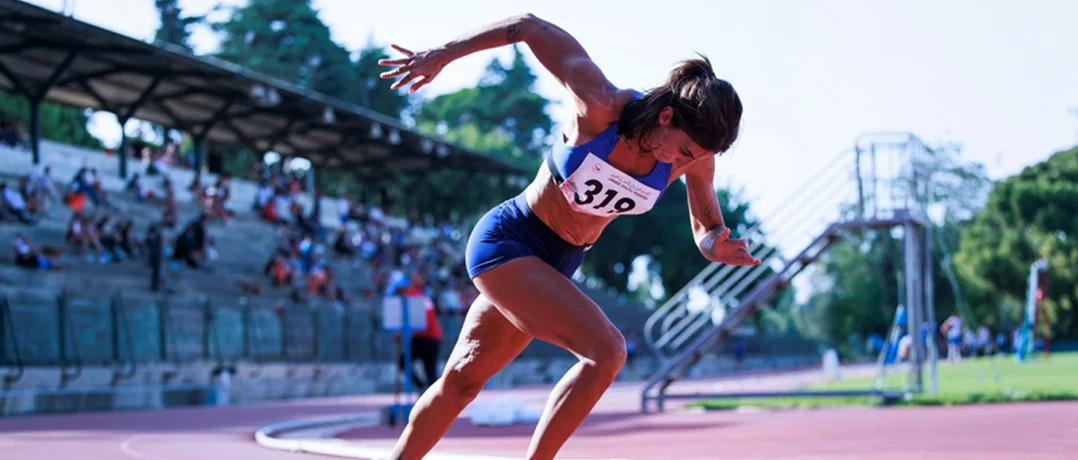
Gretta Taslakian was the first woman from the nation’s track and field ranks to compete at three Olympic Games. Her journey began under the watchful eye of a father who recognized a gift before anyone else did.
Taslakian, now 41, told The Beiruter that her career was both fate and hard work. “It is not as though I consciously decided one day that I wanted to pursue running,” she reflected. “In a way, it felt like destiny. At the same time, it was also my choice.”
Her childhood was one of ceaseless motion. “I was a very energetic child,” she recalled. “I could not sit still. Even at school, I was constantly moving around and had difficulty concentrating.” Her father, a devoted lover of sport, perceived in that restlessness a talent. “My father noticed something that perhaps not every father would have noticed.”
His friends teased him for his conviction, urging him to bring his daughter to the club that became her first athletic home. The results arrived swiftly. A second-place finish in her first competition gave way to victory, and victory to a procession of records. “Every time I went out to run, I would break another record,” she remembered.
The philosophy that drove those triumphs was inherited. Her father insisted that every race must yield a record, and the lesson settled deep within her. “Before competing against other people, you have to understand that you are competing against yourself,” she explained.
Even when I was simply training, I wanted to race against myself.
Track and field commands little of the public devotion that Lebanon reserves for football and basketball, and Taslakian trained without the facilities her successors enjoy. “I used to sprint on concrete,” she recounted.
An Olympian turned business woman
Her résumé includes an Asian Championships silver in the 200 meters, a result later elevated to gold when the original winner was disqualified for doping, along with a bronze and numerous honors at the Arab Games and Asian Games. Yet her deepest pride is not what one would expect.
“You might be surprised if I told you that, for me, participating in the Olympic Games was not necessarily comparable to winning a medal at another championship or breaking a record,” she confided. What mattered was the manner of arrival. Her aspiration was to qualify through merit, spurning the wildcard invitations that open Olympic doors for athletes from smaller federations. “I did not want that.”
The path was seldom smooth. A disappointing training camp in the United States taught her a lesson about the athlete’s inner life. “You could be training with the best coach in the world, but if you are not mentally comfortable, you can never perform at your best.”
The body kept its own ledger. Taslakian endured two meniscus procedures, an ACL reconstruction, repeated stress fractures and countless muscle tears. “Every injury could set me back by months,” she acknowledged. Out of that attrition came wisdom, “being injured did not necessarily mean I had to stop all physical activity. I had to learn how to manage my injuries, train in moderation, and understand how to make a proper comeback.”
Her retirement from competition last year was marked by the same clarity that defined her racing. As a mother of three, she found that elite sport demanded a devotion she could no longer divide. “I began to realize that my children needed me more,” she reflected. There was no bitterness in the farewell. “I have packed my bags and travelled to compete in championships countless times. I have already experienced that part of my life.”
Retirement has proved anything but restful. Taslakian now runs G Fuel, a diet kitchen born from the idea that many dietitians prescribe meal plans, yet few prepare the meals themselves. She also leads a fitness program designed primarily for women, teaching them to train independently and to understand that exercise belongs to everyone, “whether they are a mother, a teenager, or simply someone who wants to take care of herself.”
She urges women to cultivate identities of substance. “Women need to build a foundation for themselves so they can continue their journeys,” she insisted, adding that health must anchor all else, “it is the foundation of everything.”
Through a carefully nurtured social media presence, built to be “authentic and organic rather than fake”, she carries that conviction to a wider audience. One video, in which she raced men and prevailed, travelled far beyond her followers. To Taslakian, its resonance exposed an enduring discomfort.
Society still struggles to accept the idea of a woman challenging a man, whether physically, mentally, or in any other way.
She intends to keep challenging it. The finish line she crossed was simply another record to surpass and another generation of girls to inspire.
-
-

-
Jenna GeageaReporter/Writer
-
