



Sawfar’s rise as a summer retreat for Beirut’s elite, its architectural legacy and the impact of war reveal a village shaped by Lebanon’s changing history.
Sawfar and Lebanon’s summer golden age

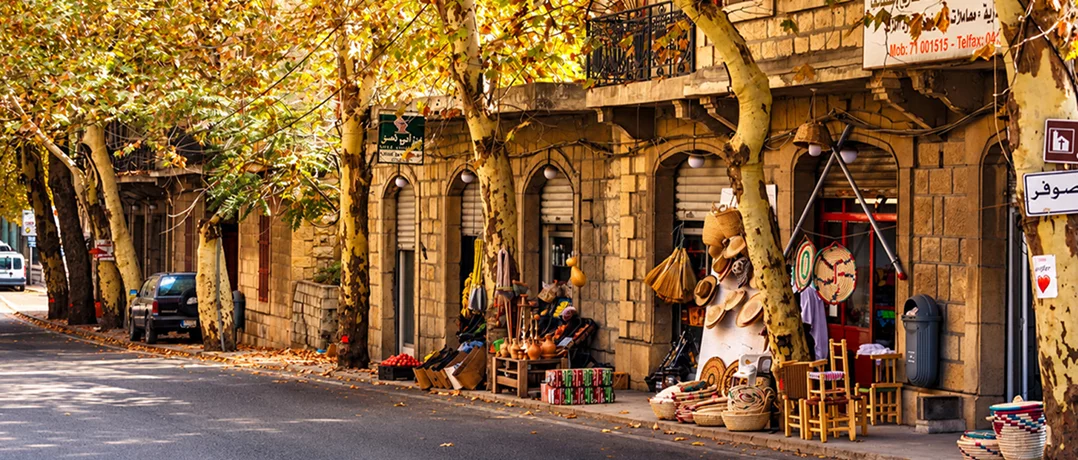
Seen from the Beirut-Damascus highway, Sawfar looks like a village paused in time. Faded villas, wide terraces and tall trees sit along a ridge above deep valleys. For about a century it was where Beirut’s elite escaped the summer heat. Its fine houses and hotels now stand as a record of an older Lebanon.
Sawfar is in the Aley District of Mount Lebanon, 27 km from Beirut and near the pass of Mdayrej and Dahr el Baydar, a former ski center. It lies at an average elevation of about 1,300 m and overlooks the Lamartine Valley and gorges such as Hammana and Falougha. The valley is named after the French poet Lamartine, who visited Lebanon, and it separates Sawfar from the Matn.
The name has several explanations. It may refer to whistling, especially of birds, to the yellow light of the first morning sun, or most likely to the moaning of the winds on the exposed mountaintop. Because of its abundant springs, the village was once known as Ain Sawfar.
The railway and the prosperous summer
Sawfar’s rise began in the 1880s. The railway linking Beirut to the Beqaa Valley and Damascus is largely responsible for its fame, since it made the village easy to reach and drew wealthy Beirutis, who built opulent houses. The line, an Ottoman-era project, hugged the mountain slope beside the highway, and the station still stands. It overlooks the Lamartine Valley and is now a favorite for photographers and history enthusiasts.
The village was organized early. The Sawfar Municipality was founded in 1890 and led by well-known Beirut families including the Daouk, Beyham, Salam, Sabargh, Trad, Sursock and Nakkache families. Before 1950, Sawfar was also a transit and rest stop for travelers between Syria and Lebanon.
The clearest marks of this golden age are its buildings. The Sursock family built the Donna Maria residence in 1890, across from the railway station. President Eddeh built a summer residence in Sawfar, and the Château Bernina Hotel was occupied by the Ottoman governor Jamal Pasha during the First World War.
Most famous was the Grand Hotel. It hosted the first Arab League conference held in Lebanon in the 1950s, and it served royals and dignitaries as a travel destination from 1892 to 1975. After years of ruin, the Grand Hotel reopened in 2018 as a venue for art exhibitions.
In 1969, rare natural Lebanese amber was found in Sawfar during excavations for the railway station. Lebanese amber is prized by paleontologists as some of the oldest in the world with insect inclusions.
Sawfar is a place of strong seasonal contrast. Visitors once outnumbered locals, and in winter, snow, freezing temperatures and fog left the town nearly deserted. The population rose from about 5,000 in winter to some 15,000 in summer. The climate is dry and moderate in summer, while winter snow can exceed a meter.
There are three churches, Maronite, Greek Catholic and Greek Orthodox, and the remains of a Jewish place of worship. The village’s character has long been mixed, with a Druze majority, Christian communities, and a summer population from all over Beirut. Locals have mostly worked in trade and agriculture.
War and ruin
The Lebanese civil war cut this era short. Sawfar stood on a front line held by Syrian forces, and the village was partly reduced to rubble, with fine houses and palaces burned, looted and sometimes destroyed. The mountain war of that period, which also scarred nearby Aley and the Chouf, ended the summer society that had made the village famous.
Since the war, Sawfar has pulled itself together and begun reconstruction. Today it is a mix of restored villas, empty shells and quiet streets. The French Embassy in Lebanon keeps its summer headquarters here. The wider Aley District is mainly Druze, followed by Maronite and Greek Orthodox communities.
Modern infrastructure has also changed the experience. A 5.5-kilometer bridge, said to be the longest in Lebanon, has stood near Sawfar since 2001. The highway that once ran through its heart now has bypasses, so many travelers pass without stopping.
Sawfar is a rare survivor of the Belle Époque in the Levant, when railways and French influence turned a windy mountain into a resort. Its story includes Ottoman-era engineering, Beirut’s merchant families, diplomacy at the Arab League, and the damage of civil war. Walking its alleys, a visitor sees both a lost world and the effort to recover it.
-
-

-
Jenna GeageaReporter/Writer
-
