



An exclusive interview with George Khabbaz on his latest achievements, artistic journey and enduring ability to capture the deepest emotions of humanity through laughter and tears.
Georges Khabbaz, honored in his own lifetime
Georges Khabbaz, honored in his own lifetime
By Jenna Geagea | November 09, 2026

Reading time: 4 min
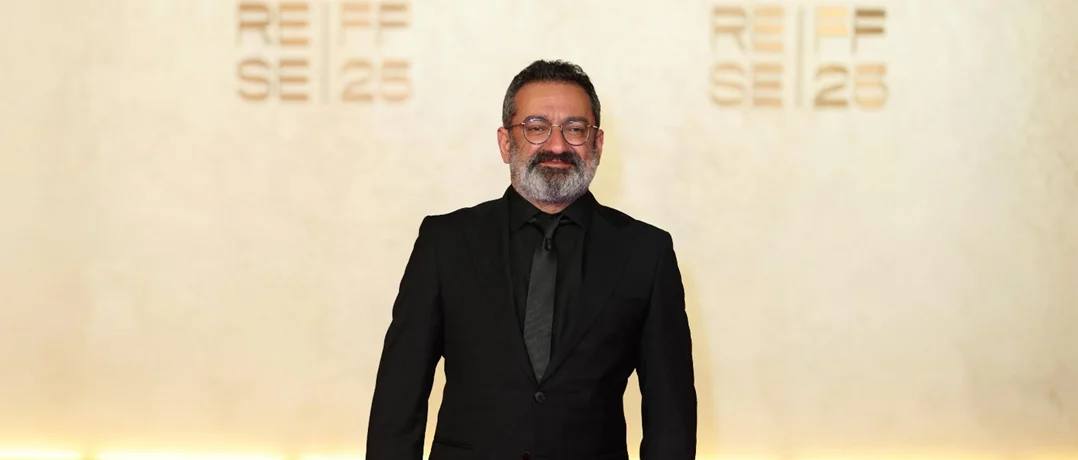
Georges Khabbaz, the Lebanese actor, playwright and theater professor whose career spans seven films, 25 plays and more than 300 television episodes, is the name on everyone's lips this month. The Beirut International Short Film Festival opened its twentieth edition by honoring the actor, playwright and director with a documentary of testimonials from the artists, directors and writers who worked alongside him. Then came a surprise, Batroun's mayor, Marcelino El Hark, announced that a street in the old market district would be named after him. Khabbaz could not hold back his tears. This was a tribute delivered while he is still at the height of his career.
Khabbaz met the suggestion that such an honor might signal a career winding down with a firm rejection. If anything, he told The Beiruter, it is Lebanon's habit that needs correcting.
Unfortunately, we wait until someone is over 80, or until after they have passed away, before honoring them, I believe people should be recognized during their lifetime.
Born in Hasbaya in 1976 and raised in Batroun, Khabbaz trained in musicology at the Holy Spirit University of Kaslik (USEK), where he now teaches theater. On screen, his trajectory runs from Under the Bombs (2007) through Silina and Perfect Strangers. Yet it is Ghadi (2013), which he wrote and starred in, that anchors his reputation, the story of a father defending his disabled son against a village's prejudice. It was selected as Lebanon's submission for the 2014 Academy Awards in the Foreign Language Film category and travelled the international festival circuit.
He also holds a writing credit on Capernaum (2018) and has led popular television series including Abdo & Abdo and Brando Al Sharq. In March 2025, USEK conferred an honorary doctorate on him at a diaspora dinner at New York's Harvard Club, and the Lebanese Presidency has awarded him the Order of the Cedar.
Far from inviting complacency, the tribute has sharpened his sense of duty. He believes "this recognition has the opposite effect, it motivates you to take on greater responsibility" and signals entry into "a new chapter." Influence carries obligation, "you have to become aware of that responsibility and produce more work, and work of even greater quality."
The body of work behind that conviction is formidable. "I have made seven films," he recounted, before adding: "Twenty-five plays, 18 of which I wrote, produced and directed. And more than 300 television episodes."
Whether Lebanon's turbulence has propelled him or confined him, he was unequivocal, "art is often born out of sorrow, pain and hardship," he explained, describing the country as "a source of inspiration, through its contradictions, its conflicts and its debates." An artist is boundless,
I believe an artist has no limits.
Lebanon even grants a latitude its citizens overlook. "We take it for granted, but compared with our Arab surroundings, Lebanon is the country that offers the greatest freedom of expression."
That reality feeds the duality that defines his work, the capacity to draw laughter and grief from the same scene. It is a matter of documentation. "This is simply a reflection of our reality," he explained. "Our situation is so absurd that, as Lebanese people, we laugh through our tears. We love life, but our circumstances often reflect the opposite." To remain faithful to that setting, he noted, "I have to reflect that contradiction."
His calendar shows no sign of slowing. A newly completed film is expected to reach audiences in 2027, a theater production is in preparation for the summer, Khayal Sahra returns to the Casino for its final season, and a 10-episode television series is in development.
Finally, what he hopes the public will remember, he settled on three words: joy, humanity and, finally, commitment, "commitment to art and to the suffering of people."
A man who built his career on laughing through tears, George Khebbaz has spent a lifetime reminding us that the deepest expressions of humanity often live somewhere between laughter and heartbreak.
-
-

-
Jenna GeageaReporter/Writer
-
