



Baalbek’s 9,000-year history reflects Lebanon’s cultural legacy and the enduring importance of protecting its heritage.
Baalbek, city of the sun

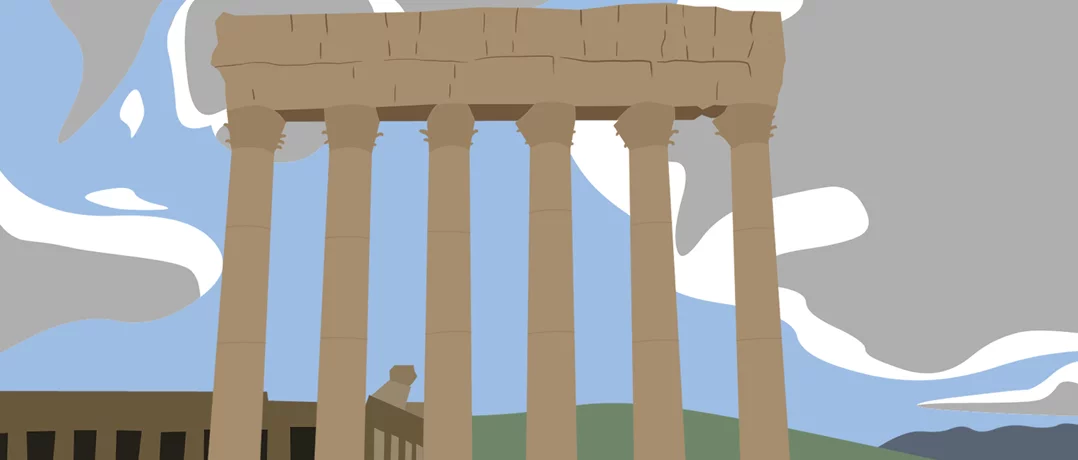
At about 1,150 meters of the Beqaa Valley, stands one of the most extraordinary ancient sites on Earth. Baalbek is home to some of the largest Roman temples ever built, among the best-preserved in the world. UNESCO inscribed it in 1984, recognizing a place where imperial Rome met far older Phoenician tradition. Yet the story of Baalbek is much longer, stranger and more human than its stones alone.
People lived on Tell Baalbek, the mound beneath the temples, thousands of years before Rome existed; estimates range from 8,000 to 9,000 years of habitation. The hill likely served as a place of worship from the start. The name itself preserves that memory. Baalbek is usually read as “Lord Baal of the Beqaa,” after the storm and sky god once honored here, in a sanctuary that also venerated a goddess often identified with Astarte. After Alexander the Great’s conquests, the Greeks renamed it Heliopolis, “City of the Sun,” a title that points to the solar cult long associated with the site.
Pompey brought the region under Roman control in 64 BC, and Heliopolis soon received Roman settlers, becoming a colony under Julius Caesar or Augustus. Over roughly three centuries, Rome poured its wealth into the hill. The result was a sanctuary dedicated to a triad, Jupiter, Venus and Mercury, local gods wearing Roman names. Pilgrims travelled from across the empire to consult the oracle of the Heliopolitan god. In AD 193 Septimius Severus granted the city the privileges of an Italian-law colony, and Heliopolis flourished.
The Temple of Jupiter was originally ringed by 54 colossal Corinthian columns. Only six remain, rising about 22 meters, and they have become the symbol of Lebanon’s antiquity. Beside it stands the Temple of Bacchus, considered among the best-preserved Roman temples of its size anywhere, its carved doorway and ceiling still astonishingly crisp. Nearby, the small circular Temple of Venus shows a lighter touch. Local influence shaped the plan too, the vast forecourts and layout differ from the classic Roman model, reflecting older Near Eastern sanctuary traditions.
The stones that defy belief
Baalbek’s greatest marvel is its masonry. Part of the podium of the Temple of Jupiter is the Trilithon, three limestone blocks each estimated at 750 to 800 tons, about 19 meters long and 3.6 meters thick, laid high in the wall. Beneath them lie blocks of around 350 tons.
The Roman quarry, roughly 800 meters away, holds even bigger ones. The Stone of the Pregnant Woman, estimated at about 1,000 tons, was never moved. Another monolith, the Stone of the South, rediscovered in the 1990s, is estimated at 1,242 tons. And in 2014 archaeologists of the German Archaeological Institute found a third monolith, the “Forgotten Stone,” estimated at around 1,500 tons, which would make it the largest stone ever quarried. Exactly how Roman engineers moved such loads remains debated, though the quarry sits slightly above the temples, and rollers and earthen ramps are among the proposed methods.
Local legend offers its own explanations. One tale says the great stone is named for a pregnant woman who tricked the townspeople into feeding her until she gave birth, promising to reveal how to move it. Another says pregnant jinn were set to cut and carry it, and some believe a woman who touches the stone becomes fertile.
When Christianity became dominant, the temples were repurposed, and the Jupiter altar was torn down under Theodosius I. After the Arab conquest in the 630s, the sanctuary became a fortress, known as al-Qala, with a mosque built within or near it. Baalbek then passed through Umayyad, Abbasid, Fatimid, Seljuk, Ayyubid and Mamluk hands. The Mongols took it in 1260, and the Mamluk sultan Qalawun later rebuilt the citadel. Ironically, the medieval walls that swallowed the temples also helped preserve them. The Ottomans arrived in 1516-17, and the Shia Harfush family maintained local dominance for centuries. Medieval Arabic writers described Baalbek as a rich, fertile city, and its sweets even found their way into tales of the Arabian Nights.
Earthquakes caused much of the damage, while Europeans gradually rediscovered the ruins. British architects Robert Wood and James Dawkins documented them in 1751. In 1898 Kaiser Wilhelm II visited, and a German mission under Otto Puchstein excavated and began restoring the site until about 1905. A small museum in the substructures of the Jupiter sanctuary now tells that story.
Culture and music
Baalbek’s modern cultural fame rests on the Baalbek International Festival, launched in the mid-1950s under President Camille Chamoun. Orchestras, ballet and opera played among the columns; Stravinsky’s Firebird reached Lebanon on the steps of the Temple of Bacchus, and the legendary Umm Kulthum performed in the first season. In 1957 a young singer named Fairuz, with the Rahbani brothers, opened the “Lebanese Nights” against the Temple of Jupiter, helping to shape a distinctly Lebanese musical identity. The festival stopped when civil war began in 1975 and returned in 1996. Its slogan sums up its meaning, when Baalbek’s festival is alive, Lebanon breathes.
Modern Baalbek is the capital of the Baalbek-Hermel Governorate, a bustling Beqaa city whose population is mostly Shia Muslim, with Sunni and Christian communities too. Faded landmarks such as the Palmyra Hotel, where the Kaiser once stayed, face the citadel.
In November 2024 an Israeli strike destroyed the Ottoman-era Al-Manshiya building near the temples, prompting UNESCO to grant provisional enhanced protection to 34 Lebanese sites, Baalbek among them. In April 2026 it extended that to 39 properties amid renewed hostilities, though reports indicate strikes near protected sites have continued. This year, for its 70th anniversary, the festival could not hold its summer edition at the temples and instead marked the occasion at the American University of Beirut in September.
After thousands of years of conquest, quakes, and conflict, Baalbek endures as a reminder that Lebanon’s heritage is not only to be admired but protected.
-
-

-
Jenna GeageaReporter/Writer
-
