



An exclusive with executive producer Nay Naffah on the vision, production efforts and Lebanese identity behind MTV’s return of Dancing with the Stars.
Dancing with the Stars, a grand spectacle with a Lebanese soul
Dancing with the Stars, a grand spectacle with a Lebanese soul
By Jenna Geagea | November 17, 2026

Reading time: 4 min
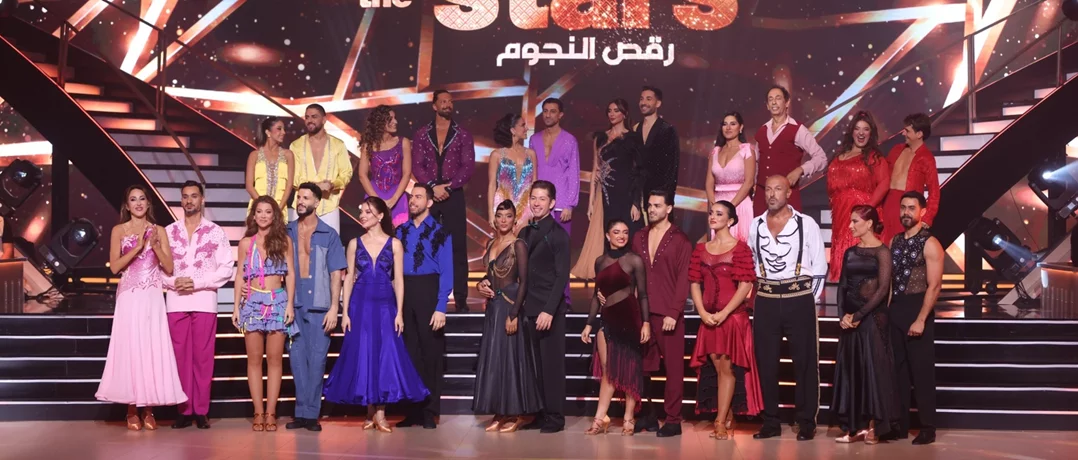
When the lights rose on the first episode of Dancing with the Stars, MTV, leading Lebanese television offered a spectacle conceived without compromise. The sweep of the set, the choreography of the cameras and the painterly composition of each routine drew a comparison few local productions invite, that of an international broadcast.
For Nay Naffah, executive producer behind the program, that comparison is both flattering and instructive. The show airs in numerous countries, many of which have budgets that dwarf anything available in a nation weathered by economic crisis and a modest advertising market. “Compared to their budgets, we are very, very far,” she told The Beiruter. “But within our means, this is what we can do: challenge ourselves.” The true test of a production lies in pushing creative boundaries despite limited resources, and Dancing with the Stars is a testament to what can be achieved.
The challenge rests on solid ground. MTV supplied technical standards that are already of international caliber, while Studio Vision contributed a formidable crew. The set design, she noted with evident pride, surpassed its American counterpart. “It resembles the American version, but it turned out more beautiful, because we added the unique Lebanese touch to it,” she remarked.
No single department, in her telling, carries the achievement. She credited director Bassem Cristo, every member of the production team, as well as Michel El Murr and, now, his children for their guidance. “With a team this large, each person has their role and contributes. If not everyone puts in such valuable effort, you do not get this result,” she observed.
The set remains the production’s crowning feature, alongside the direction, the conception of each tableau and the way the stars are presented within it. Naffah singled out the selection of the contestants as a decisive strength. “This combination came together, and it became the highlight.”
A cast as a portrait of society
Thirteen names were chosen with deliberate breadth. Naffah described a casting philosophy built on the recognition that no two viewers share the same taste. The line-up had to reflect generations, cultural outlooks and interests. Social media has erased the old boundary between the digital and the televised. “What happens on social media is seen everywhere now,” she noted.
The result is a roster of influencers, actors, singers and athletes, “a small sample of Lebanese society,” in her words. “A mother, a grandmother, and a little girl at home all find someone who resembles them.”
That ambition was visible on screen. Influencer Bert Waked, long subjected to criticism over her appearance, took to the floor to compete rather than to justify herself. Arz Zahreddine, the Olympic runner who competes with a prosthetic foot, appeared not as an object of pity but as a competitor among his peers. Daniela Rahme, herself a former winner, brought lived experience to the judging panel, while Mario Bassil contributed humor and stage presence, a reminder that the show is as much entertainment as examination.
If the premiere set the bar, Naffah intends to raise it. “MTV obliges you to be better today than yesterday,” she explained.
She anticipates a visible evolution as the series unfolds. “The stars will be more comfortable on stage. We will be more comfortable. You will see more beautiful tableaux, and you will get to know the stars’ characters more and more.” Viewers can also expect a glimpse of the rehearsal process, absent from the opening episode.
An exclusive look ahead
For the first time in the program’s history, oriental fusion is featured, and Arabic songs will occupy a larger share of the repertoire than in previous seasons. Roughly ninety per cent of the music, Naffah revealed, will be well known, a calculated choice in an age when reels and streaming platforms have made songs familiar even to those who rarely listen to English-language music.
Every episode will follow a theme. The second will devote a portion of its program to national songs, while the third will be built entirely around viral content, reflected in the teasers, the reportages, the transitions and the music itself. Guest stars will also arrive to color the evenings with performances of their own.
Beyond the technical accomplishment lies a more human achievement. As Lebanon has grown accustomed to dancing through its wounds, the program offers an evening of release. The return is a moment of entertainment, a chance to catch our breath and forget, even for a few hours, that there is a reality waiting for us beyond the screen. The show offers a moment to simply breathe, laugh and dance. We are remarkably good at dancing through our wounds, but there is nothing wrong with trying to dance without them this time.
-
-
-
Jenna GeageaReporter/Writer
-
